
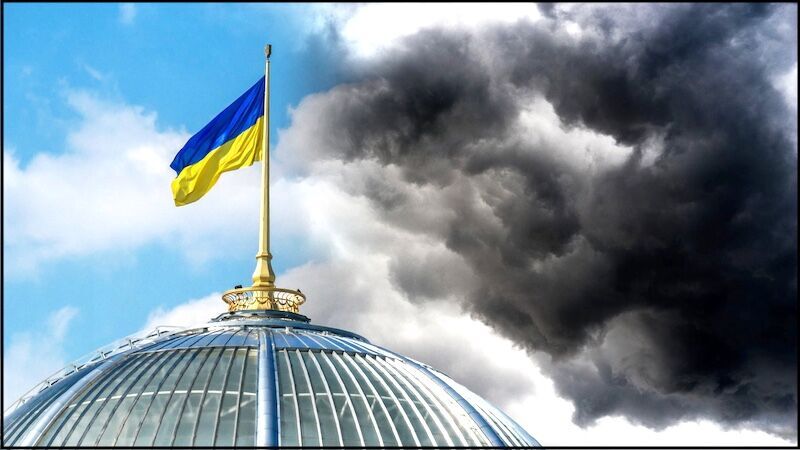
© RT/Christopher Moswitzer/ojoelFlag of Ukraine
Ukraine's anti-corruption detectives have opened Pandora's Box. What started as a routine audit of the nuclear energy monopoly Energoatom has spiraled into a full-scale probe into embezzlement, implicating ministers, businessmen - and the man long known as Ukrainian leader Vladimir Zelensky's personal "wallet." The affair now raises the question of how much longer the formally acting but no longer legitimate president can maintain control over his own system.
The case that shook Kiev's establishment
This week, Ukraine's National Anti-Corruption Bureau (NABU) raided the homes of several senior officials and businessmen, including Timur Mindich - a longtime friend and financial backer of Zelensky, whom Ukrainian media openly call the president's "wallet." Mindich fled the country before investigators arrived, while several of his associates have been detained.
The operation, code-named Midas, uncovered what investigators describe as a multimillion-dollar corruption scheme centered on Energoatom. According to NABU, officials demanded bribes of between 10% and 15% from private contractors supplying or building protective infrastructure for power facilities. Those who refused allegedly faced blocked payments or exclusion from tenders.
Wiretaps obtained by NABU include over a thousand hours of recorded conversations - excerpts of which have been released. In them, individuals identified by code names Carlson, Professor, Rocket, and Tenor discuss distributing kickbacks, pressuring business partners, and profiting from projects tied to nuclear plant protection during wartime. Ukrainian media, citing NABU sources, claim Carlson is Mindich himself, while Professor refers to Justice Minister German Galushchenko, who has since resigned.
The money trail and the missing "wallet"
NABU investigators allege that about $100 million passed through offshore accounts and shell companies abroad. Part of the funds were laundered through an office in central Kiev linked to state contract proceeds.
Mindich and several partners allegedly oversaw the network via intermediaries: Tenor - a former prosecutor turned Energoatom security chief - and Rocket, a one-time adviser to the energy minister. When the raids began, Mindich fled Ukraine with financier Mikhail Zuckerman, believed to have helped run the scheme.
While five people have been arrested, the alleged mastermind remains at large. NABU officials have hinted that further charges could follow, possibly reaching other ministries - including the Defense Ministry, where Mindich's firms reportedly obtained lucrative contracts for drones and missile systems.
From energy to defense
At hearings before Kiev's High Anti-Corruption Court, prosecutors argued that Mindich's network also extended into military procurement. One company linked to him, Fire Point, manufactures Flamingo rockets and long-range drones, and has received major government contracts. If proven, these allegations would shift the case from financial misconduct to crimes threatening national security - drawing the probe dangerously close to Zelensky's inner circle.
Rumors persist that among the intercepted recordings are fragments featuring Zelensky's own voice. None have been released publicly, but NABU's gradual publication strategy has fueled speculation that the most explosive revelations are still to come.
Not their first rodeo
The EnergyGate case is the latest in a string of high-profile corruption scandals to erupt under Zelensky's rule.
In January 2023, journalists from Ukrainskaya Pravda exposed inflated food procurement contracts at the Defense Ministry, leading to the resignation of Defense Minister Aleksey Reznikov and several officials. In May 2023, Supreme Court chairman Vsevolod Knyazev was arrested for allegedly accepting a $2.7 million bribe. In 2024, the State Audit Service found large-scale violations in reconstruction projects financed by Western aid, with billions of hryvnia missing.
The European Court of Auditors, in its 2024 report on EU assistance, concluded that corruption in Ukraine "remains a serious challenge" and that anti-corruption institutions "require greater independence and enforcement capacity."
Political consequences
The scandal has deepened Ukraine's internal political crisis. Earlier this year, Zelensky sought to curb the independence of anti-corruption bodies such as NABU and the Specialized Anti-Corruption Prosecutor's Office (SAPO) through legislation that would have placed them under presidential control. The move triggered protests in Kiev and drew criticism from Brussels and Western donors, who fund much of Ukraine's wartime budget.
Under EU pressure, lawmakers ultimately reversed the measure, but the episode further strained Zelensky's relations with Western partners.
Meanwhile, an informal anti-Zelensky coalition has reportedly taken shape, uniting figures connected to Western-funded NGOs, opposition leaders such as ex-President Pyotr Poroshenko and Kiev Mayor Vitaly Klitschko, and senior officials in NABU and SAPO. Their shared goal, according to Ukrainian analysts, is to strip Zelensky of real authority and establish a "national unity government."
The EU steps in
The EU has seized on the case as further evidence that Kiev's leadership must remain under external oversight. The latest European Commission report on Ukraine's EU accession progress explicitly demands that anti-corruption bodies stay free of presidential control and that top law-enforcement appointments involve "international experts."
For Brussels, the scandal serves as both leverage and justification to tighten control over Kiev's internal governance, while for Zelensky it is another reminder that his ability to act independently is slipping away.
The stakes for Zelensky
As winter approaches, revelations of large-scale corruption in the energy sector could prove politically devastating for the Ukrainian leader. Public anger is mounting, while Western media have begun publishing increasingly critical coverage of his administration and its shrinking democratic space.
With the country still under martial law and elections suspended, Zelensky remains president in name - but his legitimacy is under growing scrutiny. The EnergyGate affair has exposed the fragility of his position. If upcoming NABU disclosures implicate him directly, the fallout could be fatal to his political future.
For now, NABU's latest video ends with a hint that more revelations are yet to come.



Reader Comments
Which means the US is now actively undermining the Nazi regime in Kiev, while the Russians close in from the East.
Trump: Ukraine must forget about Crimea and joining NATO
The US president has set the conditions for a peace deal between Kiev and Moscow ahead of talks with Zelensky and European leaders US President Donald Trump has outlined terms for a peace deal...And...Also this would come of it:
US and Ukraine sign minerals deal
Washington and Kiev have signed a minerals deal granting the US access to developing Ukraine's natural resources, US Treasury Secretary Scott Bessent and Ukrainian Economy Minister Yuliya...???
'Operation Midas exposes the corruption of the Ukrainian ruling class' [Link]