
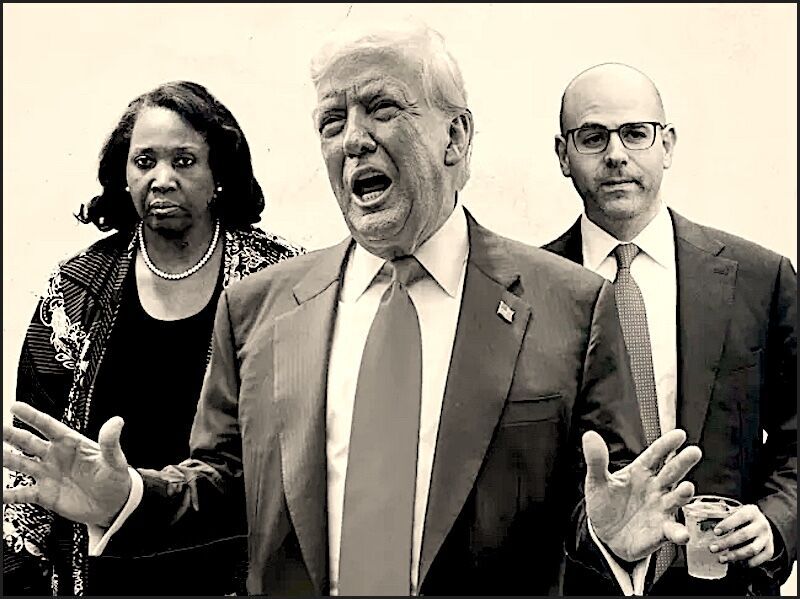
© UnknownUS President Donald Trump • Fed Governor Lisa Cook • Econ Advisor Stephen Miran
The editors are referring to the political establishment's ongoing concerns that President Trump is mounting an unprecedented and extremely dangerous effort to "take over" the Federal Reserve — turning America's central bank into a political tool for him and his successors.
What began as vague anxiety within the political class, as Trump hinted at a renewed interest in the Fed during the last campaign, grew into panic when Fed governor Adriana Kugler resigned in August, giving Trump the opportunity to appoint a voting member of the Fed board. While Kugler's term was scheduled to end anyway in January and her replacement would, therefore, only be nominated to serve the final four months, the resignation still gave Trump an earlier-than-anticipated opportunity to exert his presidential control over the Fed.
However, that panic grew to the level of hysteria when the Trump administration attempted to fire Fed governor Lisa Cook for allegedly committing mortgage fraud. Unlike Kugler, Cook's term is scheduled to run until 2038. So a Cook replacement would not only stay on the board long after Trump leaves office, but would replace an establishment-friendly, Biden-appointed governor who's supposed to remain at the Fed throughout and beyond this second Trump term.
However, the effort to fire Lisa Cook has been blocked by federal judges as the evidence of mortgage fraud turned out not to be as blatant or unique as Trump's team had initially claimed. The case is now in front of the Supreme Court.
But even if that falls apart and Cook remains at the Fed, establishment voices — like those on the WSJ editorial board — are still framing Trump's takeover of the Fed as either being imminent or even settled. Because, last week, his replacement for Kugler — Stephen Miran, one of the President's economic advisors — was officially appointed, and the Fed voted to lower rates, which Trump has been demanding for months.
On the surface, the establishment's issue with Trump exerting more control over the Fed is that he will pull the "independent" central bank away from its "data-driven" and "non-political" decision process and force it to stimulate the economy in ways politically convenient for Republicans — risking inflation.
Digging a little deeper, there's also some concern about the potential for Trump to use the Federal Reserve's power to "debank" his political opponents and to print unlimited amounts of money to fund his broad agenda.
However, it is very unlikely that these are the true reasons the American political class is worried about what Trump is doing with the Fed.
To start, the American political establishment has made it very clear for many decades that they are more than okay with inflation. Not only have they embraced monetary inflation, or money printing, as a central tool to pay for government programs, but, over the last thirty years, they have explicitly aimed to bring about price inflation — the speed at which prices rise — every single year.
In the 2010s, when price inflation remained below the Fed's arbitrary target of 2 percent per year, establishment monetary officials pushed hard to raise inflation. That same level of urgency was mostly absent when Americans were slammed with the highest price inflation in decades after the pandemic — which establishment experts falsely dismissed as "transitory." Last year and last week, the Fed decided to cut rates even though price inflation remained above what they claim is their target.
No ruling regime wants hyperinflation, of course, but the idea that the modern American political class has some passionate aversion to inflation is laughable.
It's also hard to believe the political establishment is seriously worried that Trump will debank his political opponents. They play up the threat of Trump unleashing the full power of the federal government on people he personally doesn't like, but so far, Trump has not really been interested in that kind of effort. If Trump is unwilling to seriously investigate the officials who greenlit the illegal use of American tax dollars to help fund gain-of-function virus research in Wuhan, China, before the pandemic, or the officials who certified the 2020 election that he is adamant was stolen from him, it's hard to think the political class is genuinely afraid Trump is about to start debanking his opponents.
The same goes for the establishment's cited worry about Trump using the Fed to spend more money. The big fear from establishment figures and their media allies in the early days of this term was that Trump was going to allow Elon Musk and DOGE to cut federal spending. That's their real fear — that Trump would eliminate some of the spending programs making them and their friends richer and more powerful. The fact that Trump is leaving virtually all of that spending in place and is instead looking to expand it further is not a concern from the establishment's perspective.
Finally, there's the most commonly cited problem, which is that Trump is "politicizing" the Fed.
The frequency and intensity with which this concern is raised in establishment media suggests that it's closer to the real reason the political class is so concerned about Trump's Fed takeover. However, the idea that Trump is politicizing the Federal Reserve rests on an important assumption: that the Fed is not already political. But it is.
As Jonathan Newman laid out in a talk he gave at a Mises conference earlier this year, the whole idea that the Fed is "independent" from the Treasury Department and the rest of the federal government comes from a meeting that took place in 1951 where, according to the Federal Reserve itself, an "Accord" was reached between the Fed and the Treasury Department that formally severed the tie between both agencies — resulting in the "independent Fed" we have today.
But, as Newman demonstrated by citing Fed and Treasury officials from the time of the meeting, and in the decades since in their own words, all that really changed with the 1951 Accord was the way the Fed described itself. While calling itself "independent," the Fed continued to act exactly as it had before regarding its relationship and coordination with the Treasury Department. Fed independence is simply a branding choice, not a principle that manifests itself in monetary policy.
The only reason the Fed has appeared independent or non-political is because both parties have been almost completely unified behind the inflationist, stock-market-amplifying, empire-fueling monetary policy that the Fed has been enacting for virtually its entire 111-year existence.
Which brings us to the real reason the political establishment is likely so anxious about the changes Trump is making, and trying to make, at the Fed. The danger, from their perspective, is not that Trump is politicizing an independent central bank. It's that he will make it impossible to hide the fact that the Fed is already political.
With the appointment of Stephen Miran, the media is already treating him as nothing more than a pawn there to do Trump's bidding. Fed chair Jerome Powell didn't even push back at this characterization when asked about it in his most recent press conference.
Meanwhile, as the Trump administration pushed to get Lisa Cook fired, the MAGA media machine worked to villainize her as a far-left radical Biden appointee, meaning that both parties now have a villain and — especially as the Democrats push back against Trump's attempt to fire Cook — a champion on the Federal Reserve board.
So before Trump was even scheduled to appoint his first Fed official, we are already well on our way to the public thinking of Fed Governors like most already think about Supreme Court Justices — as partisan officials appointed by presidents to help advance their party's agenda.
Going forward, with every new governor Trump appoints to the Fed, his opponents will likely consider the central bank to be more and more a naked instrument of the Trump administration. And whenever Trump comes up short and fails to either get an ally in at the Fed or pressure the board to adopt his preferred monetary policy, his base will likely come to see the Fed as a part of the anti-Trump coalition — trying to thwart the Republican agenda.
It is hard to see a way forward where the Fed's "independent, data-driven, non-political" brand does not take a serious hit. But because that characterization is a lie meant to prevent the American people from noticing or caring about all the ways the Federal Reserve is ripping them off to enrich the political class, we should consider this progress. The public ought to lose trust in untrustworthy institutions.


Reader Comments
Like that : [Link] Build back better ...