
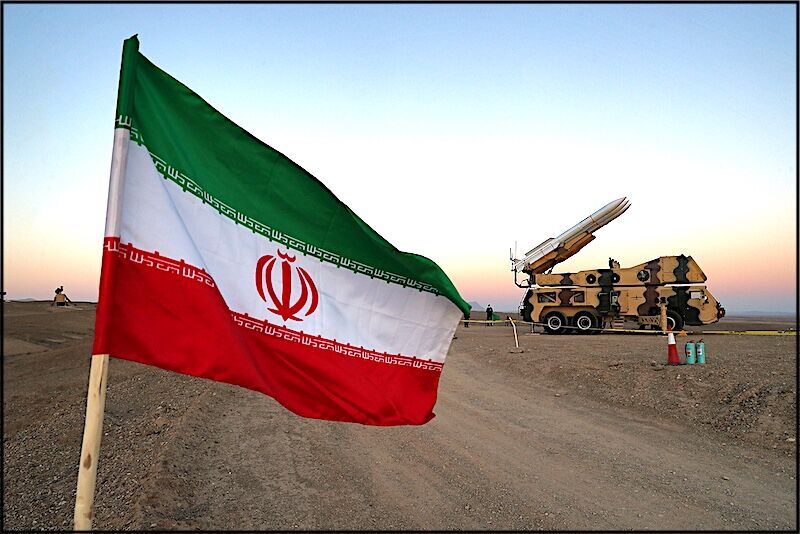
© WANA/ReutersFlag of Iran
Let's call this what it is: regime change dressed up in pseudo-diplomacy. West Asia could be plunged into yet another cycle of war. And if Gulf states do not truly step up to stop this reckless manoeuvring, they could bear the brunt equally.
The E3 marches towards war
On August 28, the United Kingdom, France, and Germany issued a joint statement announcing the initiation of the so-called snapback mechanism to reimpose United Nations sanctions on Iran — sanctions that had been lifted following the 2015 Joint Comprehensive Plan of Action (JCPOA). Citing United Nations Security Council Resolution 2231, the E3 formally triggered a 30-day process that, if completed, would result in the full restoration of all UN sanctions lifted under the nuclear agreement. The move was immediately endorsed by the United States, marking a pronounced escalation in Europe's efforts to increase pressure on Tehran. It also underscores a deliberate alignment with Washington's hardline approach, exposing the contradictions and political posturing surrounding the JCPOA.
In their statement, the E3 emphasised that despite the US withdrawal from the JCPOA in 2018, "France, Germany, and the United Kingdom (the 'E3') remained committed participants to the deal." However, this assertion glosses over important realities. While the E3 did not formally withdraw from the agreement, they consistently failed to implement the full sanctions relief mandated by the JCPOA. Numerous sanctions — particularly those tied to Iran's banking, energy, and trade sectors — remained in place or were only partially eased, which made little to no impact. On the contrary, what added insult to injury was the US decision to exit the agreement and reinstate its own unilateral sanctions. It created a chilling effect on European companies, many of which faced substantial legal and financial risks in conducting business with Iran. This severely limited Iran's economic benefits under the deal, a situation for which Tehran cannot reasonably be held accountable and a situation that made it indispensable for Iran to keep its nuclear programme and its pace intact.
Moreover, this environment contributed to growing tensions in the geopolitical arena. Instead of acknowledging these complexities, the E3 have been increasingly placing the blame on Iran for violating the terms of the JCPoA and for its eventual irrelevance. The current escalation is a continuation of past trends. However, it must be emphasised that it completely overlooks key facts, including that the recent escalation in regional hostilities was initiated by Israel, not Iran. By deflecting responsibility, the E3 risks exacerbating instability in West Asia while undermining the prospects for diplomatic resolution.
Why now?
The E3 are manoeuvring at a time when the US President has already repeatedly claimed to have destroyed Iran's nuclear infrastructure. The reality, however, is that the Israel-US war on Iran fell seriously short of achieving its key objectives, i.e., complete destruction of Iran's nuclear capability and change of regime, leaving Jerusalem far from satisfied and hungry for another war. Israel's Defence Minister, for instance, recently said that his country would continue to take steps to prevent Iran from increasing not just its nuclear but also its overall military capacity. He was referring to Iran's ballistic missiles that proved very useful for Tehran against Israel recently. While the rhetoric may not immediately escalate into a full-fledged war, both Washington and Jerusalem understand that destroying Iran's nuclear capacity and other military infrastructure is a half-measure. The other half remains regime change.
In this context, the E3 are now making moves to trigger the snapback mechanism for reimposing sanctions on Iran to bankrupt it. Thus, by creating a financial and economic burden on Iran, the West aims to put Tehran under immense pressure. If imposed, for instance, these sanctions would further cripple Iran's military and oil industry, making shipping, insurance, and transportation of Iranian oil to non-Western countries even more difficult. If triggered, snapback would also practically revive six past resolutions (2006-2010), reinstating an arms embargo, prohibitions on ballistic missile-related activity, and sweeping financial restrictions. Iran's nuclear and missile programs would face the sharpest blow.
What's next?
How would Iran respond? Tehran has already indicated that E3 has no legal basis to mobilise the snapback mechanism. It has further stated that it could withdraw from the non-proliferation treaty (NPT) — a decision that would, theoretically speaking, make it possible for Iran to acquire nuclear weapons. In short, as far as Washington and Jerusalem are concerned, Iran's actions under pressure of sanctions would create a perfect pretext for them to combine sanctions with military pressure, i.e., a war, to drive home their regime change agenda.
But another war in the Middle East could spell disaster on a much broader scale than it did in June. As recent events showed, Iran has the capacity to hit US air bases throughout the Gulf region. Gulf states, therefore, have every reason to step in to prevent any unnecessary escalations in the short and long run. As reports indicate, Iran has already been taking steps to step up its air defence system (with Russian help) and, unlike in June, is on full guard to withstand and retaliate against any other attack by Israel and the US.



Reader Comments