
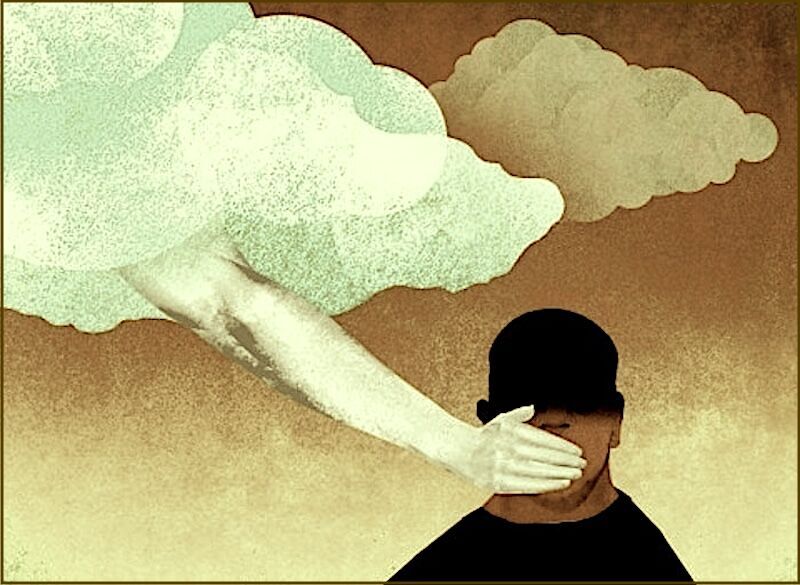
© Washington PostCensorship
Voltaire is celebrated throughout the world as the man who best defended freedom of expression and made us understand it as a prerequisite for the establishment of any democracy. This was the way of thinking of Tsarina Catherine II of Russia, with whom he lived for a long time, as well as that of J.D. Vance, the Vice President of the United States, for whom this "most fundamental European value," "shared with the United States of America," is today "in retreat" [ 1 ] .
In the 20th century, only fascists and Nazis directly opposed freedom of expression. They believed that popular unity was better than divisive public debate. We have seen the mass crimes they committed, not out of conviction, but as a predictable consequence of their ideologies.
Traditionally, in the United States, no limits are tolerated on freedom of expression, while in France, opinions are distinguished from insults and defamation.
Here, a digression is necessary: to ensure that the prohibition of insults and defamation would never be used to restrict freedom of expression, our elders imagined that all trials in this area would take place before lay juries. However, this has no longer been the case since the Second World War. In fact, the use of professional judges makes their decisions susceptible to state influence.
Furthermore, in recent years, we have insensibly re-established the power of the state and society to constrain free speech. Little by little, we have banned speech that shocks sections of the population. Before the French Revolution, we banned the crime of lèse-majesté and sacrilege; today, we ban anti-Zionism and Islamophobia. However, anti-Zionism is not an incitement against a religious or ethnic group, but a political opinion shared, among others, by prominent Israeli Jews, and Islamophobia is often just a critique of Muslim thought that is just as reasoned as the one we practice of Christian thought.
What we are trying to ban, then, is not a particular message, but rather any message that challenges truths we believe to be established. We can look at the problem the other way around: the question is not what we want to ban, but the errors we are trying to protect: the belief that we must not deviate from common prejudices.
For example: Civilizations can only develop with access to energy. This is why slavery was practiced in ancient times. Today, we use considerable reserves of gas and oil. The Bush-Cheney administration was convinced that we were reaching the end of this era and that we therefore had to invest in alternative energy sources. We ourselves are convinced that gas and oil, if they do not run out in the coming years, will pollute the atmosphere we breathe and cause global warming, just as our ancestors the Gauls believed that the sky would fall on their heads. However, this conception of things has never been the subject of scientific debate. It has been abandoned by Russia, China, and the United States. The Russian Academy of Sciences supports another theory to explain climate change, but we have never discussed it. We refer to a United Nations assembly of delegates, the IPCC, composed exclusively of officials from member states. Some are indeed scientists, but all serve as officials representing their governments. With our media stuck on the subject, we will only wake up when Russia, China, and the United States have organized themselves together and we have impoverished ourselves.
Another example: for eighty years, we have more or less lived under Anglo-Saxon protection. We therefore support the organization of the world according to the "rules" set by the G7, that is, freely accepted by us. We have forgotten the principles of international law that France and Russia created just before the First World War (the Hague Conference of 1899). Initially, it was a matter of committing not to behave like barbarians and not to massacre civilians during our wars. "Laws of war" were then devised. No one disputes this, except the United States and Israel, which have generalized torture and, in the latter case, are committing genocide. At a second conference, it was emphasized that, in order to live in peace with its neighbors, each state must respect its own commitments. And, with the United Nations, we proclaimed the right of peoples to self-determination, that is, decolonization. Yet, today, our children are not even aware that a Frenchman, Léon Bourgeois (1851-1925), was the principal author of international law. He was President of the Council, President of the National Assembly, President of the Senate, and Nobel Peace Prize winner. He was the central figure of the Third Republic (1870-1940), but he has disappeared from our history books.
Another aspect of freedom of expression is that it would never occur to anyone that the State would publish a periodical to give us its vision of current events. However, in the 17th century, Théophraste Renaudot founded a weekly newspaper, La Gazette , which prospered with the support of Cardinal Richelieu. At that time, although printing made it possible to publish newspapers, there were still no means of distributing them everywhere. The State therefore invested to make the press accessible to everyone, everywhere. But today, no one is against the existence of a public radio and television service. Certainly, at the beginning, during the interwar period, it was impossible for private funds to create radio and television stations, so the State invested in these new developments until their cost fell and private channels could be created.
A scandal has just erupted in France with the release of a video, recorded in a large Parisian café, in which we see two famous "public service" commentators explaining to officials of an opposition political party how they will defeat a minister's candidacy for mayor of Paris by manipulating their listeners and viewers. In principle, audiovisual "public service" should be at the service of all and not an instrument of partisan propaganda.
However, in France we have an "Audiovisual and Digital Communication Regulatory Authority" (Arcom) responsible for:
(1) Choosing the directors of the public service,
(2) The authorized private television channels, and
(3) Banning those which do not respect "ethics".
First, if there is to be a "public service" for audiovisual media, it is up to the government to designate its management and not to hide behind an administrative "authority." Going as far as possible in the confusion of powers, the State has placed two magistrates among the nine members of the Arcom. This is to give an appearance of justice to decisions that do not respect the principles of defense. And, while today there is no reason for the State to interfere in the audiovisual sector, the State has extended the jurisdiction of the Arcom to the Internet. It is therefore possible for an administrative authority to ban videos on the Internet in the absence of any conviction by the courts for a crime or offense.
Second, while in the past the number of channels for broadcasting radio and television was limited and therefore the state had to decide who had access to them and who was deprived of it, this is no longer the case. There is therefore no reason to decide who has the right to broadcast or not.
Third, no administrative authority should assume judicial power and decide to ban a media outlet. In a democracy, such a ban is the sole responsibility of the courts and can only be imposed in cases of crime. This is obviously not the case for Russia Today , C8 or NRJ12 .
Last observation: the constraints of the press are such that the State has been forced to grant journalists special tax conditions to find an economic balance for their activity. Thus, the written press is taxed at 2.1% and not 20%. A "Joint Commission for Publications and Press Agencies" (CPPAP) was therefore created to ensure that this tax privilege is only applied to genuine press organizations. However, in practice, this committee uses its power to deprive certain opposition press organizations of the possibility of financial balance.
Thus, the CPPAP refuses to recognize the weekly newsletter Voltaire, actualité internationale as a press publication. This Commission considered, in the sole name of its editor-in-chief (in this case, the author of this article), that this publication was not journalism. According to the minutes of its meetings, it did not even look at its content for a second.
The decline in freedom of expression in France is such that it has become a subject of reflection for our neighbours [ 2 ].
As always, the return of censorship is based on the prohibition of things that are shocking to the majority. In the 17th century, the State prohibited pornography; in the 21st century, it no longer prohibits it, but prohibits access to it by children.
References:
[ 1 ] " JD Vance tells Munich Security Conference "There's A New Sheriff In Town" ", JD Vance, Voltaire Network , February 14, 2025.
[ 2 ] " How France Invented The Censorship Industrial Complex. The Twitter Files - France, Case Studies ", Pascal Clérotte and Thomas Fazi, Civilization works (2025).




Comment: There is a saying: 'See it to believe it'. But never fear - the press will fill you in.