
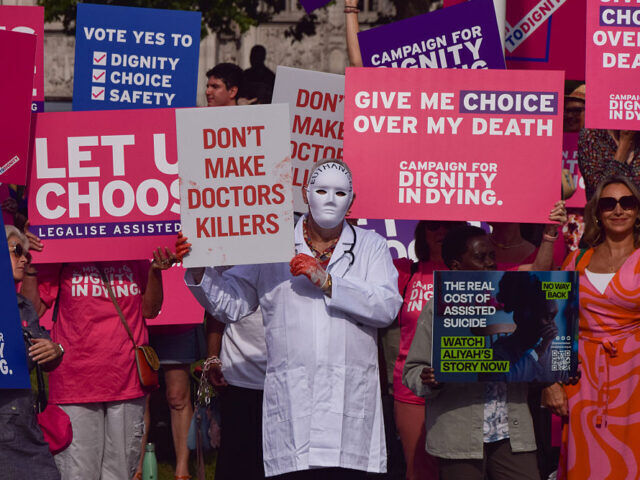
© NurPhoto Agency/Getty ImagesPro and anti-assisted dying campaigners gather outside Houses of Parliament to demonstrate their support and opposition as Terminally Ill Adults (End of Life) Bill reaches Third Reading debate and a critical vote on the Bill as a whole in the House of Commons in London, United Kingdom on June 20, 2025.
The House of Commons, Britain's elected Parliamentary chamber backed the Terminally Ill Adults (End of Life) Bill by 314 votes to 291 against, giving the it a majority of 23. The bill won't become law immediately and has to clear other Westminster hurdles but the remaining steps are essentially pro forma and the so-called assisted dying bill is now all but certain to be law.
Under the provisions of the bill, terminally ill adults will be permitted to apply to be killed, the application being considered by a panel of two doctors, a social worker, a lawyer, and a psychiatrist.
Proponents of the law have rejected concerns that elderly and unwell people could be pressured into being killed to relieve pressure on the National Health Service or their families, insisting there are strong safeguards and that the notion of a "slippery slope" of change is false.
Royal College of Psychiatrists said, however, that the concerns they'd voiced about the law remain unsolved. They said in a statement this afternoon: "Many of our key concerns remain unresolved. We are particularly concerned that the Bill does not currently require a holistic assessment of unmet need. Does a person have a mental disorder that is contributing to their wish to die? Do they feel like a burden? Are they lonely? Do they have access to the care they need?".
The vote is the second time Britain's Parliament has voted to expand the legal killing of the vulnerable just this week, the same chamber having voted overwhelmingly to decriminalise women aborting their children even up to birth on Tuesday. Achieved through an amendment to the Crime and Policing Bill, Parliamentarians voted to decriminalise abortion by mothers — not by doctors or others, who are to remain bound by the 24 week limit — by a margin of 379 to 137.
The change was argued for on the grounds that women who kill their unborn children "need care and support, and not criminalisation".
Today's so-called assisted dying decision was a free vote, with parties not telling their MPs which side to support. Because a considerable number of Labour (government) MPs rejected the notion, it appears it was only able to pass because of support from opposition politicians, including former Conservative Prime Minister Rishi Sunak. The Daily Telegraph claims that without Conservative pro-suicide votes, the bill would not have passed today.
From Reform UK, Richard Tice and Sarah Pochin voted for the End of Life bill while Nigel Farage, Lee Anderson, and James McMurdock voted against.
The double-bill of killer bills this week has prompted some expressions of despair amid the British pro-life scene. Journalist and conservative commentator Peter Hitchens asked rhetorically after the vote passed: "Parliament votes for the abortion of the old, shortly after voting for the even more ruthless abortion of the unborn. Are we now ruled by a death cult?".




Reader Comments
That is called the problem. Reaction - media screaming the sky is falling. Solution , get rid of the people by starting with the old or Vaxxed-damaged . Gee, that will work.
From a government that deliberately wanted to kill it's own population with lethal clot shots a few years ago, and already succeeded with a large segment of the elderly.
Not only are those people mostly impervious to the mass media propaganda, they are much less dependant on government handouts than officials believe. Forming a separated subculture, they mostly consume media in their native languages, from their country of origin. And they substantially engage in "shady" dealings and barter amongst themselves, and their old home countries.
In short, the idea to control and direct them when the sh*t hits the fan in the UK - or elsewhere in Europe - is very optimistic, to put it mildly ...
Nor do they have the ability to determine, or understand, the many criteria that make up my decision. How could they, when it is so personal?
Doctors can only assess medical conditions, social workers have few relevant skills or qualification, lawyers are irrelevant in such a decision, and psychiatrists limited in their ability to work outside narrow mental 'illness' problems, and deal with broader psychological, emotional and spiritual ones.
I would not want such a panel to make any decision about my life, particularly one to end it! I'm surprised they didn't try to put a priest on the panel - just for good measure! Let the agents for 'God' have a say, why not!
It's my choice, and my choice alone . It always will be.
The law should instead focus on ways to make sure undue pressure hasn't been placed on an individual to end his/her life, rather than force the individual to prove to a panel that they meet the 'requirements'!
As it stands now, it just increases the individual's suffering, when it purports to help alleviate it.