
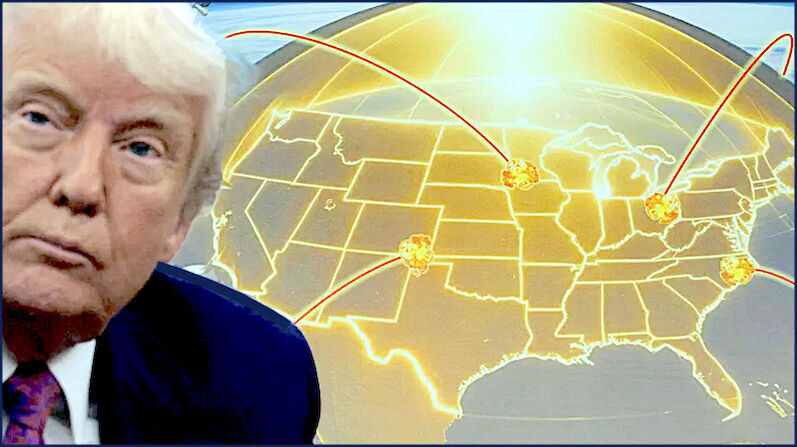
© Chip Somodevilla/Getty ImagesUS President Donald Trump and missile defense system diagram
President Donald Trump announced a plan to build a missile defense system, called the Golden Dome, on May 20, 2025. The system is intended to protect the United States from ballistic, cruise and hypersonic missiles, and missiles launched from space.
Trump is calling for the current budget to allocate US$25 billion to launch the initiative, which the government projected will cost $175 billion. He said Golden Dome will be fully operational before the end of his term in three years and will provide close to 100% protection.
The Conversation U.S. asked Iain Boyd, an aerospace engineer and director of the Center for National Security Initiatives at the University of Colorado Boulder, about the Golden Dome plan and the feasibility of Trump's claims. Boyd receives funding for research unrelated to Golden Dome from defense contractor Lockheed Martin.
Why does the United States need a missile shield?
Several countries, including China, Russia, North Korea and Iran, have been developing missiles over the past few years that challenge the United States' current missile defense systems.
These weapons include updated ballistic missiles and cruise missiles, and new hypersonic missiles. They have been specifically developed to counter America's highly advanced missile defense systems such as the Patriot and the National Advanced Surface-to-Air Missile System.
For example, the new hypersonic missiles are very high speed, operate in a region of the atmosphere where nothing else flies and are maneuverable. All of these aspects combined create a new challenge that requires a new, updated defensive approach.
Russia has fired hypersonic missiles against Ukraine in the ongoing conflict. China parades its new hypersonic missiles in Tiananmen Square.
So it's reasonable to think that, to ensure the protection of its homeland and to aid its allies, the U.S. may need a new missile defense capability.
What are the components of a national missile defense system?
Such a defense system requires a global array of geographically distributed sensors that cover all phases of all missile trajectories.
First, it is essential for the system to detect the missile threats as early as possible after launch, so some of the sensors must be located close to regions where adversaries may fire them, such as by China, Russia, North Korea and Iran. Then, it has to track the missiles along their trajectories as they travel hundreds or thousands of miles.
These requirements are met by deploying a variety of sensors on a number of different platforms on the ground, at sea, in the air and in space. Interceptors are placed in locations that protect vital U.S. assets and usually aim to engage threats during the middle portion of the trajectory between launch and the terminal dive.
The U.S. already has a broad array of sensors and interceptors in place around the world and in space primarily to protect the U.S. and its allies from ballistic missiles. The sensors would need to be expanded, including with more space-based sensors, to detect new missiles such as hypersonic missiles. The interceptors would need to be enhanced to enable them to address hypersonic weapons and other missiles and warheads that can maneuver.
Does this technology exist?
Intercepting hypersonic missiles specifically involves several steps.
First, as explained above, a hostile missile must be detected and identified as a threat.
Second, the threat must be tracked along all of its trajectory due to the ability of hypersonic missiles to maneuver.
Third, an interceptor missile must be able to follow the threat and get close enough to it to disable or destroy it.
The main new challenge here is the ability to track the hypersonic missile continuously. This requires new types of sensors to detect hypersonic vehicles and new sensor platforms that are able to provide a complete picture of the hypersonic trajectory. As described, Golden Dome would use the sensors in a layered approach in which they are installed on a variety of platforms in multiple domains, including ground, sea, air and space.
These various platforms would need to have different types of sensors that are specifically designed to track hypersonic threats in different phases of their flight paths. These defensive systems will also be designed to address weapons fired from space. Much of the infrastructure will be multipurpose and able to defend against a variety of missile types.
In terms of time frame for deployment, it is important to note that Golden Dome will build from the long legacy of existing U.S. missile defense systems. Another important aspect of Golden Dome is that some of the new capabilities have been under active development for years. In some ways, Golden Dome represents the commitment to actually deploy systems for which considerable progress has already been made.
Is near 100% protection a realistic claim?
Israel's Iron Dome air defense system has been described as the most effective system of its kind anywhere in the world.
But even Iron Dome is not 100% effective, and it has also been overwhelmed on occasion by Hamas and others who fire very large numbers of inexpensive missiles and rockets at it. So it is unlikely that any missile defense system will ever provide 100% protection.
The more important goal here is to achieve deterrence, similar to the stalemate in the Cold War with the Soviet Union that was based on nuclear weapons. All of the new weapons that Golden Dome will defend against are very expensive. The U.S. is trying to change the calculus in an opponent's thinking to the point where they will consider it not worth shooting their precious high-value missiles at the U.S. when they know there is a high probability of them not reaching their targets.
Is three years a feasible time frame?
That seems to me like a very aggressive timeline, but with multiple countries now operating hypersonic missiles, there is a real sense of urgency.
Existing missile defense systems on the ground, at sea and in the air can be expanded to include new, more capable sensors. Satellite systems are beginning to be put in place for the space layer. Sensors have been developed to track the new missile threats.
Putting all of this highly complex system together, however, is likely to take more than three years. At the same time, if the U.S. fully commits to Golden Dome, a significant amount of progress can be made in this time.
What does the president's funding request tell you?
President Trump is requesting a total budget for all defense spending of about $1 trillion in 2026. So, $25 billion to launch Golden Dome would represent only 2.5% of the total requested defense budget.
Of course, that is still a lot of money, and a lot of other programs will need to be terminated to make it possible. But it is certainly financially achievable.
How will Golden Dome differ from Iron Dome?
Similar to Iron Dome, Golden Dome will consist of sensors and interceptor missiles but will be deployed over a much wider geographical region and for defense against a broader variety of threats in comparison with Iron Dome.
A second-generation Golden Dome system in the future would likely use directed energy weapons such as high-energy lasers and high-power microwaves to destroy missiles. This approach would significantly increase the number of shots that defenders can take against ballistic, cruise and hypersonic missiles.



Reader Comments
F's up others' search for knowlege and is POLLUTION, that we ALL need go deal with. Emotional NON-INTELLIGENCE is rampant here & everywhere. Insecure validation seeking addict AIR HEADS.
Patriot systems have not sot down a single Iskander or Kh-101 missile in the Ukraine , let alone a hypersonic Khinzal or Zirkon. For God's sake, these systems can't even defend themselves !
In regard to anti-arcraft and missile systems, the West is two generations behind, about 3 decades of neglected research and development. No amount of posturing and propaganda can make up for that.
The "Golden Dome" is a balloon of hot air. Just like the "Iron dome".
Patriot has been continually upgraded and modernized to counter new and emerging threats. Key developments include the introduction of the Patriot Advanced Capability-2, or PAC-2, and later the Patriot Advanced Capability-3, or PAC-3, missiles, which brought significant enhancements in accuracy, range and lethality.
CHIMERA technology also showcased its end-to-end fire control application that reads aerial target data and enables sustained tracking during the object’s entire flight path.
Rafael Advanced Defense Systems released a video showing the laser system locking onto a moving aerial target and neutralizing it within seconds. Rafael’s next-generation laser weapon designed to reshape the future of air defense.
And how many missiles have landed in the US in the last 60 years? 0. So it seems their defense systems are undefeated.
I can't get over how profoundly jealous you are. Get a shrink. Take your wife along.
For one thing in order to protect a city the size of Kiev, it requires 10 patriot systems. Ukraine has 6 patriot systems. You also have to have a stock of the missiles required for them. Ukraine has been in a Patriot missile shortage since January 2024.
Lastly the Patriot systems have to be in range. How many Patriot missiles have missed an Iskander or KH-101. Or a hypersonic missile? Ummm... Zero misses.
Best of the Web: Psywar: AI bots manipulate your feelings
The next chapter in the Social Media battle to splinter reality, the internet, and your own mind Splinternet (as defined per Grok): The splinternet refers to the fragmentation of the internet into...Karma resonates with TRUTH + humility.
WE are in for a show 🪞
RACE to the BOTTOM
HPM weapons are high-power RF/ microwave transmitters that are combined with antennas to direct energy at a target and produce electronic upset or permanent damage depending upon the distance between the HPM source and the target. HPM weapons can operate in any weather condition, and their beams are typically much wider than a laser beam, which increases the probability of target hit. HPM weapons produce their effects by coupling energy into a target system via intentional antennas (i.e., front doors) and unintentional antennas (i.e., back doors) and transferring the energy to sensitive semiconductor components.
But up to now, it mattered not at all . None of the enemy they picked a fight with had any substantial airforce or ADS.
Perhaps you have seen it, but sometime last year, during a podcast with judge Neapolitano, Scott Ritter revealed the number of Iraqi SCUD missiles shot down by the Patriot system in the 1991 gulf war - exactly zero . He was on active duty there and at that time, so he should know. All just propaganda, smoke and mirrors.
Now you might understand why no US or other Nato soldier officially entered the Ukraine conflict, despite all the belligerent rhetoric. Some people in the Pentagon know.
The newest system hasn't even been completed. AEGIS modernization program started in 2019. The ships will have the following weapons and sensors: Cooperative Engagement Capability; ESSM; Mk 15 Close-In Weapon System Block 1B; Surface Electronic Warfare Improvement Program (SEWIP); and Nulka decoys. The Mk 41 Vertical Launching System is upgraded to support SM-3 and newer variants of the Standard Missile family. Modernized DDG 51-class guided-missile de-stroyers will continue to provide multi-mission offensive and defensive capabilities with the added benefit of sea-based ballistic missile defense. An updated AEGIS Weapon System, Baseline 10, is being developed to integrate the new SPY-6 radar and provide improved warfighting capabilities across mission areas. The first Baseline 10 ship will be DDG 125 USS JACK H. LUCAS.
Per the report:
American Patriot Missile battery in Dharan, Saudi Arabia, failed to track and intercept one incoming Iraqi Scud missile. The failure was because of an inaccurate calculation of the time since boot due to computer arithmetic errors. Specifically, the time in tenths of second as measured by the system's internal clock was multiplied by 1/10 to produce the time in seconds.
There were 46 scud missiles launched with 45 being intercepted and one was never tracked and fired upon. 2 of the 45 were hit but not completely destroyed and fell to the ground damaging two buildings. There were no misses by the Patriot system.
I was in Israel in '91. They were more than a little miffed at us for not letting Israel return fire.