
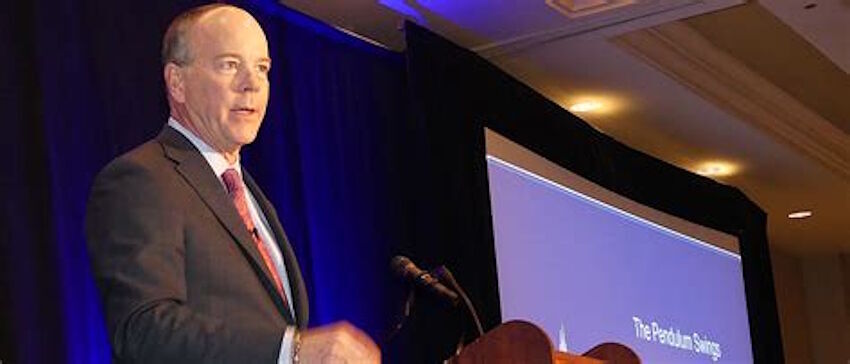
Economist Brian Wesbury
"Right now, we're paying banks 4.5% on over $5 trillion. We're paying private banks $200 billion a year to hold all this cash that the Fed printed," he said during an appearance Tuesday on Steve Bannon's War Room.
DAVE BRAT: Brian Wesbury, a friend and just a great monetary authority for our country. And this will save us potentially $1 trillion in the budget over 10 years. So Senator Ron John and House guys, here you go. Brian, take it away.
BRIAN WESBURY: You know, we could talk about this for hours and still be a little bit confused. The Fed loves us confused. But the simple story is that back in 2008, the Fed used that subprime housing crisis to grow its balance sheet massively.
I've tried to figure out ways to say this. They went from a $700 billion balance sheet to an $8 trillion balance sheet. Another way to say it is that the Fed — if you look at the bank size — it was 5% of GDP. Today —
STEVE BANNON: Hang on, hang on, hang on. Whoa, whoa, whoa, whoa. Slow down. The balance sheet of the Federal Reserve on the day they walked into the Oval Office with Bush was $880 billion. I thought the max — because you're gonna make my head blow up here — I thought the max they got to was $4.5 trillion when we took over in January 20th of 2017, Inauguration Day, it was $4.5 trillion. Are you telling me they ran it up to $8 [trillion] and they did quantitative tightening to take it down? Or did they have other pockets? They're hiding the cash, sir?
BRIAN WESBURY: Oh no, they did it again. So when Paulson and Bernanke walked into W's office — the Oval Office — in 2008, they printed $4.5 trillion. That's what they did after that -- during the subprime crisis.
Then they used that strategy all over again during COVID, and they did another $4.5 trillion. And I always compare it to 2007.
STEVE BANNON: After President Trump took $1 trillion off when Yellen was Fed chair in 2019, and this is what President Trump's growth in 2019, over 3%, was against, the headwind of shrinking the balance sheet... $1 trillion. Then you're saying they added it back in?
BRIAN WESBURY: They did it all over again.
So if you think about it, what quantitative easing is, so we just described the size, it's massive. They increased the size of the Fed's balance sheet. The peak was over 10 times bigger.
In fact, if you take the Fed's balance sheet today, it's bigger than the top 10 sovereign wealth funds in the world combined. The Fed is by far the 1,000-pound gorilla in the room.
And how, if you buy all these bonds and you print all of this money, how do you keep it from turning into inflation?
Now, we know it happened once. But how did they stop it under Bernanke from turning into inflation?
Well, what they did is they went in and did three things:So right now, we're paying banks 4.5% on over $5 trillion. We're paying private banks $200 billion a year to hold all this cash that the Fed printed. Because if they didn't pay them, it would turn into hyperinflation.
- They put massive new liquidity rules on banks. They said: "You have to hold this money we printed. Don't lend it out. Don't let it create inflation."
- They raised capital requirements on banks to do the same thing.
- The final thing — and this is what Dave was just talking about — they decided to pay banks to hold the money that they printed.
So now we've created an absolute mess. The Fed's paying banks $200 billion. They only earn about $100 billion on their bond portfolio, which means they're losing $100 billion a year.
STEVE BANNON: And who pays for that?
BRIAN WESBURY: The taxpayer. And this is why — if we stop this whole process and roll back the clock to 2007 — we could potentially save $2 trillion over the next 10 years.


Reader Comments
All it has is debt - and the debt is theirs and theirs alone - the private entices of the so-called Federal Reserve - and per the 14th Amendment if memory serves - being I consider the acts from 1913 to be a coup of sorts - that debt belongs to nobody and nobody else other than the Federal Reserve - so let them bleed to death within it - it ain't my debt.
~
So - how bout they get audited - and then lets see whom owes who what!
It ain't our debt - let the bankers work it out - but jubilee is in the air - either that or lets get the gallows back and operational - cause tis time for some heads to roll!
~
I ain't got no problem with a local banker fair - but lately all my experience with bankers have been nothing but goddamn frustration - and that is on them - and FUCK the Federal Reserve that ain't "federal" and has no "reserve" - and so they play us - and they are so wrong - ask Jackson bout that - bankers love war and death cause they think money rules the world - they worship mammon - and that is plum wrong - and we know it!
What is in Fort Knox one wonders - cause the story on that went all cold now didn't it?
and all the MMT lovers - they seem to be in congress - a house full of mostly dipshits with attendees making sure they stay in line - with the exception of that fella out of Kentucky - a fine gentleman - whose wife recently passed. My heartfelt condolences Thomas Massie - but some of us know - and so stand strong - you have our support and truly - tis a WAR of ideas - and may the best ideas prevail.
Cash is God, not merely a King.
Not to mention that debt-based financial systems guarantee that someone (usually several someone's) will always be broke, and fractional reserve systems guarantee inflation.
If it seems like the system is stacked against you, it is.
Since countries tend to grow their reserves over time, the U.S. effectively needs to run a persistent trade deficit if it wants the dollar to retain its share of reserves. The only alternative means of providing dollars to foreign savers is through large amounts of financial aid, potentially to strategic rivals, or by having the U.S. Federal Reserve run an extremely complicated and potentially risky book of multicurrency swap lines globally. Both alternatives are political and economic nonstarters so the U.S. can choose between a trade deficit or a diminishing percentage of global reserves in the long run. It’s not a coincidence that the U.S. has run trade deficits for decades.
Once foreigners have acquired dollars, they need a place to store them, and that usually means Treasury bonds. The flipside of being the reserve currency and borrowing cheaply is that a country must issue enough debt to keep up with reserve holder demand.
So everything you stated is wrong.