
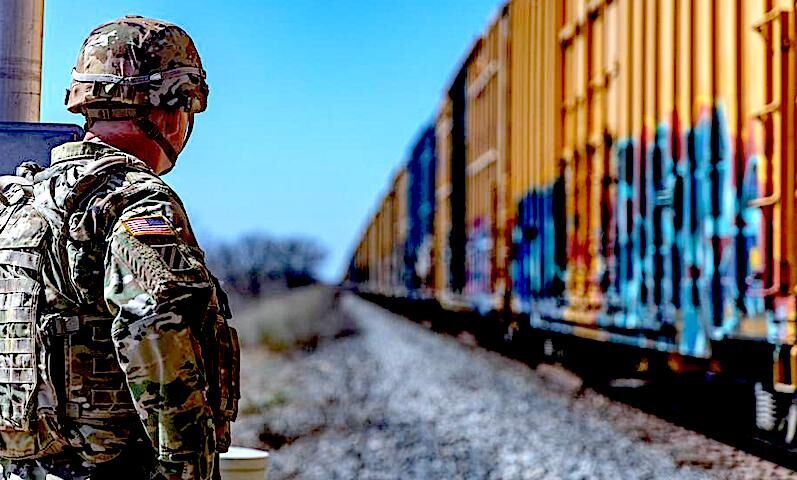
© Andrew Sveen/US ArmyUS soldier conducts visual inspection of a passing train traveling from Mexico to the U.S. to detect illegal crossings of the border in Uvalde, Texas • February 12, 2025
Defense Department Chief of Staff Joseph Kasper said Wednesday:
"Both leaders expect their agreement will serve to enable further conversations and coordination in greater detail at varied levels to ensure the mutual security of the border."The changes stemmed from a recently held meeting between Air Force Gen. Gregory Guillot, commander of U.S. Northern Command, and Gen. Ricardo Trevilla Trejo, secretary of national defense for Mexico.
The coordinated patrols will occur with each country's troops remaining on their respective sides of the Rio Grande, the river that divides the U.S. and Mexico, Kasper said.
Guillot last week told the Senate Armed Services Committee that the Pentagon had recently approved sharing more of the information that it has about the distribution and production of the synthetic drug fentanyl, which has caused a spike in U.S. overdose deaths in recent years.
"We have a better foundation now that we have increased the intelligence to make rapid progress against this threat. However, NORTHCOM could use more intelligence, surveillance and reconnaissance to better combat the drug crossing the border as well as expanded authorities to allow for more advise and assist operations between U.S. and Mexican forces."The military coordination is part of a bulked-up U.S. effort along the border after President Donald Trump signed executive orders on Jan. 20 — his first day back in office — that have increased the number of active-duty troops supporting the Department of Homeland Security. There are about 4,200 troops working on border security with the expectation it will rise.
U.S. troops have been deployed to the southwest border since 2018, but Trump said he wants the mission to be a top priority for the Defense Department. Most of the work at the border is in a support role for the Department of Homeland Security such as air and ground surveillance monitoring and adding additional barriers to existing border wall.
The Army released photos last week from Texas that showed soldiers working in Uvalde, about 50 miles in from the border, inspecting trains for migrants alongside Customs and Border Protection agents.
Mexican officials ramped up the country's border security in early February after Trump threatened to impose tariffs on Mexican imports unless it did more to prevent migrants from reaching its northern border and crossing between legal ports of entry into the U.S. and stop fentanyl from crossing into America.
Mexican President Claudia Sheinbaum complied and sent about 10,000 National Guard troops to reinforce the border and they have also begun to increase security and search on vehicles leaving the country.
She also said Wednesday that she requested the U.S. government fly surveillance drone flights over Mexico, according to The New York Times. The flights were part of a Central Intelligence Agency program to uncover fentanyl labs in northwestern Mexico, but the CIA declined to comment about it.
The flights have been going on for many years, Sheinbaum said in a news briefing Wednesday, according to The Associated Press.


Reader Comments
Just like in the West, only the banks taking the place of the cartels.
Though every Executive Order is dismantling the corruption, his identifying drug cartels as terrorist organizations allows him to use the military at the border and within the country. The MS13 gang is said to be the assassination team for crime families like the Clintons.
Here is a Brave AI response on MS13: "MS-13, also known as Mara Salvatrucha, is a transnational criminal gang founded in the 1980s in Pico-Union, Los Angeles, California, United States . The gang is primarily composed of individuals of Salvadoran, Honduran, Guatemalan, and Mexican descent and is active in El Salvador, Guatemala, Honduras, Mexico, the United States, Canada, and Spain. MS-13 engages in various criminal activities including drug trafficking, alien smuggling, weapons trafficking, murder, rape, assault, kidnapping, identification theft, prostitution, robbery, auto theft, extortion, and vandalism ."
MS-13 is not the largest, the most violent, or the fastest-growing gang, but it is the U.S. gang most strongly tied to Central America, which is where the majority of asylum-seeking teenagers come from. In that way, it’s the perfect focal point for Trump’s message of closed borders.