
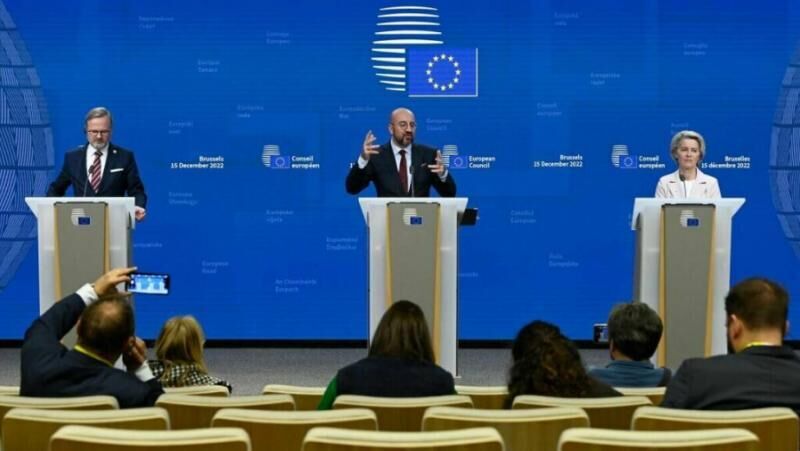
Some of the current crop of EU nullities mascarading as leaders.
With polls showing 'nationalist' parties surging in popularity ahead of the upcoming European Parliament election, Kiev's worsening situation could prove useful to the bloc's powers that be, according to a new book by French investigative journalist Charles Sapin.
Most of the EU has been outspoken in supporting the Ukrainian government in the conflict with Russia, sending an estimated €77 billion ($83 billion) worth of weapons, equipment, ammunition and even cash to Kiev. Sapin's analysis, however, implies that bad news from the battlefield could bolster the European People's Party (EPP) and the second-largest group, the Progressive Alliance of Socialists and Democrats (S&D) in upcoming elections.
"If Ukraine's position weakens, there may be a 'rallying behind the flag effect' more favorable to the forces in place," he was quoted as saying by Politico EU on Monday.
Comment: The author of this article is part of the problem and is part of the establishment media. He has worked for Le Figaro, Le Parisien and L'Opinion (all establishment papers). In his view, the EU establishment will win if Ukraine wins and also if Ukraine loses. There is next to no deep thinking involved from the author and little understanding of how deeply unpopular the EU establishment is.
Sapin is a reporter for the weekly Le Point who spent six years researching what he calls the "nationalist" parties that form the Identity and Democracy (ID) bloc in the European parliament - such as Hungary's Fidesz, Portugal's Chega, Spain's Vox, France's National Rally, Brothers of Italy and the Sweden Democrats. The final result was the book called 'Les Moissons de la Colere' (The Harvests of Wrath), presented as a deep dive into "nationalist Europe."
One major weakness of the parties in the ID grouping, according to Sapin, is that they have different opinions on the Ukraine conflict.
Nationalists' numbers might be rising but they are "isolated" in Brussels because of their particularism, he contends. Their victories in the upcoming election would move the needle to the right, but to the benefit of the EPP, currently the majority group.
This may help explain why French President Emmanuel Macron brought up Ukraine at a recent brainstorming session about the upcoming elections. Amid the strategy discussions the French leader suddenly voiced a concern that Ukraine "could fall very quickly," according to sources that spoke with Politico. He then set up a 'New Europeans' coalition, an alliance of liberal parties from France, Denmark, Poland, Romania and Slovenia.
Comment: It is alarming when strategic discussions are made based on sources from Politico, which is a deep state rag.
Hungarian Prime Minister Viktor Orban - long the sole dissenter when it came to aiding Kiev - doubled down on calls for a ceasefire in Ukraine and a negotiated peace.
According to Sapin, parties like Orban's have gained power thanks to semantic tricks and ideological acrobatics, converting "old bourgeois" voters by talking about immigration, identity and the environment and abandoning calls for leaving the EU. His book includes insights from both the closest political advisers to Orban, from Italian PM Giorgia Meloni and French presidential candidate Marine Le Pen - and from their political enemies.





Comment: The last paragraph shows how shallow this 'investigative journalist' is. Saying that Orban's power is due to semantics and ideological acrobatics is absurd. Saying No to NATO expansion, no to the demolishment of traditional values and Christianity and no to the goals of the globalists, might have more to do with why Orban has a strong backing in Hungary and why he is still in power.
The author does not examine what the consequences will be when Ukraine is defeated. European citizens will likely be even more up in arms of the hundreds of billions spent on project Ukraine. Will the millions of workers who have lost their jobs due to de-industrialisation vote for the establishment? Or the farmers whom the EU establishment have used as scape goats for the manufactured climate 'crisis'? Or the average EU citizen who has seen inflation go up along with exploding energy prices and food prices, while millions of immigrants have been let in? The list goes on and on.
Will the EU and/or NATO even exist after the war finishes as splits are already appearing?
The fall of Ukraine is likely leading to millions of Ukrainians seeking refuge in the EU, which is already tired of immigrants. Along with the defeat of Ukraine comes also the bill to be paid afterwards. The EU having been a strong backer of the war on the side of Ukraine is perhaps going to pay hundreds of billions in war reparations to Russia and to the rebuilding of what used to be Ukraine.
The voters will not forget that it was the EU establishment who sold the NATO expansion into Ukraine as a good idea and the war which followed.
See also: