
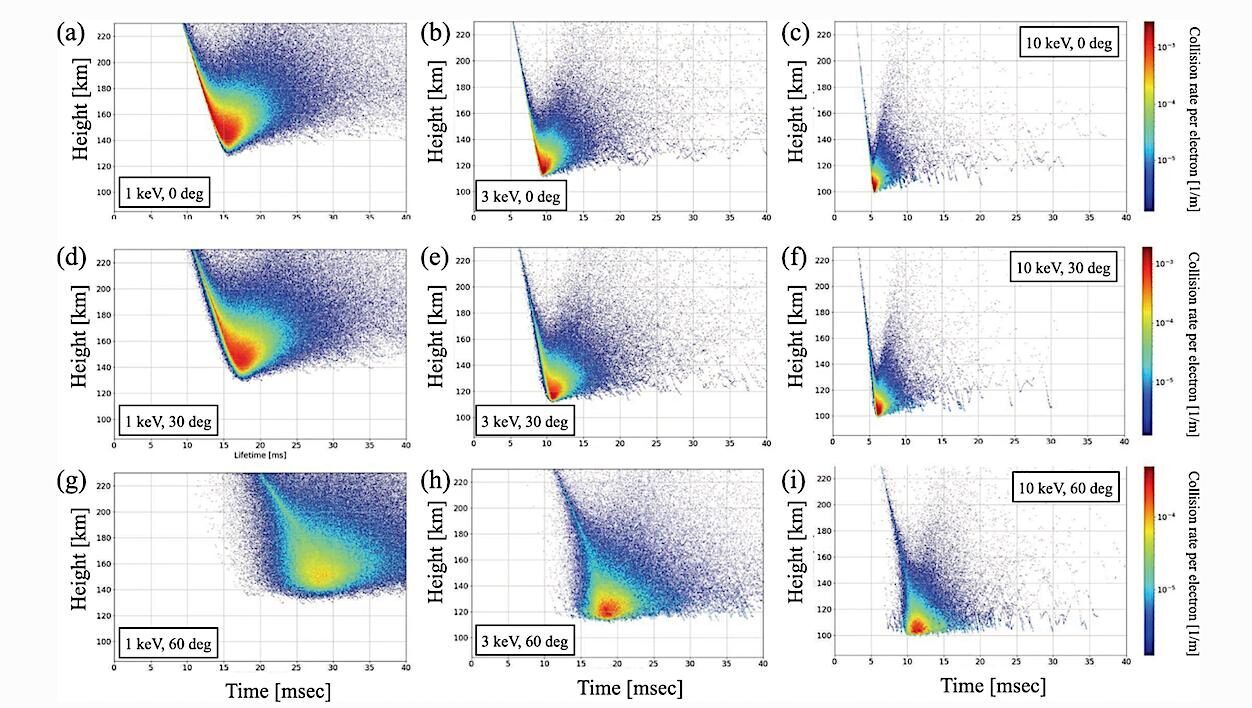
© Tohoku UniversityTime histories of the altitude profiles of the collision rate per electron obtained by a series of simulations with mirror force. The initial kinetic energy of (a, d, g) 1 keV, (b, e, h) 3 keV, and (c, f, i) 10 keV and the initial pitch angle of (a-c) 0 degree, (d-f) 30 degree, and (g-i) 60 degree are assumed at 400 km
"Our results clarify the unexpected role of the geomagnetic field surrounding the Earth in protecting the atmosphere from high energy electrons," says Katoh. The ionosphere is a wide region between roughly 60 and more than 600 kilometers above the Earth's surface. It contains electrically charged particles that are a mixture of ions and free electrons generated by the interaction of the atmosphere with radiation from the sun.
Polar regions of the ionosphere are subjected to a particularly steady and energetic stream of incoming electrons in a process called electron precipitation. These 'relativistic' electrons move at close to the speed of light, where the effects of Einstein's relativity theory become ever more significant. They collide with gas molecules and contribute to many phenomena in the ionosphere, including colourful auroral displays. The processes are heavily influenced by the effects of the geomagnetic field on the charged particles involved.
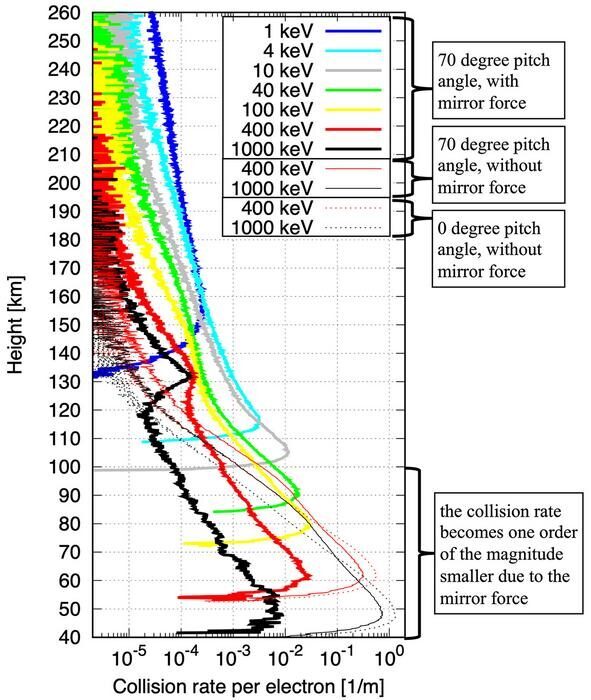
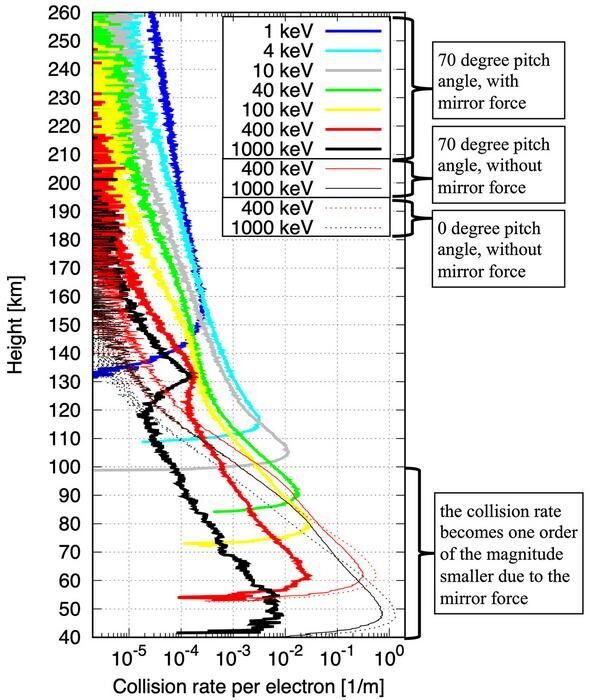
© Yuto Katoh et al. — Tohoku UniversityAltitude profiles of the collision rate per electron for the cases of the precipitation of 1, 4, 10, 40, 100, 400, and 1000 keV electrons whose initial pitch angle is 70 degrees at an altitude of 400 km (thick solid lines).
The simulations demonstrated how the mirror force causes relativistic electrons to bounce back upwards, to an extent dependent on the angles at which the electrons arrive. The predicted effects mean that electrons collide with other charged particles higher in the ionosphere than previously suspected.
Illustrating one example of the significance of this work, Katoh comments: "Precipitating electrons that manage to pass through the mirror force can reach the middle and lower atmosphere, contributing to chemical reactions related to variations in ozone levels." Decreased ozone levels at the poles caused by atmospheric pollution reduce the protection ozone offers living organisms from ultraviolet radiation.
Comment: Notably, back in 2021 it was reported that the ozone hole above Antarctica was one of the largest ever, and that it may be linked to stratospheric cooling.
© Yuto Katoh et al. — Tohoku UniversityIllustration showing the relation between precipitating electrons, mirror force, and collisions with neutrals. The cases (a) without and (b) with mirror force are shown, indicating that the mirror force tends to move electrons upward through the collisions with neutrals.
"We have now started a project to combine the simulation studies used in this work with real observations of the polar ionosphere to build even deeper understanding of these crucial geophysical processes," says Katoh.
Effect of the mirror force on the collision rate due to energetic electron precipitation: Monte Carlo simulations, Earth, Planets and Space
Keith Cowing SpaceRef co-founder, Explorers Club Fellow, ex-NASA, Away Teams, Journalist, Space & Astrobiology, Lapsed climber.








Does any one here have historical screenshots of Earth's ionosphere, if they did? They'd know that inhabitants on Earth are under threat because of solar radiation and how its increasing massively.