
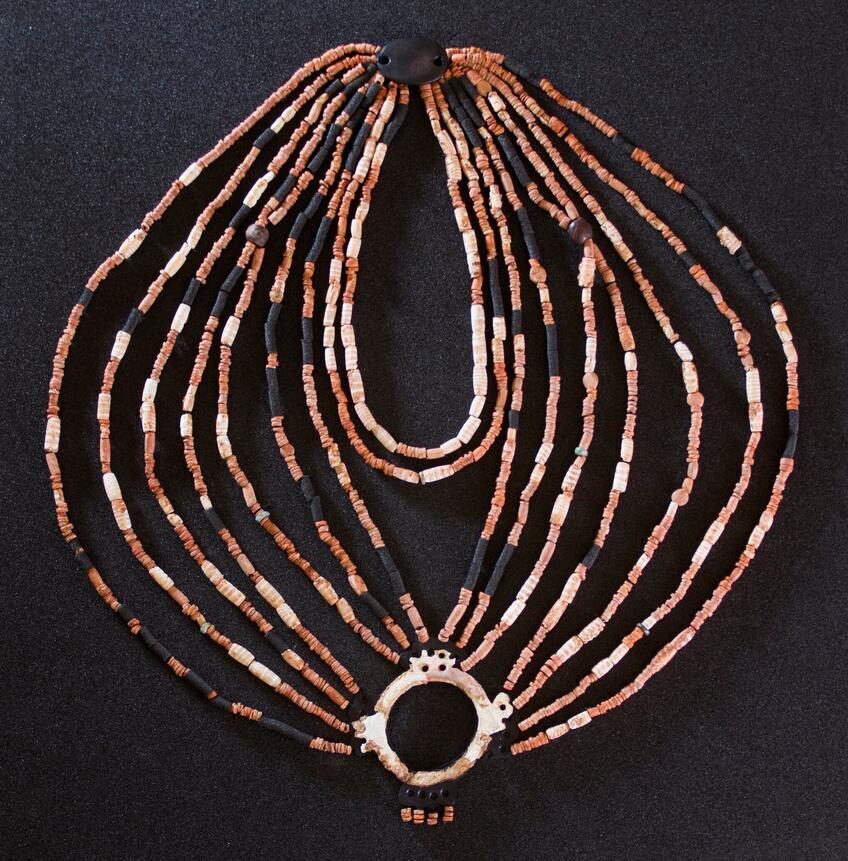
© Alarashi et al., 2023, PLOS ONE, CC-BY 4.0 (creativecommons.org/licenses/by/4.0/)Final physical reconstruction of the necklace, today exposed at the new museum of Petra in Jordan.
Body adornments are powerful symbols that communicate cultural values and personal identities, and they are therefore highly valuable in the study of ancient cultures. In this study, Alarashi and colleagues analyze materials that adorned the body of an eight-year-old child buried in a grave at the Neolithic village of Ba'ja in Jordan, dating to between 7400 and 6800 BCE.
The materials in question comprise over 2,500 colorful stone and shell, two exceptional amber beads — the oldest known thus far in the Levant — along with a large stone pendant and a delicately engraved mother-of-pearl ring.
Analyzing the composition, craftsmanship, and spatial layout of these items, the authors conclude that they belonged to a single composite multi-row necklace that had since fallen apart. As part of this study, the researchers created a physical reconstruction of the original necklace, which is now on display in the Petra Museum in Southern Jordan.
The multi-row necklace is one of the oldest and most impressive Neolithic ornaments, providing new insights into funerary practices at the time for individuals of apparently high social status. The making of the necklace appears to have involved meticulous work, as well as the import of certain exotic materials from other regions.
The study of this necklace reveals complex social dynamics between community members at Ba'ja — including artisans, traders, and high-status authorities who would commission such pieces — which certainly merit further investigation of this Neolithic culture.
The authors add, "Adorning the deceased child, bridging the worlds of life and death. The discovery and reconstruction of an extraordinary necklace from the 9,000-year-old village of Ba'ja (Jordan)."





I understand graves need to be moved from time to time but profiting from the grief someone had for their dead child just rings hollow....