
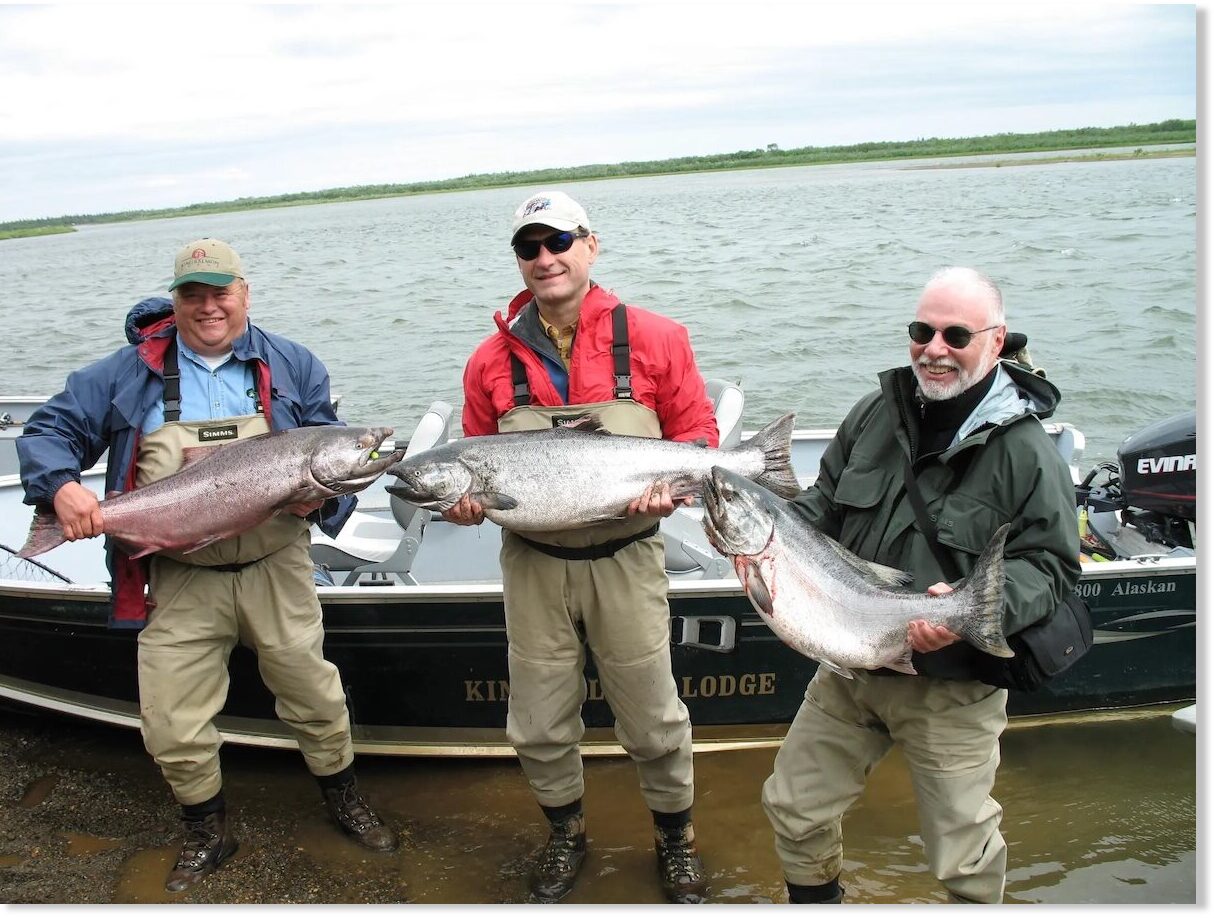
© Photo obtained by ProPublicaSupreme Court Justice Samuel Alito, center, and hedge fund billionaire Paul Singer, right, hold king salmon with another guest.
Singer was more than a fellow angler. He flew Alito to Alaska on a private jet. If the justice chartered the plane himself, the cost could have exceeded $100,000 one way.
In the years that followed, Singer's hedge fund came before the court at least 10 times in cases where his role was often covered by the legal press and mainstream media. In 2014, the court agreed to resolve a key issue in a decade-long battle between Singer's hedge fund and the nation of Argentina. Alito did not recuse himself from the case and voted with the 7-1 majority in Singer's favor. The hedge fund was ultimately paid $2.4 billion.
Alito did not report the 2008 fishing trip on his annual financial disclosures. By failing to disclose the private jet flight Singer provided, Alito appears to have violated a federal law that requires justices to disclose most gifts, according to ethics law experts.
Experts said they could not identify an instance of a justice ruling on a case after receiving an expensive gift paid for by one of the parties.
"If you were good friends, what were you doing ruling on his case?" said Charles Geyh, an Indiana University law professor and leading expert on recusals. "And if you weren't good friends, what were you doing accepting this?" referring to the flight on the private jet.
Justices are almost entirely left to police themselves on ethical issues, with few restrictions on what gifts they can accept. When a potential conflict arises, the sole arbiter of whether a justice should step away from a case is the justice him or herself.
ProPublica's investigation sheds new light on how luxury travel has given prominent political donors — including one who has had cases before the Supreme Court — intimate access to the most powerful judges in the country. Another wealthy businessman provided expensive vacations to two members of the high court, ProPublica found. On his Alaska trip, Alito stayed at a commercial fishing lodge owned by this businessman, who was also a major conservative donor. Three years before, that same businessman flew Justice Antonin Scalia, who died in 2016, on a private jet to Alaska and paid the bill for his stay.
Such trips would be unheard of for the vast majority of federal workers, who are generally barred from taking even modest gifts.
Leonard Leo, the longtime leader of the conservative Federalist Society, attended and helped organize the Alaska fishing vacation. Leo invited Singer to join, according to a person familiar with the trip, and asked Singer if he and Alito could fly on the billionaire's jet. Leo had recently played an important role in the justice's confirmation to the court. Singer and the lodge owner were both major donors to Leo's political groups.
ProPublica's examination of Alito's and Scalia's travel drew on trip planning emails, Alaska fishing licenses, and interviews with dozens of people including private jet pilots, fishing guides, former high-level employees of both Singer and the lodge owner, and other guests on the trips.
ProPublica sent Alito a list of detailed questions last week, and on Tuesday, the Supreme Court's head spokeswoman told ProPublica that Alito would not be commenting. Several hours later, The Wall Street Journal published an op-ed by Alito responding to ProPublica's questions about the trip.
Alito said that when Singer's companies came before the court, the justice was unaware of the billionaire's connection to the cases. He said he recalled speaking to Singer on "no more than a handful of occasions," and they never discussed Singer's business or issues before the court.
Alito said that he was invited to fly on Singer's plane shortly before the trip and that the seat "would have otherwise been vacant." He defended his failure to report the trip to the public, writing that justices "commonly interpreted" the disclosure requirements to not include "accommodations and transportation for social events."
In a statement, a spokesperson for Singer told ProPublica that Singer didn't organize the trip and that he wasn't aware Alito would be attending when he accepted the invitation. Singer "never discussed his business interests" with the justice, the spokesperson said, adding that at the time of trip, neither Singer nor his companies had "any pending matters before the Supreme Court, nor could Mr. Singer have anticipated in 2008 that a subsequent matter would arise that would merit Supreme Court review."
Comment: That's rich (no pun intended).
Leo did not respond to questions about his organizing the trip but said in a statement that he "would never presume to tell" Alito and Scalia "what to do."
This spring, ProPublica reported that Justice Clarence Thomas received decades of luxury travel from another Republican megadonor, Dallas real estate magnate Harlan Crow. In a statement, Thomas defended the undisclosed trips, saying unnamed colleagues advised him that he didn't need to report such gifts to the public. Crow also gave Thomas money in an undisclosed real estate deal and paid private school tuition for his grandnephew, who Thomas was raising as a son. Thomas reported neither transaction on his disclosure forms.
The undisclosed gifts have prompted lawmakers to launch investigations and call for ethics reform. Recent bills would impose tighter rules for justices' recusals, require the Supreme Court to adopt a binding code of conduct and create an ethics body, which would investigate complaints. Neither a code nor an ethics office currently exists.
"We wouldn't tolerate this from a city council member or an alderman," Sen. Dick Durbin, an Illinois Democrat and chair of the Senate Judiciary Committee, said of Thomas in a recent hearing. "And yet the Supreme Court won't even acknowledge it's a problem."
So far, the court has chafed at the prospect of such reforms. Though the court recently laid out its ethics practices in a statement signed by all nine justices, Chief Justice John Roberts has not directly addressed the recent revelations. In fact, he has repeatedly suggested Congress might not have the power to regulate the court at all.
"We Take Good Care of Him Because He Makes All the Rules"
In the 1960s in his first year at Harvard Law School, Singer was listening to a lecture by a famed liberal professor when, he later recalled, he had an epiphany: "My goodness. They're making it up as they go along."
It was a common sentiment among conservative lawyers, who often accuse liberal judges of activist overreach. While Singer's career as an attorney was short-lived, his convictions about the law stayed with him for decades. After starting a hedge fund that eventually made him one of the richest people in the country, he began directing huge sums to causes on the right. That included groups, like the Federalist Society, dedicated to fostering the conservative legal movement and putting its followers on the bench.
In the last decade, Singer has contributed over $80 million to Republican political groups. He has also given millions to the Manhattan Institute, a conservative think tank where he has served as chairman since 2008. The institute regularly files friend-of-the-court briefs with the Supreme Court — at least 15 this term, including one asking the court to block student loan relief.
Singer's interest in the courts is more than ideological. His hedge fund, Elliott Management, is best known for making investments that promise handsome returns but could require bruising legal battles. Singer has said he's drawn to positions where you "control your own destiny, not just riding up and down with the waves of financial markets." That can mean pressuring corporate boards to fire a CEO, brawling with creditors over the remains of a bankrupt company and suing opponents.
The fund now manages more than $50 billion in assets. "The investments are extremely shrewdly litigation-driven," a person familiar with Singer's fund told ProPublica. "That's why he's a billionaire."
Singer's most famous gamble eventually made its way to the Supreme Court.
In 2001, Argentina was in a devastating economic depression. Unemployment skyrocketed and deadly riots broke out in the street. The day after Christmas, the government finally went into default. For Singer, the crisis was an opportunity. As other investors fled, his fund purchased Argentine government debt at a steep discount.
Within several years, as the Argentine economy recovered, most creditors settled with the government and accepted a fraction of what the debt was originally worth. But Singer's fund, an arm of Elliott called NML Capital, held out. Soon, they were at war: a midtown Manhattan-based hedge fund trying to impose its will on a sovereign nation thousands of miles away.
The fight played out on familiar turf for Singer: the U.S. courts. He launched an aggressive legal campaign to force Argentina to pay in full, and his personal involvement in the case attracted widespread media attention. Over 13 years of litigation, the arguments spanned what rights foreign governments have in the U.S. and whether Argentina could pay off debts to others before Singer settled his claim.
If Singer succeeded, he stood to make a fortune.
In 2007, for the first but not the last time, Singer's fund asked the Supreme Court to intervene. A lower court had stopped Singer and another fund from seizing Argentine central bank funds held in the U.S. The investors appealed, but that October, the Supreme Court declined to take up the case.
On July 8 of the following year, Singer took Alito to Alaska on the private jet, according to emails, flight data from the Federal Aviation Administration and people familiar with the trip.
The group flew across the country to the town of King Salmon on the Alaska peninsula. They returned to the East Coast three days later.
In Alaska, they stayed at the King Salmon Lodge, a luxury fishing resort that drew celebrities, wealthy businessmen and sports stars. On July 9, one of the lodge's pilots flew Alito and other guests around 70 miles to the west to fish the Nushagak River, known for one of the best salmon runs in the world. Snapshots from the trip show Alito in waders and an Indianapolis Grand Prix hat, smiling broadly as he holds his catch.
"Sam Alito is in the red jacket there," one lodge worker said, as he narrated an amateur video of the justice on the water. "We take good care of him because he makes all the rules."
Continue reading on ProPublica.






Comment: Liberal or conservative, America is a plutocracy.