
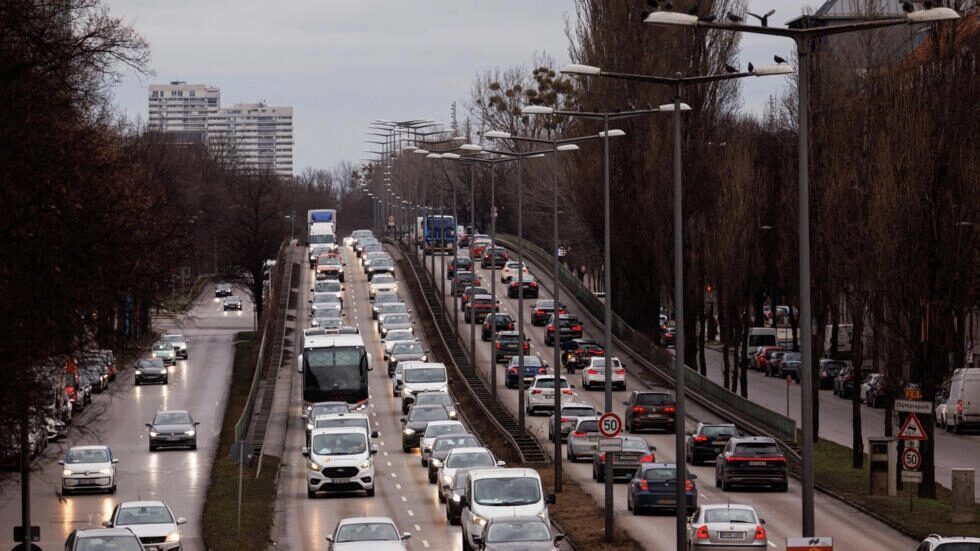
© Lukas Barth, ReutersCars drive on the Mittlerer Ring in Munich, Germany, February 1, 2023.
European Union member states have already approved the legislation and will now formally nod it into law at an upcoming ministerial meeting, despite opposition from conservative MEPs, the parliament's biggest group.
Supporters of the bill had argued to that it would give European carmakers a clear timeframe in which to switch production to zero-emission electric vehicles, and spur investment to counter competition from China and the United States.
Comment: The idea that banning something will somehow spur innovation regardless of the fact that it's considered to be a technological impossibility reveals just how deluded, or corrupt, these people are.
This, in turn, will also support the European Union's ambitious plan to become a "climate neutral" economy by 2050, with net-zero greenhouse gas emissions.
"Let me remind you that between last year and the end of this year China will bring 80 models of electric cars to the international market," EU vice president Frans Timmermans warned MEPs.
Comment: 80 models that operate on much the same technology and under similar constraints as the rest, such as battery life, time taken to charge, and so on.
There are a great many needs of our society, from building homes to farming food, and yet in the West we do not see groundbreaking innovation solving these problems - that in addition just seem to be getting - and so why on earth would cars be any different?
"These are good cars. These are cars that will be more and more affordable, and we need to compete with that. We don't want to give up this essential industry to outsiders."
But opponents argued that neither European industry nor many private motorists are ready for such a dramatic cut off in production of internal combustion engine vehicles -- and that hundreds of thousands of jobs are at risk.
"Our proposal is ... to let the market decide what technology is best to reach our goals," said MEP Jens Gieseke, a member of the centre-right European People's Party.
Gieseke declared that arguments from Green and socialist MEPs that electric cars are cheaper to run had been rendered "null and void" by the crisis of soaring energy costs.
"In Germany 600,000 people work on ICE production, those jobs are at risk," he declared, urging the European Commission to rethink plans to also extend the ban to trucks and buses.
The EPP group warned of what it said would be the "Havana effect" - Europeans continuing to drive vintage fuel-burning cars after new sales are banned because they can't find or afford an electric.
Comment: Or because they don't want an EV?
Opponents also argue car batteries are produced abroad by Europe's competitors like the United States, but Timmermans argued that thanks to EU-backed investment European production would increase.
Green MEPs stressed the importance of the ban in reducing emissions and pollution.
Victory for the planet?
Karima Delli, president of the transport committee, declared: "Today's vote is a historic vote for the ecological transition.
"We will no longer, or almost no longer, have petrol or diesel cars on our roads in 2050 ... it is a victory for our planet and our populations"
Cars currently account for about 15 percent of all CO2 emissions in the EU, while transportation overall accounts for around a quarter.
Comment: CO2 emissions are of little import; other kinds of air pollution do indeed harm health but banning combustion cars will simply cause a number of other problems that jeapordise health.
In October last year, EU member states, the European Commission and parliament's negotiators agreed on a proposal to reduce CO2 emissions from new cars in Europe to zero by 2035.
In practice, in the final legislation, this means a halt to sales of new petrol and diesel cars, light commercial vehicles and hybrids in the bloc by that date, in favour of all-electric vehicles.
US green subsidies
Car-making giant Germany and conservative MEPs have been dubious about the new rules, fearing the burden of re-tooling their plants and retraining workers while global rivals have looser targets.
But the European car industry itself did not lobby hard against the law, with many firms already jockeying for position in the race to become electric vehicle giants.
Comment: Rather curious, because pharmaceutical companies sure lobby hard when their interests are threatened.
Since the law began its journey through the EU legislative process, however, the United States has unveiled a huge plan to subsidise the green transition of its own industry with government hand-outs.
This has led to fears in Europe that its US rival will siphon away investment and jobs in electric vehicle and battery production.
Currently around 12 percent of new cars sold in the European Union are electric, with consumers shifting away from CO2-emitting models as energy costs and greener traffic regulations bite.
Comment: One wonders how the energy crisis is impacting these sales of EVs.
Meanwhile, China - the world's biggest automobile market - wants at least half of all new cars to be electric, plug-in hybrid or hydrogen-powered by 2035.
Comment: China 'wants' cars to be electric, whilst the EU enforces a ban - and it's China that's the dictatorship?
The law passed the Strasbourg assembly by 340 votes to 279, with 21 abstentions.














I don't believe the European Union will still exist in 2035.