
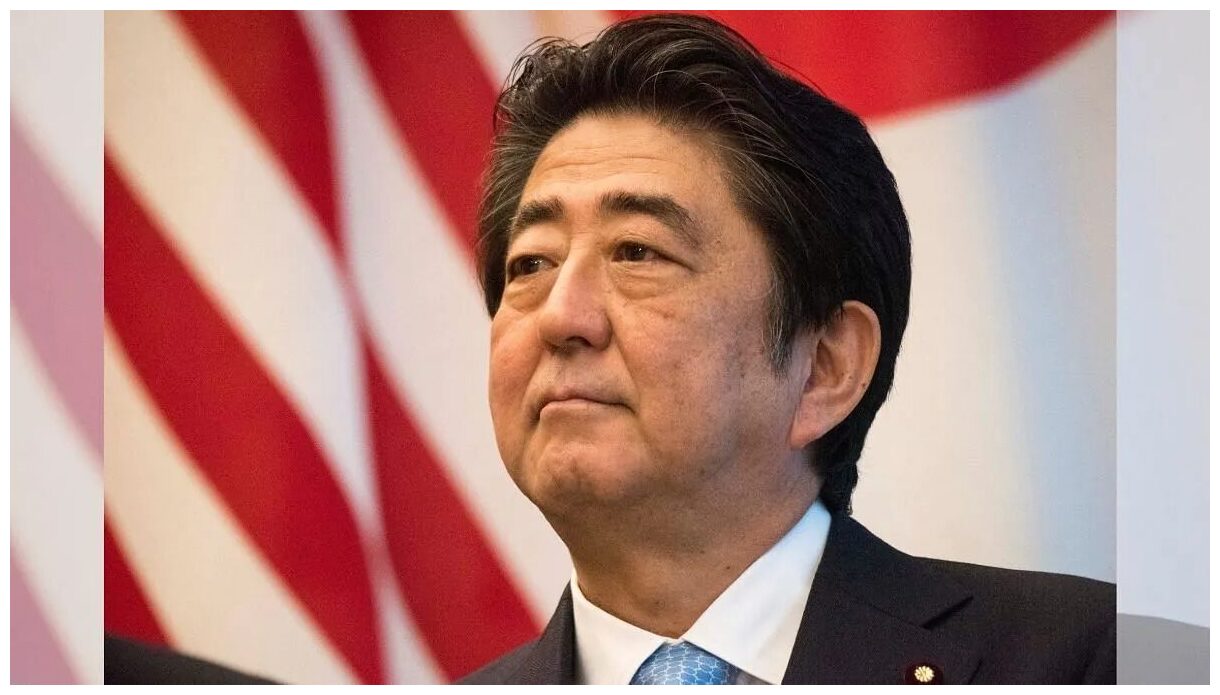
© FlickrFile photo of former Japanese Prime Minister Shinzo Abe.
The leaders of Japan, France, Germany and Italy were against the introduction of anti-Russian sanctions at the G7 meeting in 2014, according to the book of memoirs of former Japanese Prime Minister Shinzo Abe.
The book was published this week, the memoirs were recorded by a group of journalists in the form of interviews from October 2020 to October 2021. The summit they are talking about was held in Brussels, and not in Sochi, as planned. The reason was the situation around the Crimea, which became part of the Russian Federation following the results of the referendum, and the exclusion of Russia from the G8.
"The G7 positions itself as a platform uniting (countries) with common values, Russia was introduced into the membership and for many years met with the leaders of the leading countries (G8). But if due to the fact that an unacceptable situation has occurred, it will be impossible to expel the one (who did it), it will be impossible to solve the problem," Abe writes.
He recalls that at a meeting in Brussels, US President Barack Obama took a tough stance against Russia and personally handed out to the participants a document containing several points of sanctions against Russia. Usually Sherpas do this in advance, so "when suddenly the US president personally took out the papers, everyone was surprised." "Each of the European countries is connected with Russia economically, so the sanctions were treated cautiously," Abe said, recalling that France was supposed to supply Russia with Mistrals, and Germany was buying oil. "Chancellor Merkel asked me: "What will Japan do with sanctions?", I replied: "We have negotiations with Russia on the territorial issue, so sanctions are impossible. Why not criticize the change of the status quo with the help of force, giving it the form of a document?". And we decided to go in this direction," Abe recalls.
After French President Francois Hollande expressed a very cautious attitude towards Obama's document, Merkel asked Abe to speak. Then he suggested to all those gathered to avoid a split in the "seven", which "will mean its end", to issue a joint statement criticizing Russia, and to work out the issue of sanctions for each country separately in a working order. "Everyone exhaled. Matteo Renzi, the Prime Minister of Italy, was sitting next to me, he held out his palm to me (with a gesture) "high five". I doubted whether it would be offensive to Obama, but I still held out my hand to him... Merkel told Obama: "Wouldn't it be better to collect these papers with sanctions?", and I remember how Obama hurriedly bypassed the leaders and collected the papers," Abe writes.
Abe said in his memoirs that his visit to Russia in 2016 caused Obama's anger
According to the politician, this was due to the desire of the United States to preserve the unity of the Group of Seven countries in the issue of sanctions pressure on Moscow after the reunification of Crimea with the Russian Federation
Barack Obama, who held the post of US President in 2016, was extremely dissatisfied with the visit of then Japanese Prime Minister Shinzo Abe to Russia for talks with Russian President Vladimir Putin, but the trip took place contrary to the position of the American administration. This is described in the memoirs of the former head of the Japanese government published this week.
"US President Barack Obama was against my trip to Sochi (in May 2016 - approx. ). In March of the same year, when I visited the United States to participate in the nuclear security summit, I told him that I would meet with Putin in Sochi. Obama replied that if he were in my place, he wouldn't do it," Abe recalls. In his opinion, this was due to the desire of the United States to preserve the unity of the Group of Seven countries in the issue of sanctions pressure on Moscow after the reunification of Crimea with the Russian Federation.
"I told him that Japan does not have a peace treaty with Russia and that I have to change this situation. It ruined the atmosphere. After that, Obama apparently got angry, and the US Foreign Ministry also opposed my visit. Thus, the visit to Sochi went against the wishes of the United States," the former prime minister said.
On May 6, 2016, Abe visited Sochi, where he was received by Putin. Within the framework of this meeting, Abe proposed an eight-point plan to intensify cooperation with Russia aimed at developing energy, small and medium-sized businesses, expanding the export base, cooperation in the field of advanced technologies and humanitarian exchanges. This plan has been the basis for the development of economic cooperation between Tokyo and Moscow for several years.
About the memoirs
A book titled Shinzo Abe. Memoirs went on sale in Japan this week. It includes eighteen interviews with a total duration of 36 hours, which were not previously published due to their too sensitive nature. It is written in a question-answer format with some author's notes. Among the authors of the book is Japanese journalist Goro Hashimoto.
Former Japanese Prime Minister Abe was shot dead on July 8, 2022 during an election rally. On July 12, a private Buddhist funeral ceremony was held in Tokyo's Zojoji Temple for family members, close friends and associates. Abe's body was cremated. Taking into account his services to the country, the Government decided to hold a state funeral ceremony on September 27.


Reader Comments
7 BILLION crabs 'disappear' from Bering Straits in last 4 years, industry faces ruin with shortages & price increases already occuring
The future of one of the Discovery Channel's most successful franchises is under severe threat following the news that Alaska's lucrative snow crab fishing season has been canceled. Deadliest...'Billions of snow crabs have disappeared from Alaska waters' [Link] Seems most people/'normies,' have a memory like a sieve.
*
"...It is true that Abe had a very dangerous and destructive mission to restore Japan to its status as an imperialistic empire. He was a corrupt insider who pushed for the dangerous privatization of the Japanese government and increased the gap between the wealthy and middle-class citizens. However, it is also too simplistic as to celebrate his death as an absolute triumph. As we can clearly see seven months after Abe’s assassination, Japan has not become more peaceful and ready for dialogue with its eastern partners but rather has become much more bellicose and stauncher in its cooperation with the increasingly war frenzied western demands. Japan has also greatly severed motion towards greater economic and political cooperation with Russia and China, which was still moving forward when Abe was alive..."
"...It was precisely Abe’s grand vision of Japan returning to its “glory” days as an empire that was problematic for the League of Nations vision, for if Japan saw itself on par with other great empires, or perhaps even greater, it meant that it did not ultimately intend to bend the knee. That is, Abe was not willing to sell off Japan as a satrapy, however, that was exactly what the western diktat was essentially demanding of Japan. Under this western diktat Japan was being ordered to accept its fate to collapse economically and sink into desperation, become increasingly militaristic and extremist and lead a kamikaze charge into a war with China and Russia which would lead to the ruination of the Japanese civilization. It does not look like Abe was going to go along with that stark vision for Japan..."
"...One thing is for certain since Abe’s assassination. Japan is moving ever more rapidly forward on a very dangerous path that threatens it to be once again on the wrong side of history. The question is, are Germany and Japan so foolish as to make the same mistake twice, for they should not assume they will survive such a reckoning a second time."