
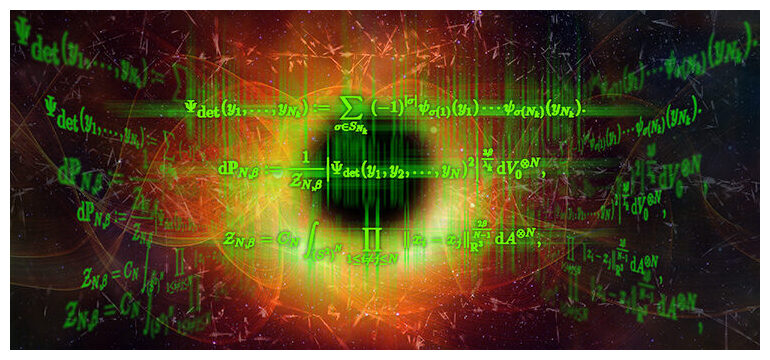
© Chalmers University of TechnologyThe quantum mechanical description of black holes is still in its infancy but involves spectacular advanced mathematics.
A grand challenge in modern theoretical physics is to find a 'unified theory' that can describe all the laws of nature within a single framework - connecting Einstein's general theory of relativity, which describes the universe on a large scale, and quantum mechanics, which describes our world at the atomic level. Such a theory of 'quantum gravity' would include both a macroscopic and microscopic description of nature.
"We strive to understand the laws of nature and the language in which these are written is mathematics. When we seek answers to questions in physics, we are often led to new discoveries in mathematics too. This interaction is particularly prominent in the search for quantum gravity - where it is extremely difficult to perform experiments," explains Daniel Persson, Professor at the Department of Mathematical Sciences at Chalmers university of technology.
An example of a phenomenon that requires this type of unified description is black holes. A black hole forms when a sufficiently heavy star expands and collapses under its own gravitational force, so that all its mass is concentrated in an extremely small volume. The quantum mechanical description of black holes is still in its infancy but involves spectacular advanced mathematics.
A simplified model for quantum gravity
"The challenge is to describe how gravity arises as an 'emergent' phenomenon. Just as everyday phenomena - such as the flow of a liquid - emerge from the chaotic movements of individual droplets, we want to describe how gravity emerges from quantum mechanical system at the microscopic level," says Robert Berman, Professor at the Department of Mathematical Sciences at Chalmers University of Technology.
In an article recently published in the journal Nature Communications, Daniel Persson and Robert Berman, together with Tristan Collins of MIT in the USA, showed how gravity emerges from a special quantum mechanical system, in a simplified model for quantum gravity called the 'holographic principle'.
"Using techniques from the mathematics that I have researched before, we managed to formulate an explanation for how gravity emerges by the holographic principle, in a more precise way than has previously been done," explains Robert Berman.
Ripples of dark energy
The new article may also offer new insight into mysterious dark energy. In Einstein's general theory of relativity, gravity is described as a geometric phenomenon. Just as a newly made bed curves under a person's weight, heavy objects can bend the geometric shape of the universe. But according to Einstein's theory, even the empty space - the 'vacuum state' of the universe - has a rich geometric structure. If you could zoom in and look at this vacuum on a microscopic level, you would see quantum mechanical fluctuations or ripples, known as dark energy. It is this mysterious form of energy that, from a larger perspective, is responsible for the accelerated expansion of the universe.
This new work may lead to new insights into how and why these microscopic quantum mechanical ripples arise, as well as the relationship between Einstein's theory of gravity and quantum mechanics, something that has eluded scientists for decades.
"These results open up the possibility to test other aspects of the holographic principle such as the microscopic description of black holes. We also hope to be able to use these new connections in the future to break new ground in mathematics," says Daniel Persson.
The scientific article, Emergent Sasaki-Einstein geometry and AdS/CFT, is published in Nature Communications and is written by Robert Berman, Tristan Collins and Daniel Persson at Chalmers University of Technology, Sweden, and Massachusetts Institute of Technology, USA.



Reader Comments
Reading "black hole" told me all I needed to know. Math is a scientific tool, a language to express relations. It is not a science by itself.
Infering from a mathematical model to the real object is stupid.
Actually, it's beyond stupid.
As long as those "scientists" are happy with that lifelong intellectual masturbation ...
hmm
"The day science begins to study non-physical phenomena, it will make more progress in one decade than in all the previous centuries of its existence."
“Einstein's relativity work is a magnificent mathematical garb which fascinates, dazzles and makes people blind to the underlying errors. The theory is like a beggar clothed in purple whom ignorant people take for a king... its exponents are brilliant men but they are metaphysicists rather than scientists.”
what i find most intriguing is howcome/why thousands of the worlds brightest ppl usually needs 50 to 100 years to figure out such "simple/basic" things 🤭
..
"Leonard Susskind said, “The three-dimensional world of ordinary experience––the universe filled with galaxies, stars, planets, houses, boulders, and people––is a hologram, an image of reality cited on a distant two-dimensional (2D) surface.".
..
So, the programmitic output for the 3-d existence is a production? If I'm reading it, AdS/CFT only proposes 5-dimensions...
Let's say on an "AdS map" there is constant (negative Gaussian) curvature, so I think in 2-D it graphs onto a Poincare(sic) disk using hyperbolic geometry. Taking that different basis then integrating to form sections of 3-D, to 4-D (out from what's described as an inital 1-D symmetry breaking as (at least two "gravitons"? or) gravitational line(s) of force or point charge(s) diverging at microscale to generate) forms, forms a conception of what may be imminent or remote "spheres of influence". This forms a "sphere"? The saddle-conformer of glucose, or the 3 standard lines drawn on a basketball are simplistic forms of AdS 3-D in my opinion.
To continue the conjecture and speculation, from the Enneagram from the Fourth Way you can trace a Saddle-Conformer (AdS 3-D?) by moving a point along the 6-sided shape, taking the point as turning with spin as it arcs to form a sphere around the middle structure; number the points starting with the top as 9, then 1 going clockwise from there through 8 -- the last point on the "6-sided shape", now with constant curvature by tracing through 1-4-2-8-5-7 forwards or backwards from any point in that sequence. Then, if that 1-D->2-D>3-D movement generates the conformer, or "shape of the field" or whatever it is, by integrating the whole play of 3-D movement to agglomerated 4-D time sections, integrating to 5-D encompasses... What? Is the whole show bottoms-up?
The math in that paper is beyond my level, built from the "ground up out of nothing", in my estimation, to try to make a descriptive language. Maybe it's top-down intelligence but it's from a remote (5-D) "sphere"? Probably wishful thinking on my part that I knew squat about these formalizations...
...Or, what is folded into the 5-D playbill?
codis , or rakarb , have you derived any impressions from this fap show?
but, interesting to see a status-report now and then 👍