
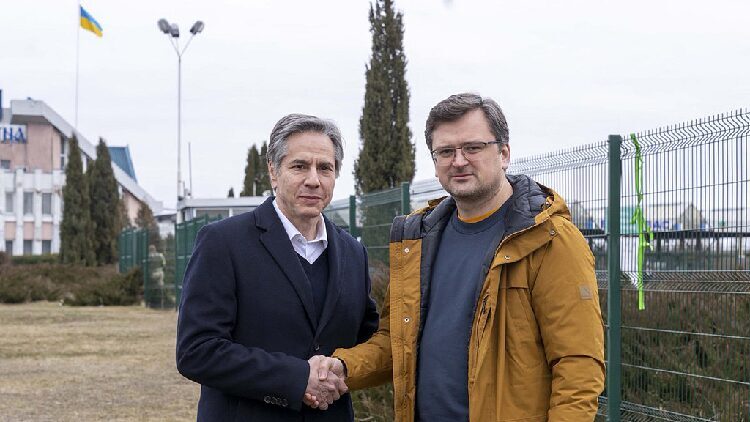
US Secretary of State Antony Blinken (left) and Ukraine's Foreign Minister Dimitro Kuleba meet at the Ukrainian-Polish border crossing on March 5, 2022. /vcg
While observers may welcome the idea that Ukraine would never join a US-led anti-Russian military bloc at Russia's request as a positive step toward a settlement, all may not be exactly the same. As it seems at first glance. Arkhamia's mention of NATO members could upset Russia as it could be interpreted as countries following the de facto expansion into Ukraine of Article 5 of the bloc, which refers to the organization's collective security commitments.
It should not be forgotten that Russian President Vladimir Putin revealed during his speech on 24 February that NATO had allegedly established secret military infrastructure in Ukraine, which he warned was a well-planned attack against his country. It was a surprise attack. He implied that this could follow a US effort to neutralize Russia's nuclear second-strike capabilities through continued regional deployment of "anti-missile systems" and strike weapons near its borders.
While NATO and Ukraine denied these Russian claims, they have both been very forward about the block's dispatch of spear anti-tank missiles and other forms of military equipment. Joint military exercises have also taken place in the territory of that former Soviet republic over the years. Their relationship is so close to the surface, which leaves one wondering how deep they go beneath it. They are not formal allies, but their relations are certainly very privileged and strategic in nature.
Russia's ongoing special military operation in Ukraine aims to complete three strategic tasks, in addition to immediately stopping Kyiv's attacks against the indigenous Russian people of the Donbass. These are demilitarization, demilitarization and neutralization of that country. Russia considers the Nazis to be ultra-nationalist forces that came to power with US support after the Western-backed "Euromaidan" color revolution coup of 2013-2014, although Ukraine and its allies deny this description.
The former Soviet republic intensified its militarization with full Western aid following the loss of Crimea that spring and the subsequent conflict in the Donbass region of eastern Ukraine. Russia considered this and other US regional moves, as previously described, in gross violation of the Organization for Security and Co-operation in Europe (OSCE) principle of indivisible security, under which any party or group cannot be protected at the expense of another.
This explains one of the reasons why it wants Ukraine to remove its constitutionally implied goal of joining NATO that was ratified by the bloc during the 2008 Bucharest summit. Moscow has legitimate security interests in what international relations experts call a "security dilemma". The concept refers to the suspicion of one side of the other's self-proclaimed defensive moves such as the Kremlin claiming the US, NATO and Ukraine have done what it has along its national security red lines.
Russia's openly expressed desire to modify the European security architecture in such a way that the principles of the OSCE can eventually be implemented has been described as the broader impetus behind its diplomatic and military moves of late. Since events in and around Ukraine marked the beginning of Moscow's special military operation there, the former Soviet republic would inevitably be part of a larger solution between Russia and NATO, although it would not be implemented in light of the deteriorating relations of recent events. It may take time.
Knowing what Russian officials have publicly disclosed about their country's threat perception of the US, NATO, and military moves in and around Ukraine, it is unlikely that the Kremlin would be able to defend against this anti-Russian Coalition. This essentially ruins that aspect of Arkhamia's proposal, but the concept of a "non-NATO model" is still promising as Ukraine and its allies decide to carry out the principles of the OSCE.
Despite Russian diplomats actively trying to encourage them to do so since publishing their security guarantee requests in late December, it has not yet happened to ensure undivided security in Europe. It remains the most viable political solution. No serious progress is expected on this front except for unforeseen events, many of which have occurred over the past month, but it is expected that all parties will agree on the need to rely on OSCE for guidance.




I think Russia will enforce the non-membership on the rest Ukraine, which will be the Western half. The East and the South around the Black Sea will be lost.