
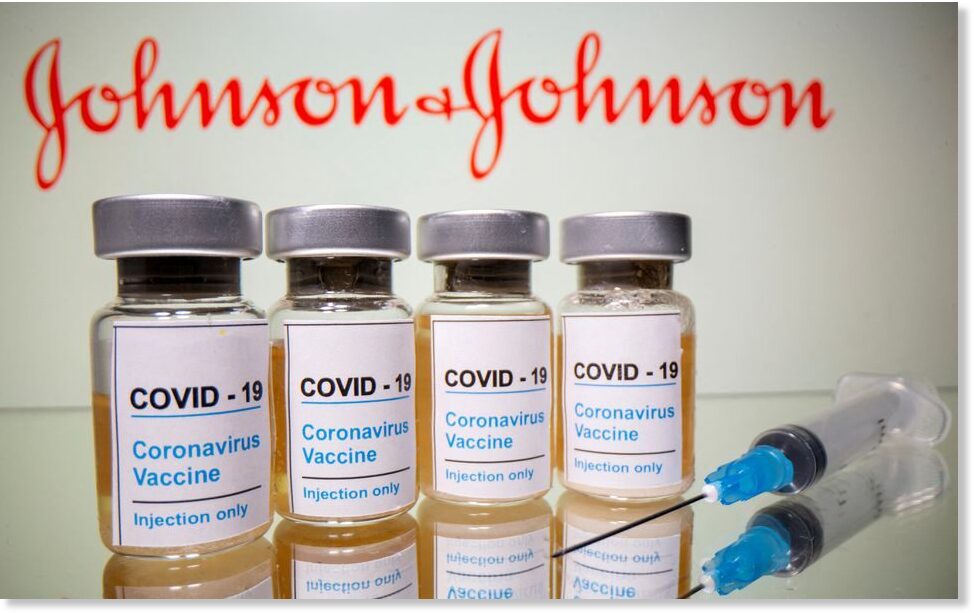
Yet the American company, which has already fallen far behind on its deliveries to poorer countries, late last year quietly shut down the only plant making usable batches of the vaccine, according to people familiar with the decision.
The facility, in the Dutch city of Leiden, has instead been making an experimental but potentially more profitable vaccine to protect against an unrelated virus.
The halt is temporary — the Leiden plant is expected to start churning out the Covid vaccine again after a pause of a few months — and it is not clear whether it has had an impact on vaccine supplies yet, thanks to stockpiles.
But over the next several months, the interruption has the potential to reduce the supply of Johnson & Johnson's Covid vaccine by a few hundred million doses, according to one of the people familiar with the decision. Other facilities have been hired to produce the vaccine but either aren't up and running yet or haven't received regulatory approval to send what they're making to be bottled.
Inside Johnson & Johnson's executive suites, the decision to suspend production at Leiden prompted concerns that it would impair the company's ability to deliver on its vaccine commitments to the developing world.
Johnson & Johnson's move also blindsided officials at two of the company's most important customers: the African Union and Covax, the clearinghouse responsible for getting vaccines to poor countries. Leaders of those organizations learned of the halt in production from New York Times reporters.
"This is not the time to be switching production lines of anything, when the lives of people across the developing world hang in the balance," said Dr. Ayoade Alakija, a co-head of the African Union's vaccine-delivery program.
Jake Sargent, a spokesman for Johnson & Johnson, said in an email that the company was "focused on ensuring our vaccine is available where people are in need" and that its global production network "is working day and night" to help fight the pandemic.
He said the company was continuing to deliver batches of the vaccine to facilities that bottled and packaged doses. He also said Johnson & Johnson had millions of finished doses in inventory.
Johnson & Johnson's Covid vaccine, initially billed as a single shot, fell out of favor in the United States and other wealthy countries in part because of its link to a rare but dangerous blood-clotting disorder. Studies have found that it performs worse by some measures than the shots from Pfizer and Moderna.
But poorer countries remain reliant on Johnson & Johnson's vaccine, which does not require ultracold refrigeration. It has been shown to provide strong and long-lasting protection against severe disease across variants, including Omicron, when given as a two-shot regimen. As a single shot, the vaccine is less expensive and relatively easy to give to hard-to-reach populations.
"In many low- and middle-income countries, our vaccine is the most important and sometimes only option," Dr. Penny Heaton, a Johnson & Johnson executive, said in December at a meeting of experts advising the U.S. government on vaccines. She added, "The world is depending on us."
Lower-income countries now have more vaccine options than at any previous point in the pandemic, and the impact of pausing production at the Leiden plant is therefore less severe than it might have been in the past. Some African governments have asked vaccine manufacturers to pause shipments until the countries use what they have on hand. Companies have cited that as evidence that they are providing plenty of vaccines to poorer countries.
But the reality is more complicated.
Only about 11 percent of Africans have been fully vaccinated (and few have received boosters). Many countries lack the infrastructure — medical personnel, storage facilities and transportation — to quickly inoculate their populations. They don't need a huge pile of vaccines all at once; they need a steady and predictable supply over many months.
As recently as last summer, Johnson & Johnson had projected that it would deliver one billion doses of its Covid vaccine in 2021. The company badly missed that target, releasing roughly 400 million doses, according to a person familiar with the company's vaccine production.
Mr. Sargent said the company was continuing to fulfill its contractual obligations to the African Union, which has ordered vaccines on behalf of dozens of countries in Africa and the Caribbean, and to Covax, which buys vaccines for scores of low-income governments.
But Johnson & Johnson failed to deliver anywhere near as many doses to Covax as it planned. The company said in May that it "aimed to supply" up to 200 million vaccine doses to Covax by the end of last year. Covax got only four million; another 151,000 arrived last month, according to Gavi, the main nonprofit that runs Covax. (Wealthy countries supplemented that with donations.)
The African Union, which ordered 220 million doses, has fared better. It has been receiving doses on or ahead of schedule, with the bulk of the order due in the next eight months.
Dr. Seth Berkley, who helps run Covax as the chief executive of Gavi, said the Johnson & Johnson vaccine had been at the center of the program's strategy for fighting Covid last year. But because of Johnson & Johnson's delay in delivering doses, Covax has increasingly looked to other vaccine providers.
"We really needed their doses in 2021, and we were counting on them," Dr. Berkley said. "They didn't deliver. So we had to find other doses to meet the countries' needs."
An African Union official said the bloc was also concerned by the decision to pause production at the Leiden plant because it had been assured that all of its vaccine would come from that facility. The official said Johnson & Johnson's move raised doubts about whether the bloc would exercise an option to buy an additional 180 million Johnson & Johnson doses.
Johnson & Johnson has already faced criticism for failing to prioritize people in developing countries for its Covid vaccine. Last summer, the head of the World Health Organization rebuked the company after The Times reported that millions of doses that had been bottled in South Africa were being exported for distribution in Europe.
To make its Covid vaccine, Johnson & Johnson relies on a sprawling international network. In addition to the company-run Leiden facility, factories in India, Baltimore and North Carolina have been hired to make the substance of the vaccine. Others, including a plant in South Africa, handle the so-called fill-finish process of bottling and packaging doses.
From the start, Johnson & Johnson executives told U.S. officials that they planned to eventually pull the Leiden facility out of the rotation so it could make other products, according to current and former U.S. officials.
That was before Johnson & Johnson's network was overrun with problems.
Read more...



Reader Comments
Now, there REALLY is an emergency - governments of the world allowed the banksters to suck them into massive debt, while the banksters themselves were gambling with Trillions in derivatives - and now the world financial system is on the verge of collapse.
The pair have teamed up and decided to depopulate as a solution - governments around the world need to be overthrown - ASAP.
I agree. But profit is a vector of Tyranny, is it not. Socio/Psychopaths, enjoy the fruits of their labours....including on going murder
But how can you build real knowledge if you are ignorant of the propaganda? To me, this is important to know because it's another contradiction of the narrative that we are still in emergency mode, which is the justification for all the authoritarianism.
And I don't come to SOTT to be fed an opinion. I come here because it has and continues to force me to assess what I think I know.
EACH AND EVERY SACK OF SHITE THAT WORKED FOR THEM, ARE COMPLICIT IN THE MURDER, MASS GENOCIDE,
HOPE YOU RETARDS ARE SEEING THIS, MOFUS..
FOR A PAYCHECK, YOUR ALL EITHER GONNA BURN NEXT LIFE, OR BE SWINGING FROM A ROPE SOMETIME IN THIS
WHEN KARMA FINALLY CATCHES UP, AND THE CARDS COME CRASHING DOWN, FOOK YOUR EXEMPT FROM JAB
BEING EMPLOYED BY THESE EVIL SACKS, YOUR ALL COMPLICIT, IT SUCKS TO BE YOU, AND RELATED TO YOU!!
ALL TARGETS WHEN THE CARDS CRASH.. HEHE, BE AN AWESOME SHOW..