
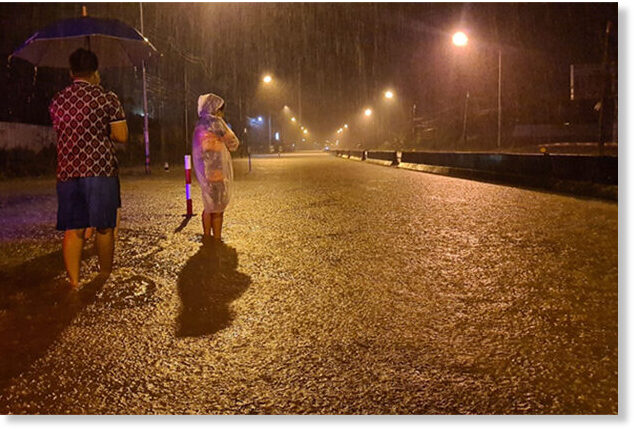
© Assawin PakkawanResidents at Bang Klong Luek in Hat Yai district of Songkhla watch as continuous rain floods a main road in Muang district in the early hours of Friday.
Water up to 50 centimetres deep blocked traffic on Road 407, a main road connecting Hat Yai and Muang districts of Songkhla province.
Motorists slowed their vehicles to a crawl as they negotiated the flooded section at Ban Klong Leuk in Muang district, causing traffic to build up. Another road in Hat Yai district was also flooded.
Songkhla and other southern provinces along the Gulf of Thailand have been pummelled by rain for three days.
In Narathiwat, parts of the municipal area in Muang district were flooded and rescuers were helping people move valued possessions to higher ground, with more rain expected.
The Meteorological Department on Friday forecast rain in 80% of the area from Chumphon south to Narathiwat until Saturday. The forecast followed a weather warning on Thursday that strong winds and rough seas were expected to continue into Saturday.
Songkhla experienced the fiercest downpours, with 263 millimetres of rain falling on Thursday, the department reported.



Anything upto 35 degrees either side of the equator has seen a massive increase in yearly rainfall, due to the compression of warm moist air at the equator.
This compression is due to the development of colder air at both poles, that has continued to build and sink towards the equator.
This is why Northern Africa, Saudi Arabia, Iraq, Iran, India, China and across to Japan have experienced epic rainfall, and its only going to get worse.
There is a development occuring in the middle of the Pacific ocean and it has already stalled the normal conveyance of oceanic currents, which will result in the start of a reversal of all ocean circulations.
This in turn will trigger a total collapse of all normal weather patterns around the globe, it has happened many times before and is nothing to do with CO2 are any other man made gas.
So a rather cheery outlook don't you think.