
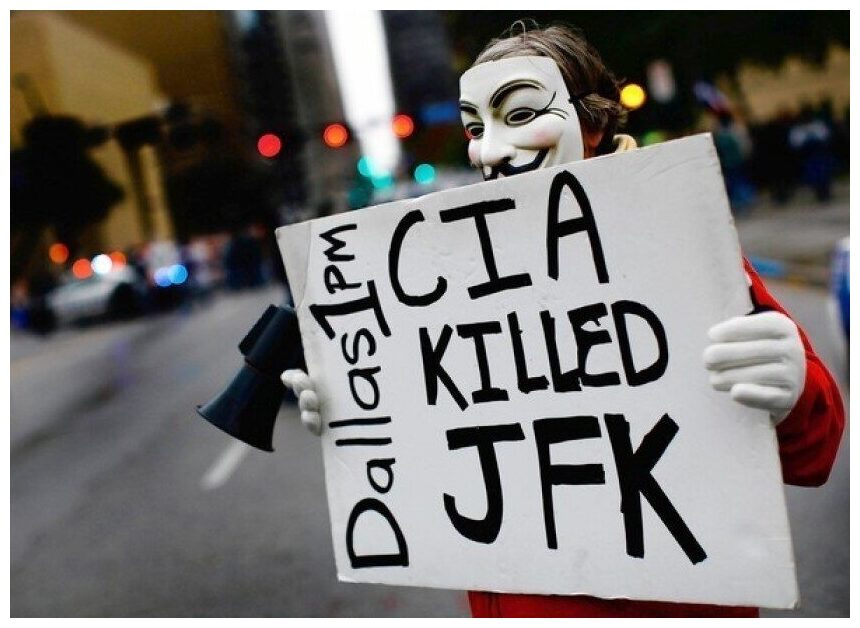
© Loas Angeles Times
Owing to the many federal records that have been released over the years relating to the Kennedy assassination, especially through the efforts of the Assassination Records Review Board in the 1990s, many Americans are now aware of the war that was being waged between President Kennedy and the CIA throughout his presidency. The details of this war are set forth in FFF's book JFK's War with the National Security Establishment: Why Kennedy Was Assassinated by Douglas Horne.
In the interview, Robert Kennedy Jr. revealed a fascinating aspect of this war with which I was unfamiliar. He stated that the deep animosity that the CIA had for the Kennedy family actually stretched back to something the family patriarch, Joseph P. Kennedy, did in the 1950s that incurred the wrath of Allen Dulles, the head of the CIA.
Kennedy Jr. stated that his grandfather, Joseph P. Kennedy, had served on a commission that was charged with examining and analyzing CIA covert activities, or "dirty tricks" as Kennedy Jr. put them. As part of that commission, Kennedy Jr stated, Joseph Kennedy (John Kennedy and Bobby Kennedy's father) had determined that the CIA had done bad things with its regime-change operations that were destroying democracies, such as in Iran and Guatemala.
Consequently, Joseph Kennedy recommended that the CIA's power to engage in covert activities be terminated and that the CIA be strictly limited to collecting intelligence and empowered to do nothing else.
According to Kennedy Jr., "Allen Dulles never forgave him — never forgave my family — for that."
I wasn't aware of that fact. I assumed that the war between President Kennedy and the CIA had begun with the CIA's invasion at the Bay of Pigs in Cuba. The additional information added by Kennedy Jr. places things in a much more fascinating and revealing context.
Upon doing a bit of research on the Internet, I found that the commission that Kennedy Jr. must have been referring to was the President's Board of Consultants on Foreign Intelligence Activities, which President Eisenhower had established in 1956 through Executive Order 10656. Eisenhower appointed Joseph Kennedy to serve on that commission.
That year was three years after the CIA's 1953 regime change operation in Iran which destroyed that country's democratic system. It was two years after the CIA's regime-change operation in Guatemala that destroyed that country's democratic system.
Keep in mind that the ostensible reason that the CIA engaged in these regime-change operations was to protect "national security," which over time has become the most important term in the American political lexicon. Although no one has ever come up with an objective definition for the term, the CIA's power to address threats to "national security," including through coups and assassinations, became omnipotent.
Yet, here was Joseph P. Kennedy declaring that the CIA's power to exercise such powers should be terminated and recommending that the CIA's power be strictly limited to intelligence gathering.
It is not difficult to imagine how livid CIA Director Dulles and his cohorts must have been at Kennedy. No bureaucrat likes to have his power limited. More important, for Dulles and his cohorts, it would have been clear that if Kennedy got his way, "national security" would be gravely threatened given the Cold War that the United States was engaged in with the Soviet Union, China, Cuba, North Korea, and other communist nations.
Now consider what happened with the Bay of Pigs. The CIA's plan for a regime-change invasion of Cuba, was conceived under President Eisenhower. Believing that Vice President Nixon would be elected president in 1960, the CIA was quite surprised that Kennedy was elected instead. To ensure that the invasion would go forth anyway, the CIA assured Kennedy that the invasion would succeed without U.S. air support. It was a lie. The CIA assumed that once the invasion was going to go down in defeat at the hands of the communists, Kennedy would have to provide the air support in order to "save face."
But Kennedy refused to be played by the CIA. When the CIA's army of Cuban exiles was going down in defeat, the CIA requested the air support, convinced that their plan to manipulate the new president would work. It didn't. Kennedy refused to provide the air support and the CIA's invasion went down in defeat.
Now consider what happened after the Bay of Pigs: Knowing that the CIA had played him and double-crossed him, John Kennedy fired Allen Dulles as CIA director, along with his chief deputy, Charles Cabell. He then put his younger brother Bobby Kennedy in charge of monitoring the CIA, which infuriated the CIA.
Now jump ahead to the Cuban Missile Crisis, which Kennedy resolved by promising that the United States would not invade Cuba for a regime-change operation. That necessarily would leave a permanent communist regime in Cuba, something that the CIA steadfastly maintained was a grave threat to "national security" — a much bigger threat, in fact, than the threats supposedly posed by the regimes in Iran in 1953 and Guatemala in 1954.
And then Kennedy did the unforgivable, at least insofar as the CIA was concerned. In his famous Peace Speech at American University in June 1963, he declared an end to the entire Cold War and announced that the United States was going to establish friendly and peaceful relations with the communist world.
Kennedy had thrown the gauntlet down in front of the CIA. It was either going to be his way or the CIA's way. There was no room for compromise, and both sides knew it.
In the minds of former CIA Director Allen Dulles and the people still at the CIA, what Kennedy was doing was anathema and, even worse, the gravest threat to "national security" the United States had ever faced, a much bigger threat than even that posed by the democratic regimes in Iran and Guatemala. At that point, the CIA's animosity toward President Kennedy far exceeded the animosity it had borne toward his father, Joseph P. Kennedy, several years before.
Jacob G. Hornberger is founder and president of The Future of Freedom Foundation. He was born and raised in Laredo, Texas, and received his B.A. in economics from Virginia Military Institute and his law degree from the University of Texas. He was a trial attorney for twelve years in Texas. He also was an adjunct professor at the University of Dallas, where he taught law and economics. In 1987, Mr. Hornberger left the practice of law to become director of programs at the Foundation for Economic Education. He has advanced freedom and free markets on talk-radio stations all across the country as well as on Fox News' Neil Cavuto and Greta van Susteren shows and he appeared as a regular commentator on Judge Andrew Napolitano's show Freedom Watch. View these interviews at LewRockwell.com and from Full Context. Send him email.






Dulles and Cabell showed Kennedy a map where operations were scheduled. The original idea was to come ashore near the city of Trinidad and capture it, then set up a bogus, CIA-run radio station which would appeal to the Cuban people to join the anti-Castro counter-revolution and announce to the world that a new government was taking control of Cuba. The carrier USS Essex was sent to "patrol" just off the south coast of Cuba, with a full contingent of US Marines aboard. Once the radio station was working, the supposed new government would appeal for "international" help, at which point the Marines would land and bolster the CIA's tiny raiding force. (The portable radio station went to the bottom of the Bay, never unloaded from the CIA ship the Houston.)
There were mountains not far from Trinidad and Dulles told JFK that if anything went wrong, the men in the landing force could retreat to the mountains and hold out while waiting for an air rescue and evacuation. Kennedy looked over the plans and told the CIA people that he didn't want the US military (or the CIA mercenaries) to attack a Cuban city. He then tapped the map further west along the coast--at Bay of Pigs. He approved a landing there, in a relatively rural area. Nobody, especially the CIA planners, took notice of the fact that the Bay was shallow, ringed by mangrove swamps, and that the CIA's small flotilla of ships would be unable to get as close to shore as was desired.
Dulles and Cabell (as I have heard it) told him there would have to be some air attacks, a finite number was given--four or five raids coming in from CIA bases in Nicaragua, plus the two planes sent purposely to land in Florida so as to make the US media think the attack was coming from discontented fighter pilots of FAR--Castro's air force. When the operation began and the CIA realized their mercenaries were headed for certain defeat, the planned flights were taken with little or no effect and with Castro's jets knocking down some of the CIA planes and also aircraft from the Alabama Air National Guard, also ordered in for the attack. Dulles had vanished just prior to the attack, off giving a "speech" in Puerto Rico. Cabell began calling JFK, begging for more air attacks, but Kennedy refused. As the mercenaries were driven further back through the mangroves, facing certain defeat, and after repeated calls from Cabell, Kennedy did agree to one last flight, to be launched from the USS Essex. Some historians say he was looking for a way to protect the men stranded in the swamps so that a rescue operation could evacuate them. He demanded that the US insignia and numbers on the Essex planes be painted over. This last flight took place, but as history shows, there was nothing that could be done to rescue the "brigade" of exile waiters, bartenders, fishermen, students, and former Batista goons, who were captured and jailed until Robert Kennedy negotiated their release some months later.