
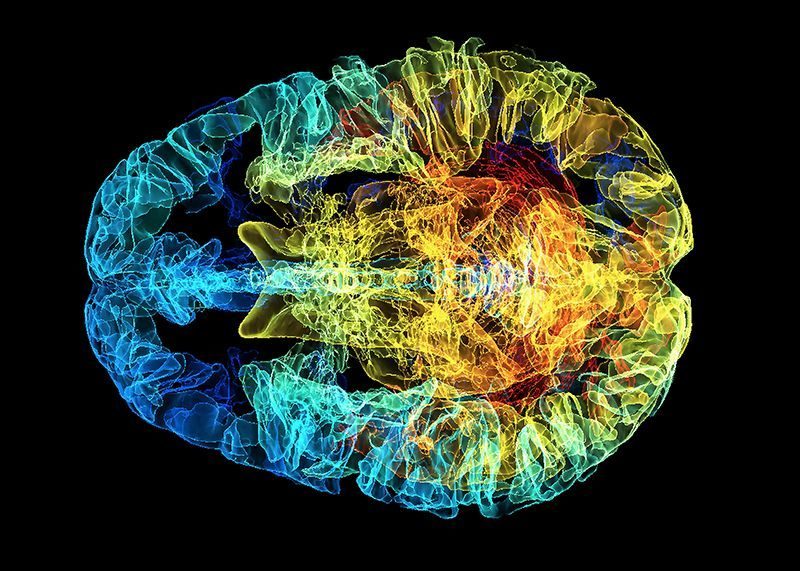
© K H Fung/Science Photo LibraryAn artificially coloured 3D magnetic resonance imaging scan of a human brain.
I woke one morning in 2010 to see an especially bad extrapolation of this study on the Early Show, a programme on US television network CBS. The presenter, Harry Smith, gushed as medical correspondent Jennifer Ashton declared that men have "six-and-a-half times more grey matter" than women, whereas women have "ten times as much white matter" as men. Next came the obvious quips about men's talent at mathematics and women's uncanny ability to multitask. Never mind that these differences would demand that women's heads were about 50% larger, or that the Irvine team didn't even compare brain volumes, but investigated a correlation between IQ and measures of grey or white matter.
Neurosexism
The history of sex-difference research is rife with innumeracy, misinterpretation, publication bias, weak statistical power, inadequate controls and worse. Rippon, a leading voice against the bad neuroscience of sex differences, uncovers so many examples in this ambitious book that she uses a whack-a-mole metaphor to evoke the eternal cycle. A brain study purports to discover a difference between men and women; it is publicized as, 'At last, the truth!', taunting political correctness; other researchers expose some hyped extrapolation or fatal design flaw; and, with luck, the faulty claim fades away - until the next post hoc analysis produces another 'Aha!' moment and the cycle repeats. As Rippon shows, this hunt for brain differences "has been vigorously pursued down the ages with all the techniques that science could muster". And it has exploded in the past three decades, since MRI research joined the fray.
Yet, as The Gendered Brain reveals, conclusive findings about sex-linked brain differences have failed to materialize. Beyond the "missing five ounces" of female brain - gloated about since the nineteenth century - modern neuroscientists have identified no decisive, category-defining differences between the brains of men and women. In women's brains, language-processing is not spread any more evenly across the hemispheres than it is in men's, as a small 1995 Nature study proclaimed but a large 2008 meta-analysis disproved (B. A. Shaywitz et al. Nature 373, 607-609 (1995) and I. E. Sommer et al. Brain Res. 1206, 76-88; 2008). Brain size increases with body size, and certain features, such as the ratio of grey to white matter or the cross-sectional area of a nerve tract called the corpus callosum, scale slightly non-linearly with brain size. But these are differences in degree, not kind. As Rippon notes, they are also seen when we compare small-headed men to large-headed women, and have no relationship to differences in hobbies or take-home pay.
History of bias
Rippon's central message is that "a gendered world will produce a gendered brain". Her book stands with Angela Saini's 2017 Inferior and Cordelia Fine's 2010 Delusions of Gender in rooting out the "neurosexism" that has pervaded attempts to understand difference at the brain level. It's a juicy history that would make for super-fun reading, if it were all truly in the past. Sadly, the moles keep surfacing. Rippon begins with an 1895 quote from social psychologist Gustave Le Bon, who used his portable cephalometer to declare that women "represent the most inferior forms of human evolution". She ends in 2017, with Google engineer James Damore blogging to co-workers about "biological causes" for the dearth of women in tech and leadership roles.
Comment: When a child is born its gender is written in its DNA and so its biology, including its brain, is inherently gendered: Sex differences are real: Men more likely to die of brain cancer
As Rippon shows, the hunt for proof of women's inferiority has more recently elided into the hunt for proof of male-female 'complementarity'. So, this line goes, women are not really less intelligent than men, just 'different' in a way that happens to coincide with biblical teachings and the status quo of gender roles. Thus, women's brains are said to be wired for empathy and intuition, whereas male brains are supposed to be optimized for reason and action.
Comment: There can be a difference without either being inferior.
This was how researchers at the University of Pennsylvania in Philadelphia framed a highly touted 2014 MRI study that seared into the public imagination a picture of men's and women's brains as diametrically opposed subway maps: the connections in women are mostly between hemispheres, and those in men within them (M. Ingalhalikar et al. Proc. Natl Acad. Sci. USA 111, 823-828; 2014). However, the map omits the vast majority of connections that did not differ between the study's adolescent participants; nor did it control for puberty-related maturation or, once again, for brain size, all of which reduces apparent male-female difference.
Cultural paths
So if it's not brain hard-wiring, how do we explain the often stark differences in behaviour and interests between men and women? Here is where we get to Rippon's thesis on the impact of a gendered world on the human brain. She builds her case in four loosely defined parts, from the sordid history of sex-difference research through modern brain-imaging methods, the emergence of social cognitive neuroscience and the surprisingly weak evidence for brain sex differences in newborns. Rippon shows how children's "cerebral sponges" probably differentiate thanks to the starkly pink-versus-blue cultures in which they are soaked from the moment of prenatal sex reveal.
Comment: While even very young children clearly show gender differences, puberty obviously brings about some of the most significant changes, therefore using new born brains as a proof of a lack of gender is evidently flawed.
Part 4 brings us into the twenty-first century, although not to any happy ending. It focuses on women in science and technology, and how the gendered world - including the professionalization of science and a masculine stereotype of "brilliance" - has impeded their entry into, and advancement across, this high-status realm. Talented women are regarded as "workhorses", men as "feral geniuses", a distinction that children internalize by the age of six, according to research by Lin Bian, Sarah-Jane Leslie and Andrei Cimpian (L. Bian et al. Am. Psychol. 73, 1139-1153; 2018). And all of this factors into the brain-building cycle of differential expectations, self-confidence and risk-taking that drives boys and girls down different trajectories of career and success.
Changing minds
This final focus explains the book's subtitle, 'The New Neuroscience that Shatters the Myth of the Female Brain'. For a volume about debunking brain difference, why narrow it to women? At first, I thought it was a stab at Louann Brizendine's 2006 The Female Brain, skewered in these very pages (R. M. Young and E. Balaban Nature 443, 634; 2006). Or perhaps it's to underscore how 'the female brain' has been sized up as a strange variant of the real thing, much as we refer to a 'female physicist' or 'female surgeon'.
Whatever the subtitle, the book accomplishes its goal of debunking the concept of a gendered brain. The brain is no more gendered than the liver or kidneys or heart. Towards the end, Rippon flirts with the implications of this finding for the growing number of people transitioning or living between current binary gender categories. But for now, she concludes, most of us remain strapped in the "biosocial straitjackets" that divert a basically unisex brain down one culturally gendered pathway or another.
Nature 566, 453-454 (2019)
doi: 10.1038/d41586-019-00677-x
The Gendered Brain: The New Neuroscience That Shatters The Myth Of The Female Brain Gina Rippon The Bodley Head (2019)





While scientific studies are increasinggly prevalent, they have not become more reliable. It was more informative to me to learn of the varied cultures of humans on earth and how they deal with the sexes. One example was seeing a video of the San Bushmen of the Kalahari some years ago. I was astonished to find that it was initially difficult to tell the males from the females. Being scantily clad due to the climate, one could quickly sort it all out, but while small groups are certainly quite different from large 'modern' societies, I did notice immediately that the San needed and used no gender role, sexual differentiation clues like we do - clothing, hair styles, make-up, simpering/blustering, and all the utter nonsense 'modern' cultures are steeped in.
The vast majority of human adults are not, I think, engaged in the 'mating game' at any given time, but still women of all ages and marital status in 'Western' cultures are likely to use clothing, make-up, hair-dos, wear heels!, etec. as well as behave in certain ways on. Why? This is conforming to the "gender role", not a sex difference. Societal pressure also convinced females that they could not, as well as should not, attempt various types of education or seek entry into a number of professions because of innate inability. This has been substantively reversed, by people, not by scientific studies.
Looking in the brain has apparently not revealed what some researchers were looking for. The major differences between the sexes are on the outside, not on the inside. Sex is more about reproductive biology while gender is whatever roles the culture demands of its people, based on their sex. Using the terms interchangeably has never been proper or helpful. Culture and societies should belong to the people, not the other way around.