
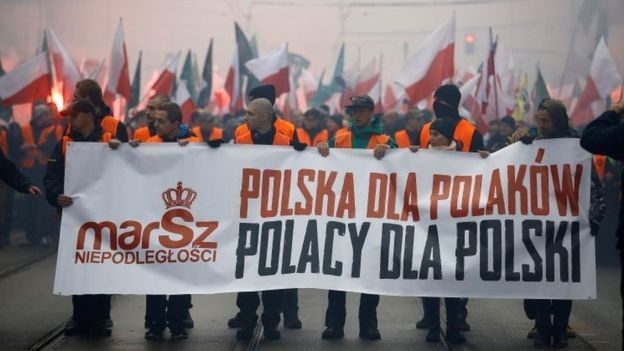
© ReutersIn 2015, some participants carried a banner that read Poland for Poles - Poles for Poland
"We're victorious," said the organisers of the annual event, which has become a magnet for the far right and has been marked by violence in recent years.
The ruling comes a day after Mayor Hanna Gronkiewicz-Waltz barred Sunday's rally, saying the city had suffered enough from "aggressive nationalism".
After the ban, President Andrzej Duda vowed to organise an official march.
"Everyone is invited, come only with red-and-white flags," he said, referring to the march that was expected to follow the same route as the nationalist rally - only starting one hour later.
The president warned that anyone carrying the kind of offensive banners seen last year would be dealt with by the police. An estimated 60,000 people took part in the 2017 march but far more are expected in Warsaw this Sunday to mark the centenary of independence.
Comment: Mainstream media 'shocked' at 60,000-strong nationalist march in Warsaw - but are they really?
Why are nationalist marches controversial?
Although the yearly event is popular with thousands of ordinary, patriotic Poles, including supporters of the ruling Law and Justice (PiS) party, it is partly organised by the far-right National Radical Camp (ONR).
Among the Polish flags last year were smoke bombs, along with racist and anti-Semitic chants and banners. Some of the marchers were far-right agitators from other countries including the UK and Italy.
A smaller counter-protest attracted some 2,000 people.
The march was cited in a European Parliament resolution last month, which called for a ban on neo-fascist and neo-Nazi groups.
What did the mayor say?
Ms Gronkiewicz-Waltz, a member of the opposition Civic Platform party, explained that security on Sunday was a concern and her appeals to the government for help had fallen on deaf ears.
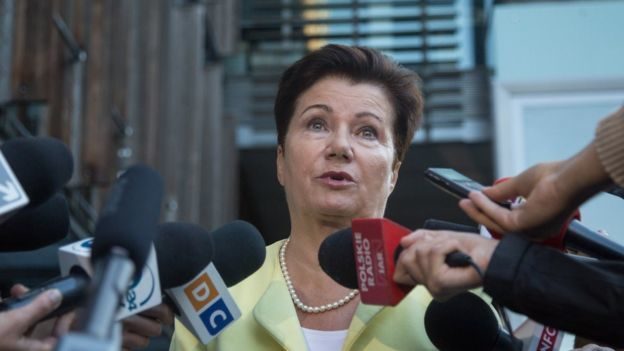
© GettyThe mayor complained that no charges had been brought against people who had broken laws at last year's march
"Poland's 100th anniversary of independence shouldn't look like this, hence my decision to forbid it," she said. Poland's second republic was established on 11 November 1918 at the end of World War One, after more than a century of rule by Prussia, the Austro-Hungarian empire and Russia.
Ms Gronkiewicz-Waltz also complained that no charges had been brought against people who had broken laws at last year's march.


Comment: See also:
- 'Don't be fooled!': German-owned Polish media trying to influence local elections - Poland's PM
- Poland's anti-fascist law defends national dignity in the face of Israeli and Ukrainian intimidation
- Color revolution? Thousands rally against Polish government in Warsaw
- Serbia and Poland: Alternative media's biggest reversal?
- Accepting the reality: Polish newspaper releases map showing Crimea as part of Russia
- Poland offers US $2bn bribe in exchange for permanent US armoured division garrison - Moscow warns of 'dangerous' consequences
And check out SOTT radio's: NewsReal: What's The Problem With Nationalism?