
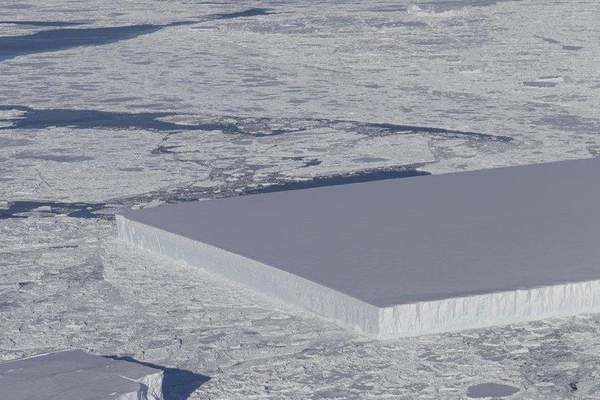
© @NASA_ICE/NASA
The enormous block of ice, known as a Tabular berg, is thought to be a mile in length, experts said.
It was found off the east coast of the Antarctic Peninsula, near the Larsen C ice shelf, by scientists flying over the region.
The iceberg's sharp angles and flat surface suggest it was recently calved from the ice shelf, NASA Ice researchers said.
And it was not the only iceberg formed as a geometric shape the scientists spotted on their flight over the Atlantic last week.
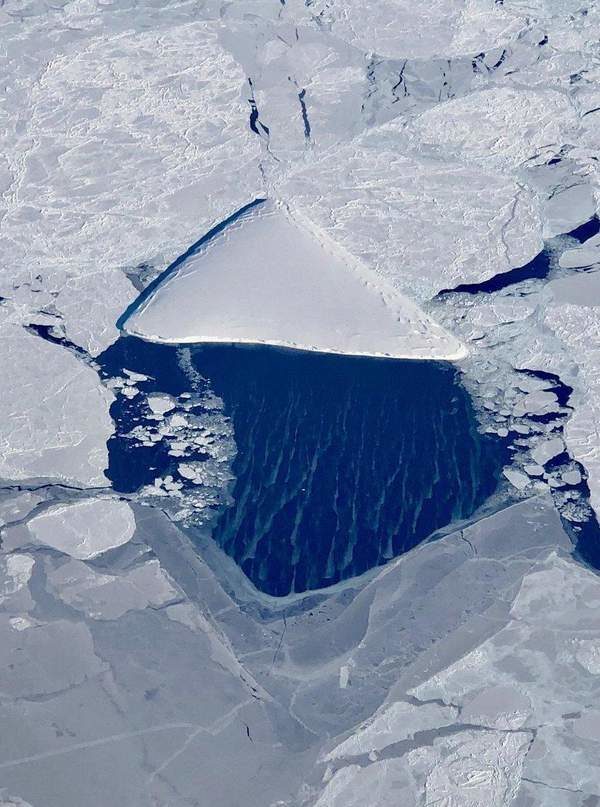
© @NASA_ICE/NASATriangular iceberg surrounded by different types of sea ice, off the Larsen ice shelf in the Weddell Sea
Speaking to Live Science, NASA ice scientist Kelly Brunt explained how such perfectly shaped bergs form.
She said Tabular icebergs are made through a process "a bit like a fingernail growing too long and cracking off at the end".
They are often rectangular and geometric as a result, she continued.
Scientists took the image as part of its operation IceBridge, in order to help understand how ice has changed in recent years.
They intend to study the calving process of icebergs as a way of measuring melting due to global warning.
Ice shelves are far more susceptible to calve off and melt as the planet continues to warm.



Comment: One wonders the increasing activity of Earth's undersea volcanoes coupled with the cooling above ground is partly responsible for the migrating ice bergs, and perhaps their unexpected shapes:
- Gigantic iceberg A-68 that broke off Larsen ice shelf blocked by dense sea ice, surprising scientists
- Stargate? Saturn sprouts another weird hexagon
- Arctic lake mysteriously disappears in Novaya Zemlya, Russia
- 'Perfectoid geometry' may be the secret that links numbers and shapes
- Stem cells organize using geometry as a guide
- Evidence of volcanic eruptions under Antarctic Ice
- Antarctica is even colder than scientists thought
Also check out SOTT radio's: Behind the Headlines: Earth changes in an electric universe: Is climate change really man-made?