
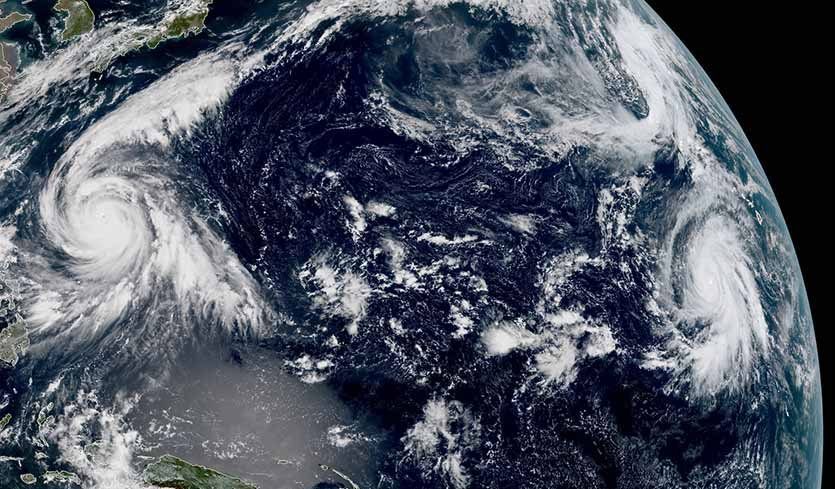
© NOAA/RAMMBSimultaneous Cat 5s: Super Typhoon Kong-rey (left) and Hurricane Walaka (right) roil the Pacific Ocean at 10 pm EDT October 1, 2018.
Walaka was deemed a Category 5 by the Central Pacific Hurricane Center at 8 p.m. EDT Monday while it was well to the southwest of Hawaii. Kong-rey hit this top rating on the Saffir-Simpson Hurricane Wind Scale a few hours later at 11 p.m. EDT Monday, according to the Joint Typhoon Warning Center.
Category 5 tropical cyclones have maximum sustained winds of 157+ mph.
Kong-rey and Walaka did not remain a duo of Category 5 tropical cyclones very long. Both were downgraded to strong Category 4 storms at 11 a.m. EDT Tuesday.
The last time two Category 5 strength typhoons or hurricanes coexisted was July 17, 2005, according to Dr. Phil Klotzbach, a tropical scientist at Colorado State University. On that day Hurricane Emily was raging through the western Caribbean as Super Typhoon Haitang pushed toward Taiwan over the western Pacific waters.
Klotzbach added that there was at least one time three Category 5s coexisted across the world's oceans in the available historical record. On Sept. 11, 1961, Hurricane Carla was in the Gulf of Mexico while Super Typhoon Nancy and Super Typhoon Pamela were both in the northwest Pacific.
Eight tropical cyclones have now reached Category 5 intensity around the world in 2018, according to wunderground.com meteorologist Dr. Jeff Masters. The average number of Category 5 storms per year on Earth is about five (1990-2017).
Hurricane Walaka and Super Typhoon Kong-rey were not affecting land when they reached this extreme intensity.
Walaka was lashing the Johnston Atoll on Tuesday, but the island is unpopulated. However, four wildlife refuge workers on the Johnston Atoll had to be evacuated ahead of Walaka's arrival, according to The Associated Press.



Comment: See also: The Day After Tomorrow? A record 7 named storms are whirling across the globe and Unseen in 35 years: Veteran weather reporter on oceans 'exploding with cyclonic activity'.