
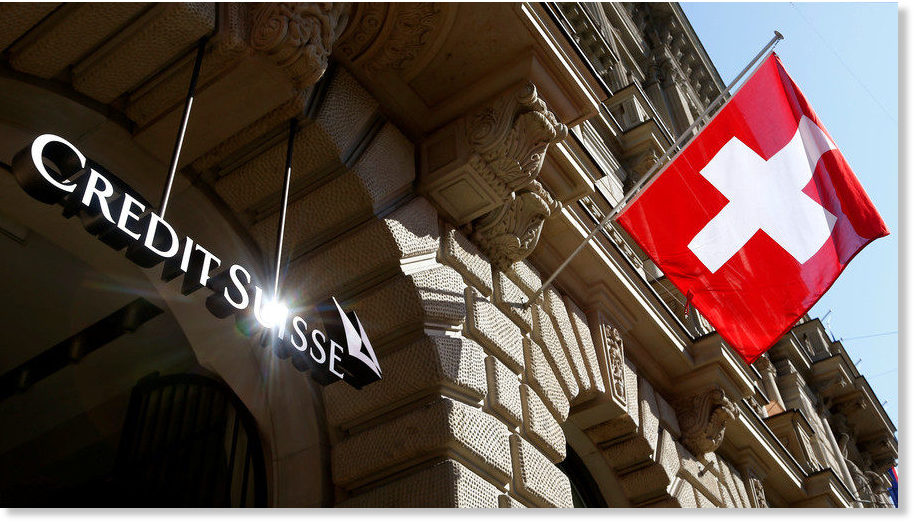
© Arnd Wiegmann / Reuters
There is reportedly growing fear among Western banks of reprisals from the US for working with targeted Russian individuals and entities.
The bank froze the funds in the second quarter of 2018, according to Reuters.
In an e-mailed statement to RT, Credit Suisse denied freezing Russian assets, explaining that it has reclassified assets of some Russian clients. The bank said that it works with international regulators wherever it does business to ensure compliance, including sanctions involving Russia.
"Following recent US sanctions and given US regulatory restrictions, Credit Suisse reclassified certain impacted assets from Assets under Management to Assets under Custody," the statement read.
"This reclassification does not represent a freezing of the assets. In addition, non-sanctioned clients were not affected by the re-classification. Neither did this result in any financial loss or provision."
Credit Suisse says it remains highly committed to Russia and continues to monitor developments.
The Zurich-based Credit Suisse owned aircraft surrendered by Russian tycoon Oleg Deripaska before the sanctions, and had also lent money to businessman Viktor Vekselberg.
Switzerland has been one of destinations for money leaving Russia. According to data from the Russian central bank, around $6.2 billion, or 14 percent of total Russian cross-border outflows, went to Switzerland in 2017.
Other Swiss banks, including UBS and Julius Baer, told Reuters they also respected international sanctions. The banks, however, declined to say whether they had taken similar asset-freezing operations.
"UBS ... implements worldwide at least the sanctions currently imposed by Switzerland, the UN, the EU and the US," said a spokesman for the bank.
A spokesman for Julius Baer said it "cooperates with international regulators... in the field of sanction regulations."
The fear among banks stems from facing possible huge penalties from Washington. In 2014, France's BNP Paribas agreed to pay a record $8.9 billion for violating US sanctions against Sudan, Cuba and Iran.



Reader Comments
Nonetheless the article also explains that the Bank did not freeze assets, but “reclassify assets” of customers. It is important to remember that Russia asked business men to repatriate money to Russian banks. To help the economy and protect their assets. And previous US sanctions targeted russian business men (that did not follow Russia recommendations). So keeping money outside the country. It is very curious to see some US actions are not helping. But causing fear on russian business men that feel they are unjustly punished. Therefore causing a mass repatriation of funds and assets. Better to pay higher taxes in Russia that having their assets and companies suffer.
Whatever happens, it has already been announced. Some extreme sanctions will trigger Russia to do the same. This meaning that all exports to the US can be halted. Including the export of rocket engines for NASA. Which could affect the deployment of new satellites and other ongoing projects. Curious this never has been halted. Neither the investment of US oil interests in Russian projects.