
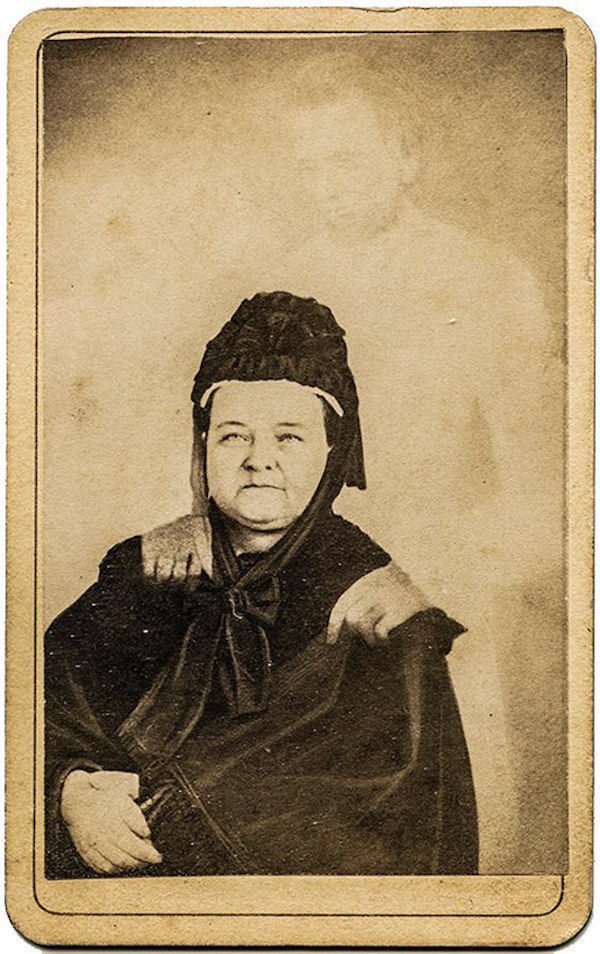
© William H. MumlerMary Todd Lincoln, circa 1870.
Nothing captured the fervid confusion of the new medium better than spirit photographs, in which the ghosts of the departed seem to float cheek by jowl with those who mourn them. In his new book, "The Apparitionists," Peter Manseau offers a sensitive, insightful history of the original spirit photographer, William Mumler, whose rise and fall in the late nineteenth century put him at the center of a debate about religion, fraud, and, of course, the material reality of our immortal souls.
Mumler worked as an engraver in Boston, but he dabbled in photography on the side. His first spirit photograph, developed in the early eighteen-sixties, came by surprise: in a self-portrait he'd taken, he discovered "a girl made of light," as Manseau puts it, and identified it as the spectral figure of his deceased cousin. Regarding the photo as a curio, he began to pass it around, garnering astonishment and acclaim from the city's thriving spiritualist community. Mumler had stumbled - unwittingly, he later argued - into a realm of séances and mesmerism, and its adherents ascribed to him the same gifts they saw in clairvoyants and mediums. Here was a man who'd breached the black curtain between worlds. They blared his name in such papers as the Banner of Light and the Herald of Progress.
As word spread, Mumler's hobby became a lucrative business, and soon he was taking spirit photographs from dusk till dawn, summoning lost loves beneath his skylight, and dispensing solace to a public addled by the rising death toll of the Civil War. His images retain their intimate, macabre tint even now. His subjects assume stately, almost catatonic poses - the process required them to sit still for a full minute - their expressions pensive and inscrutable, their arms stiff and expectant. As for the spirits, they have the denatured texture of blighted leaves. Translucent smudges against a sooty backdrop, they sometimes coalesce into personhood only under scrutiny, in the same way that faces emerge from clouds. Stare at enough of them in sequence and you'll fall into a loop of cognitive dissonance: they look so fake that they must be real, and then so real that they must be fake.
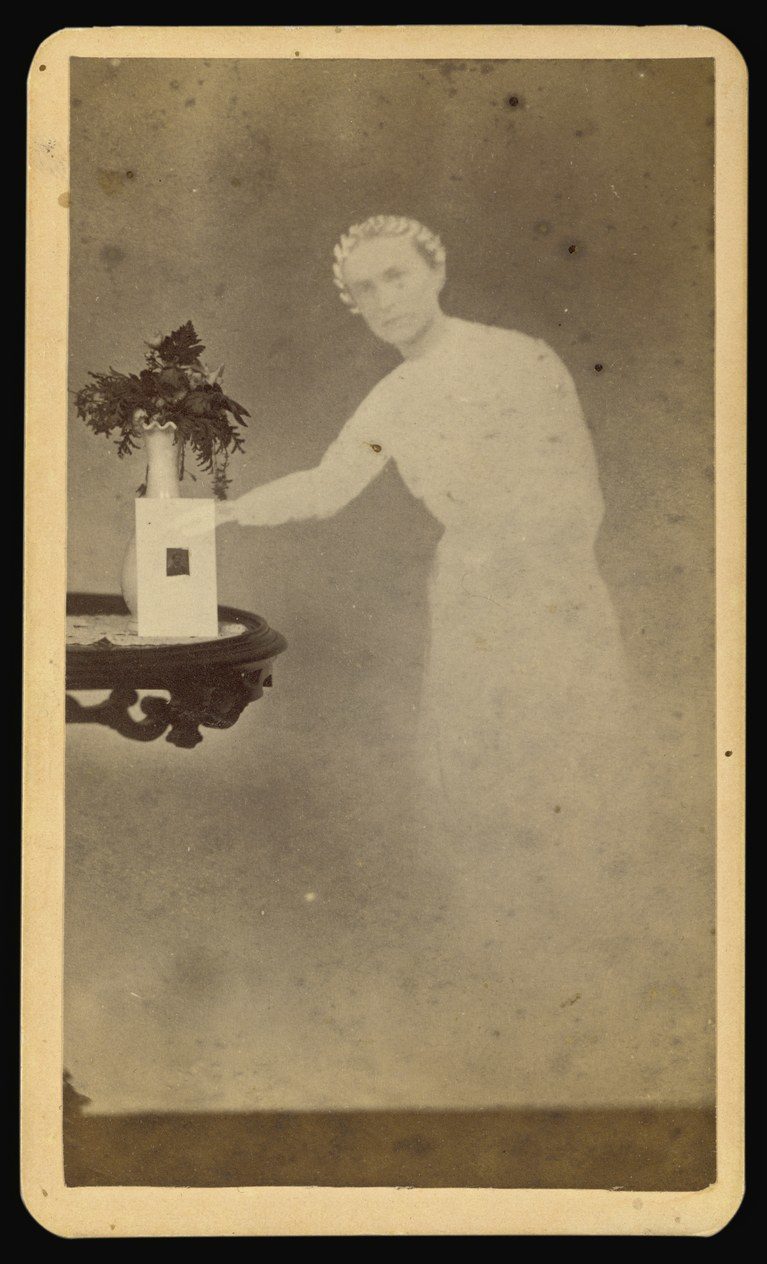
© William H. Mumler Courtesy of the Getty’s Open Content ProgramA “spirit” woman photographed by William Mumler in Boston.
A slew of investigators visited Mumler to verify his methods, and most were convinced that his results were legitimate. Success emboldened, albeit coarsened, him, and he expanded the operation to include a mail-order service: send a description of the spirit you hope to see, plus seven dollars and fifty cents, and you, too, could see ghosts "hold intercourse with mortals," as one spiritualist put it. Then a stray visitor to the studio identified one of the "spirits" as his wife - not a problem, on the face of it, except that his wife was still alive, and had posed at Mumler's gallery well in advance of his otherworldly turn.
The skeptics began to outnumber the believers, and Mumler, cowed by the loss of faith, eventually moved to New York, where he set up shop anew, in 1868. By the following year, he'd been formally accused of fraud and larceny and locked up in the Tombs. The ensuing trial made headlines around the world; more than a matter of guilt or innocence, it seemed a referendum on the spiritualist worldview, and Manseau offers a gripping account of the many witnesses who appeared to laud Mumler's powers or to deride him as a grifter. But, though it sowed the seeds of doubt, the prosecution could never prove how Mumler had perpetrated the hoax - and so he was exonerated.
Retreating to Boston, Mumler mostly retired from spirit photography in his final years, though he couldn't resist one high-profile client: Mary Todd Lincoln. Mumler's grim portrait of the widowed First Lady depicted an ethereal Abe resting two comforting hands on her shoulders. The picture, ersatz but powerful, exemplifies the "peace and comfort to the weary soul" that Mumler trumpeted as his hallmark. He saw himself as a purveyor of "the bright, effulgent rays of the spiritual sun." If his more credulous customers were too eager to bask in those rays, who can blame them? In the throes of grief, no one asks why the clouds are parting.




Comment: See also: