

The occasion for this atmosphere of impending confrontation was a panel discussion - "Identity Politics: The New Racialism on Campus?" - sponsored by the left-libertarian British political website Spiked. As part of its "Unsafe Spaces" American tour, Spiked has convened a series of panels at American colleges this fall to discuss questions of identity politics, free speech, and viewpoint diversity on campus.
If panels of writers and tweedy intellectuals don't strike terror into your heart, then you aren't an administrator at American University, the Washington, D.C. college scheduled to host the first event a week earlier. It disinvited Spiked at the last minute after a campus women's group claimed (with apparent seriousness) that the event on feminism and Title IX constituted hate speech and would incur "violence and trauma" on listeners. Evidently Rutgers has more spine.
As we waited in the auditorium for the speakers to arrive through a separate door, I looked around and saw that easily half the audience were protesters, identifiable by their t-shirts. Most were affiliated with Black Lives Matter or Rutgers One, a campus leftwing coalition, and they chattered excitedly as they hyped themselves up for the spectacle to come. Of course, the event was public: the whole point, after all, was to stir debate. But it soon became clear that the protesters had no intention of listening to, or participating in, a debate. They were there to shut it down.
Moderator Tom Slater introduced the panelists, who each delivered short opening statements. Kmele Foster, host of the libertarian podcast "The Fifth Column," opened the evening with a pitch for the importance of dialogue and the need to resist political "balkanization." In pre-emptive reference to the protesters, he added, "I suspect we agree far more than we disagree," and explained that he sought the same things they did - especially racial justice and an end to mass incarceration and police brutality - but that his own research led him to believe that many progressive claims on these subjects were inaccurate.
Second to speak was Bryan Stascavage, who first achieved notoriety when his 2015 Wesleyan Argus op-ed gently criticizing the tactics of Black Lives Matter resulted in the de-funding of the paper by the Wesleyan student union. Stascavage emphasized the importance of free speech in academia. "If Osama bin Laden himself taught a class I would be the first to sign up," he announced. Arguing that the recent preoccupation with hate speech is misguided, he asked the audience to raise their hand if they had ever heard hate speech, in person or online. Almost everyone raised their hand. "How many of you were persuaded by it?" he asked. No hands were raised. ("Charlottesville," someone muttered.)
Third was Pakistani-American feminist and religious skeptic Sarah Haider, the co-founder of Ex-Muslims of North America, a support group for former Muslims who face violence or ostracism for their decision to leave the faith. She discussed how her criticisms of Islamism on human rights grounds led her to be labeled a "hatemonger" by the very feminists and progressives she thought were natural allies. (The event's stringent security was partly for Haider's benefit; although she didn't mention it, her apostasy has earned her death threats.) She argued for a more sophisticated and mature discourse around sensitive topics: "Let's do what we can to awaken a sense of political courage."
Last was Columbia historian Mark Lilla, whose recent book The Once and Future Liberal expands on his contentious 2016 New York Times op-ed calling for an end to "identity liberalism." Lilla drew a distinction between himself and the other panelists. "I'm not so interested in free speech," he said. "I'm interested in winning." In his view as a self-described liberal, the Left's obsessive focus on identity politics has been a political disaster. The Left is losing, he said, and will continue to lose until it changes its tactics. He rattled off some dismal numbers (Republicans control both houses of Congress, the White House, 34 governorships, 32 state legislatures, and in 26 states control both the state legislatures and governorships; Democrats control six) and argued that a universalist, non-identitarian progressive liberalism could do far more to protect minority rights if it actually won elections and held power.
That each of the panelists was so measured and penetrating made what followed all the more embarrassing. The first disruption set the template. A student stood up, interrupting a man who had raised his hand to ask the panel a question, and announced, "Before we get to that we're gonna stop this little rhetoric here." He then berated the panelists with a rambling indictment of structural oppression until the moderator finally cut him off.
As if some signal had been given, the protesters, who had remained mostly quiet during the panelists' opening statements, began working overtime to hijack the evening. For the course of the 90-minute panel, they repeatedly interrupted the panelists (and other audience members) to deliver vociferous, open-ended monologues that went on for minutes; they drowned out the panel by chanting "Black lives matter" (a slogan completely unrelated to anything the panelists had just said); and they started screaming whenever someone said something with which they disagreed. Usually they kept screaming till they ran out of breath or coherence.
The panelists responded with grace and generosity. They not only tolerated the disruptors' obnoxious behavior, but gave the protesters numerous opportunities to speak. In fact, the panelists repeatedly made it clear that they agreed with many of the protestors' concerns. But that was beside the point. Most of the protestors clearly had no idea who the panelists were (they kept mispronouncing their names) or what the event was about; their rage was rooted in a vague sense that the panel's very existence was an injustice and they therefore had a mandate to shut it down and prevent its contagion from spreading.
Many of the disruptions took the form of impromptu, condescending lectures on intersectionality, a once obscure academic theory that has over time become the driving doctrine of identity politics for a significant part of the progressive and radical Left. Simply stated, intersectionality refers to the idea that people exist at the intersection of multiple identities, and some of those identities have suffered greater disadvantage than others. So, for example, a white woman is oppressed by virtue of being a woman; but a white gay woman is doubly oppressed, and a black or Latina lesbian is more oppressed than either. Intricate instructional diagrams (such as the "matrix of oppression" table and the illustration below) exist to guide initiates.
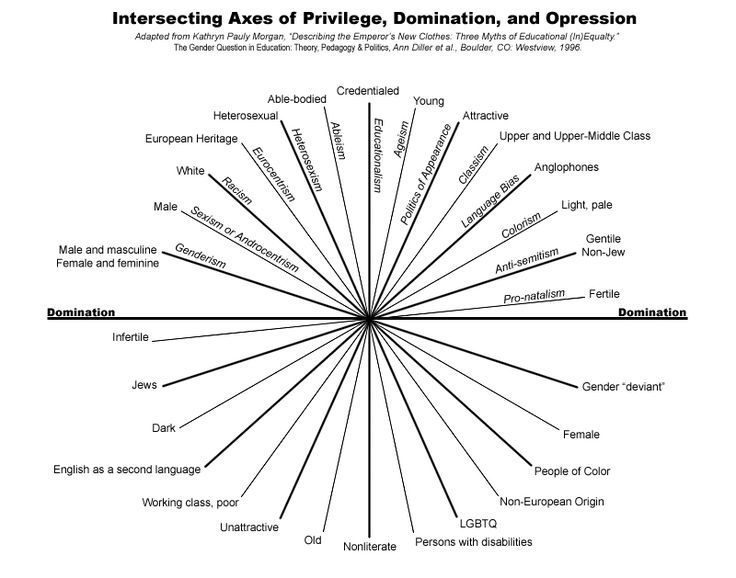
The intersectional worldview is obviously incompatible with the basic tenets of life in a liberal democracy. That doesn't bother intersectional activists, however, because they believe liberalism itself to be an elaborate sham that uses the illusory equality of procedural democracy - free and fair elections, courts, the rule of law, the Bill of Rights - to paper over vast social injustices. In the eyes of the intersectional Left, the very idea of universal rights is fatally flawed - or "problematic," to use a frequent, lazy phrase - because those rights can benefit the wrong people, such as white supremacists (in the case of free speech), or campus rapists (in the case of due process and the rights of the accused).
Comment:
There is a creepy authoritarian bent to all of this. For someone really steeped in the intersectional worldview, almost any tactic or behavior can be justified if it serves the purpose of fighting "oppression," the definition of which is elastic and gets a little more capacious every day. Because many intersectional activists believe that exposing people to harmful ideas can cause them emotional trauma, they view speech as a form of literal violence. For that reason, it is justifiable to shut down opposing voices before they even speak, a tactic called "no-platforming."
Were it not for the heavy presence of police and security guards, it is entirely possible that the protesters at Rutgers would have stormed the stage and physically prevented the panelists from speaking, as recently occurred at William & Mary. There, the protesters, who proudly live streamed their actions on Facebook, swarmed the stage during a scheduled talk by the director of the Virginia American Civil Liberties Union, surrounding her and chanting the unfortunate slogans "liberalism is white supremacy" and "the revolution will not uphold the constitution" until she left.
Since that wasn't an option, the Rutgers protesters settled for a shouting campaign with the dual goals of rattling the panelists and, more importantly, keeping the rest of us from hearing what they had to say. Tellingly, it was usually when a speaker was in the middle of making a compelling - and potentially damning - point that the protesters suddenly became most determined to drown him or her out.
The worst of the audience's animosity was directed at Kmele Foster, who is black. "How can you deracialize yourself?" one student demanded, before referencing the dismal racial disparities of the New Jersey penal system. Foster noted that even if every black and brown person were to be released from every prison in America, the country would still be the fifth or sixth most incarcerated in the world. "It seems odd to me for one to invest themselves in a concept" - race - "that they agree has been contrived and invented," he reflected at one point. He went on:
I suspect that most of the people here would not be particularly excited if [white nationalist] Richard Spencer was to walk into the room. And you might not really want him to come here and talk because were he to talk about race he would talk about the fact that it is a source of pride, that he believes it is a source of power, that he thinks his race is beautiful. The fact that one can make those claims about whiteness and one can immediately recognize just how retrograde and backwards it is to talk about race in that way, and that one can make the same claims about some other race and not recognize how retrograde those ideas are - what's retrograde is not the embrace of whiteness, it is the embrace of race.The protesters were particularly antagonized by Foster's contention that police violence against African-Americans has been statistically exaggerated. When he started explaining the methodological research behind his claim, the audience exploded. "Facts?! Facts?! Don't tell me about facts!" one person screamed. Foster tried to finish as five or six people shouted at him. "Do facts matter?" Foster asked, and repeated it several times in mounting frustration. "Do facts matter? Do facts-"
The resounding, devastating answer was no, facts do not matter. One of the things that struck me over and over was the protesters' complete intolerance of complexity. Despite intersectionality's roots in academic theory, the politics of the intersectional Left are deeply anti-intellectual. It's not just that many intersectional activists seem to have no capacity for nuance; they fear and hate it, because they hate anything with the potential to complicate their narrative. Things are right or wrong; you're with us or against us. Human beings, rather than complex agents with independent motivations and intellects, are nothing more than the sum total of their identities. Get on the bus or get under it.
As I listened to a middle-aged white woman (a faculty member) berate the panelists about structural oppression, and then a young male student, in a badly-conceived attempt to regain argument footing, launch into a disjointed rant about capitalism, I thought of the famous observation attributed to Reinhold Niebuhr: "Frantic orthodoxy is never rooted in faith but in doubt. It is when we are unsure that we are doubly sure."
I'm not the first to notice that intersectionality has less in common with an academic school or political movement than a religion. It is a fundamentalist religion, with no tolerance for ambiguity and, like any newly founded religion, it is insecure. People who disagree are blasphemers; people who change their minds are heretics; and the true believer cannot ever rest knowing that out there - somewhere, anywhere - are people who think differently. They must be converted, or destroyed. And, like a religion, intersectionality has its rituals and catechisms. As linguist John McWhorter put it in an incisive essay for The Daily Beast:
The call for people to soberly 'acknowledge' their White Privilege as a self-standing, totemic act is based on the same justification as acknowledging one's fundamental sinfulness is as a Christian. One is born marked by original sin; to be white is to be born with the stain of unearned privilege.Not by coincidence did a postwar generation of ex-communists, searching for a way to describe their catastrophic disillusionment, call communism "the God that failed." For many Left activists, intersectionality functions like the Marxist dialectic did for earlier radicals: not only as political prescription but as all-encompassing, all-explaining theory. Like Marxism in its more vulgar forms, intersectionality is highly deterministic, with no allowance for individual human agency; and, like Marxism, intersectionality takes a rather cynical view of society, which it believes is simply a giant web of power relations.
Instead of class consciousness, intersectionality takes racial and sexual/gender identity as its chief conceptual categories. (Social class is technically one of intersectionality's areas of concern but in six years around college campuses I can count on one hand the number of times I've heard an intersectional leftist raise that rather uncomfortable topic. To do so would require acknowledging the single, unspoken privilege that most campus activists have in common.) Instead of economic inequality, intersectionality's great, amorphous foe is "structural oppression"; instead of class struggle, intersectionality is concerned with battling "power differentials."
Like most theories that claim to explain everything, intersectionality quickly turns out to explain almost nothing. The presumption that a person's politics and worldview are determined by their race or gender or sexuality is both insulting and easily shown to be untrue, which is why leftist activists tend to react with confusion or hostility when they meet a black libertarian or a gay conservative or anyone who doesn't think of their racial or sexual affiliations as the defining aspect of their humanity. During a section devoted to questions from the floor, a man who introduced himself as Jason offered this:
Looking at the world and all social phenomena strictly through a racial prism engenders, I think, a certain kind of myopia. I'm a Puerto Rican guy from the Bronx raised in a single-parent household. But what does that mean? Should I think a certain way because of that? I don't. You know, people like 'diversity' - as a thing we all speak of, as a value. How many people care about idea diversity? How many protesters here have read Thomas Sowell or John McWhorter or Jason Riley - and read them openly, to receive? It's just something I wonder about. Why would you want to build an ideological prison around yourself? I've heard people say they can't disconnect from identity. I fear they wouldn't have it any other way.For perhaps the only time during the course of the evening, the room momentarily fell silent.
Intersectionality is a strange kind of essentialism that professes to hate essentialism. It assumes people are determined by inherited characteristics, which is exactly what racists also think. In an unsettling essay for Jacobin analyzing the similarities between leftist identity politics and the rhetoric of the far-Right, Shuja Haider notes that American white nationalists carefully study and mimic the vocabulary and tactics of the "social justice" Left. And by positing "white supremacy" as the original sin and the source of all problems in the world, intersectionality also props up the same narrative of white domination held by actual white supremacists. As Thomas Chatterton Williams put it in a recent New York Times piece: for white progressives,
...whiteness and wrongness have become interchangeable - the high ground is now accessible only by way of 'allyship,' which is to say silence and total repentance. The upside to this new white burden, of course, is that whichever way they may choose, those deemed white remain this nation's primary actors.If every messy and intractable problem in society can be blamed on abstract, single-causal phenomena - "white supremacy," "structural oppression," "patriarchal heterosexism" - there is no motivation to master the technical complexity of public policy, or build electorally viable political platforms, or to entertain alternative theories of - and potential solutions to - inequality. Still less to engage with those who disagree. Why bother, when the problem is simply that people need to change? "One can invent a narrative that makes the people who disagree with you the most despicable human beings on earth," Foster said at one point. "That doesn't make that narrative true."
In their attitudes toward their opponents, intersectional activists frequently sound suspiciously similar to the kind of "dehumanizing" and "invalidating" rhetoric they roundly condemn in other contexts. Of course, those who bear the brunt of intersectional rage are rarely white nationalists or anti-feminists or theocrats; they're more likely to be people such as the "untenured, gay, mixed-race" female Reed professor who, in a recent Washington Post op-ed, wrote of her shame in not having the courage to stand up to bullying student protesters.
Professors like me can't stay silent about this extremist moment on campuses https://t.co/8ua51idjGYThe whole teetering husk of what we used to call democratic civil society is built on the crucial premise that one can coexist with others with whom one disagrees, even people whose views one finds repugnant. But the protesters at Rutgers, like those at William & Mary and Reed and campuses across the country, made it clear that they can't. They view free speech, and rights in general, as a one-way street. They are entitled to voice their opinions at any and every moment, but people who hold what they've decided are the wrong views are entitled to no opinion at all. Ever.
- Sherrilyn Ifill (@Sifill_LDF) October 28, 2017
A number of people on the Left no longer seem to understand that rights like free speech are universal, and reciprocal, for a reason. Rights exist for them, too, and the day may come when they're the ones with their backs against a wall. But by then the liberal principles they hold in such contempt may no longer exist to protect them. Theirs is a reckless revolutionary logic of ends justifying means. It's a posture that is not only morally troubling, but also, as Mark Lilla pointed out, pathetically inadequate to the task of achieving power and governing in one of the world's largest, messiest, and most diverse republics. After yet another audience disruption he gave the evening's most acid rejoinder. "I'm old enough to remember the politics of the late '60s and early '70s, and I can tell you how this movie ends. It ends with you accomplishing nothing."
Actually, the intersectional Left will leave at least one enduring legacy: a generation of university-educated people - "progressive" yet deeply illiberal - whose attitudes toward free expression range from indifference to skepticism to hostility. In a particularly bizarre twist of history, students today regard free speech - once one of the defining causes of the American Left - as a "rightwing" doctrine, and therefore suspect. A woman in my college year explained it to me with chilling clarity: sometimes ensuring "truly fair speech" in "the so-called 'marketplace of ideas'" requires the "temporary dissuasion of opposing rhetoric." She is now a lawyer.


Comment: For an example of how the intersectional worldview can infect the law profession: Ontario Law Society's self importance results in compelled speech