RTTue, 08 Aug 2017 16:40 UTC
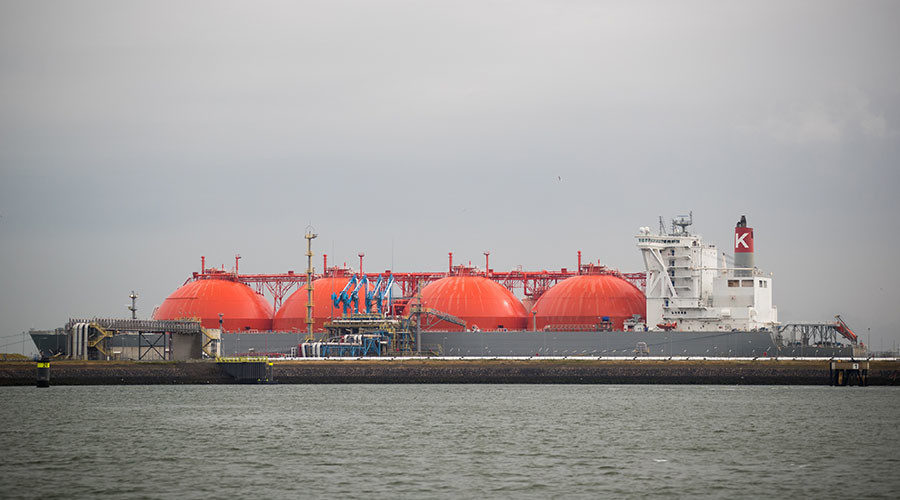
© Jasper Juinen / Bloomberg / Getty Images
The European Union should be more active in finding alternative gas supplies, as the United States will be actively pushing its liquefied natural gas (LNG) into Europe, according to the CEO of German energy major Uniper.
"The core reason (for the sanctions) are strategic economic interests, meaning the targeted dominance of the US in energy markets," Uniper CEO Klaus Schaefer said on Tuesday.Uniper is among five European energy companies who have invested in the extension of the Nord Stream pipeline from Russia to Germany. The other four are ENGIE, OMV, Shell, and Wintershall.
The Nord Stream-2 pipeline plans to double the delivery capacity of Russian natural gas to Germany from the current 55 billion cubic meters per year.
According to Schaefer, US shipments are 50 percent more expensive compared with European reference prices."Nobody wants to pay such a premium," he said.
Last week, US President Donald Trump signed sanctions targeting Russia's oil and gas sector. The new measure means Washington could now penalize European investors in Russian energy projects.
Senior officials in Germany have spoken against the sanctions and promised retaliation if European companies' interests are hurt.
Trump has been seeking American "energy dominance." In June, the first US tanker carrying LNG arrived in the Polish port of Swinoujscie.
As a group, the countries aim to diversify energy supplies, reducing their dependence on oil and gas provided by Russia.
Comment: More analysis from
The Duran:
In truth the new sanctions law serves multiple agendas. There is the wish of some people in the US to give the highly contested claim that Russia meddled in the US election the stamp of legal authority by imposing on the country and the President a law which insists it. There was the desire of some people to provoke Donald Trump into a head-on collision with Congress in a way that might have set the scene for his impeachment (discussed by me at length here). There was the desire of some people to protect the Maidan regime in Ukraine by blocking the building of Russian gas pipelines that bypass Ukraine. There is the widespread wish in the US - extending far back into the Cold War - to limit economic contacts between the US's European allies and Russia as much as possible. Above all there is the overarching desire of the overwhelming majority of the US political class - including above all its intelligence and media communities - to maintain the confrontation with Russia, and to block President Trump's attempt to end it.
Last but not least, there are undoubtedly the tough minded commercial calculations of some people in the US - including some US businessmen - who are looking to leverage this quarrel to gain commercial advantages for the US and themselves by forcing the Europeans to buy expensive American liquefied gas instead of cheap Russian pipeline gas.
It is the last which is provoking the greatest anger in Germany and Europe.
Pipeline gas from Russia is inherently cheaper than liquefied gas from the US because of the geographic proximity between Russia and Europe and the simple and cheap way it is transported.
Replacing Russian pipeline gas by US liquefied gas by contrast would require a stupendous investment in new storage facilities and in building the large numbers of specialized and expensive ships needed to transport it.
Whilst the resources to do this exist in Europe and the US, doing so would come at a fearsome cost, and would be a gross misallocation of resources making no economic or commercial sense. Moreover even after the storage facilities and the ships were built, the liquefied gas transported to Europe from the US would still be significantly more expensive than the pipeline gas Russia would offer.
Meanwhile the US and China - Europe's biggest industrial competitors - would have the competitive benefit of cheaper gas, in the case of the US from its own production - though there are doubts as to how sustainable that is - and in the case of China - far more sustainably - in the form of cheap pipeline gas from Russia transported via the pipelines which are being built now.
What makes this episode even weirder is that the one other country which might conceivably have sufficient pipeline gas to replace Russian pipeline gas in the European energy market cheaply and effectively - though this is doubted by many - is Iran.
It is precisely because some European officials see Iran as a major source of energy for Europe that the Europeans have lobbied so hard for the sanctions on Iran to be lifted. One of the strongest European advocates of the EU forging energy links with Iran is Frederica Mogherini, the EU's High Representative for Foreign Affairs and Security Policy, who has just visited Iran to attend President Rouhani's inauguration, where she received an enthusiastic reception from some Iranian parliamentarians.
The US is however as adamantly hostile to Iran as it is to Russia. Indeed the US military and the Republican Party appear if anything to be even more hostile to Iran than to Russia. The US therefore opposes energy projects linking Europe to Iran if anything even more fervidly than it opposes energy projects linking Europe to Russia. One reason why the EU's ill-starred Nabucco pipeline project failed was precisely because as a result of US opposition and UN sanctions it was prevented from drawing gas from Iran.
Faced by this US hostility to any energy arrangement that makes for Europe economic or commercial sense, it is not surprising if some European business people like Klaus Schaefer, and some European governments like notably the Austrian government, are now showing signs of growing anger and exasperation.
I would add that gas is not the only example of the US leveraging its geopolitical dominance in order to gain commercial advantages for itself and for certain US businessmen at the expense of its European allies. My cynical and no doubt controversial view is that the ongoing attack on the German car industry and the criticism of its diesel engine technology is simply another case of the same thing.
Suffice to say that I do not think it is any coincidence that the whole emissions scandal that suddenly targeted the German car industry came at precisely the same time when certain people in the US were investing heavily in electric car technology and were receiving huge subsidies from the US government to do so. The fact that electric car technology still looks to me immature - and therefore expensive and inefficient - is of course neither here nor there, and is being drowned out by the blizzard of orchestrated publicity which invariably accompanies such moves.
It is however the issue of gas which possibly enrages the business community in Germany the most, to the point where it is now reflected in the increasingly angry words coming from German and EU officials. The insouciant way in which the US Congress disregarded European economic interests - with some members of Congress openly bragging about the fact - has unsurprisingly caused particular offense, and seems for some people in Europe to have come close to being the crossing of a red line. There is now even talk in some parts of Europe that the new US sanctions law might harden European opposition to the existing EU sanctions, and might lead to them being lifted more quickly.
The Russians doubt that will happen, and so do I. Atlanticist voices within the European elite are still strong and in my opinion are still dominant. Already some of them - alarmed by the opposition in Europe to the new US sanctions law - are calling on Europe to drop its opposition to the new sanctions law and to submit to it.
The fact however remains that the European business elite has now been given an object lesson in the cost the subservience of Europe's political leaders to US demands is causing them. The Russians are already driving the point home, with Russian officials apparently already saying both openly and in private that it was Europe that brought this calamity on itself by agreeing in 2014 to the US demand for sanctions.
It will be interesting to see for how much longer the European business community is prepared to put up with it.



Comment: More analysis from The Duran: