
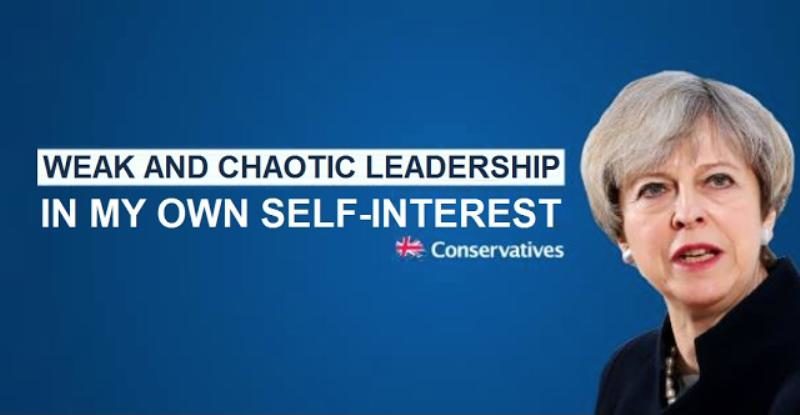
Even the possibility of a Tory-DUP deal has raised tensions and fears in Northern Ireland, with experts asserting that the collaboration between the two parties puts the 'Good Friday Agreement' at serious risk, threatening the fragile peace process.
In spite of this, the Tories persist in pursuing such a deal for their own narrow gain,
They have attempted to justify this tactic by claiming it's 'for the good of the country' and that Britain would be destabilised, with no clear path of transition to a Labour government when the parliamentary arithmetic means Labour could not achieve - without the very unlikely and problematic support of the DUP - a Commons majority.
This is a lie.
In the run-up to the 2015 election, which all the pollsters and pundits incorrectly expected to result in a 'hung Parliament', an expert in constitutional law looked at the legal precedent and convention surrounding the possibility that then-incumbent PM David Cameron would fail to get his Queen's Speech through a Commons vote.
And he not only concluded that the leader of the next-largest party would automatically become Prime Minister, but pointed out no fewer than four occasions within the last century when exactly that happened.
In a 2015 article on the law site Head of Legal, Carl Gardiner looked in detail at constitutional law, how it applied in those four examples and how it would apply to a hung Parliament in 2015. For the detailed legal analysis, read the full article - but his examples and key conclusions are:
1924: then-leader Ramsay MacDonald was immediately invited by the king to form a minority Labour government when the Tories - the largest single party - could not pass its King's Speech. MacDonald did not have to seek a coalition or demonstrate a functional majority
1929: MacDonald was again invited to be PM, even though Labour had won only 287 of the then-615 parliamentary seats, after Tory PM Baldwin resigned upon being unable to command a Commons majority. Again, MacDonald did not have to demonstrate a functioning majority
1974: Harold Wilson was invited by the queen to form a government after Edward Heath's attempts to agree a coalition with the Liberals failed. He immediately formed a minority government in spite of stating firmly that he would not seek nor enter any coalition
2010: Then-PM Gordon Brown resigned immediately it became clear that he could not command a Commons majority, even though David Cameron had not yet agreed a coalition with the LibDems' Nick Clegg. The coalition gave Cameron a functioning majority - but before the deal with the LibDems was finalised, he was summoned to the Palace 'as a matter of course'.
He concludes his discussion of the course of events:
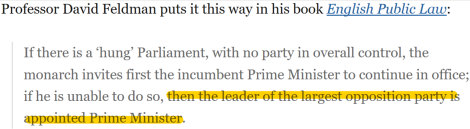
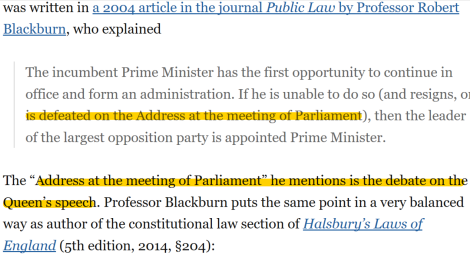
If she cannot get her Queen's Speech through Parliament at the first attempt - constitutional law makes Jeremy Corbyn the Prime Minister by default, without the need for him to do the same.

Reader Comments
to our Newsletter