© Stanislav Filippov / AFP
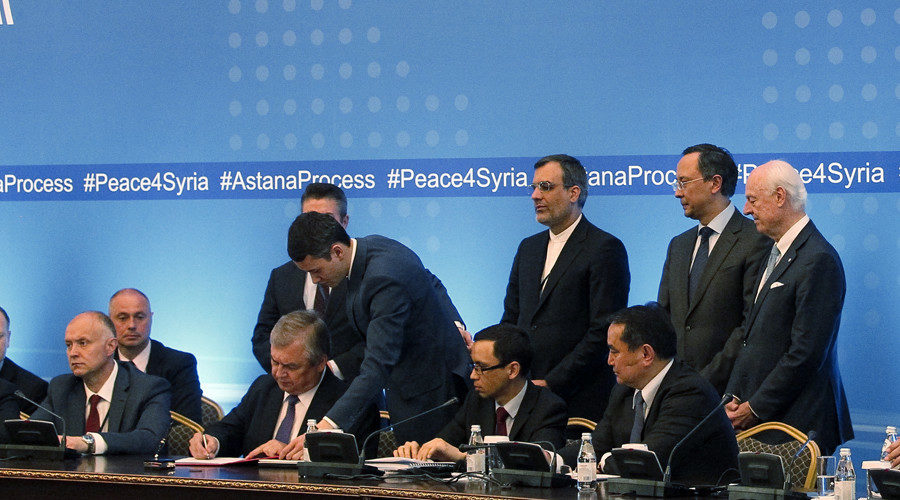
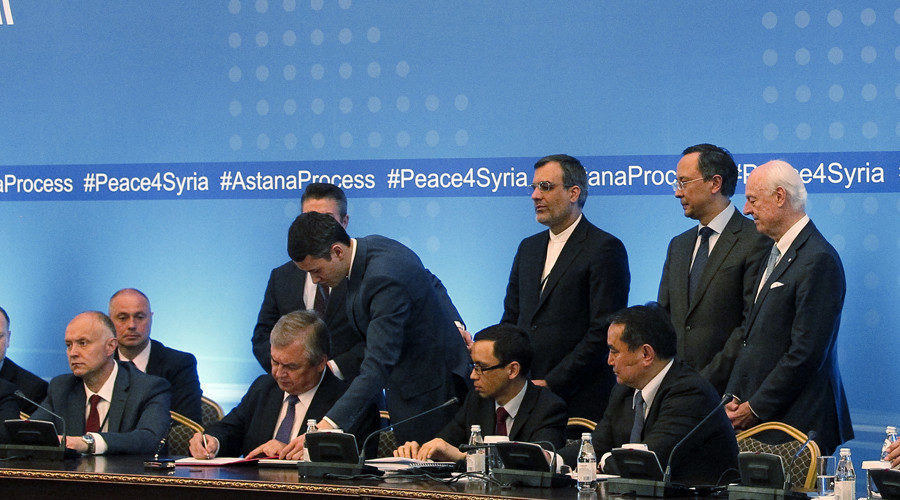
Ceasefire guarantor states Russia, Iran and Turkey have adopted a memorandum on the creation of four security zones in Syria, during peace talks in the Kazakh capital of Astana.
The de-escalation zones were earlier proposed by Russia. They are aimed at separating extremist groups, including Islamic State terrorists (IS, formerly ISIS/ISIL) and Jabhat al-Nusra (Al-Nusra Front), from the moderate opposition.
Idlib, Latakia and Homs are included in the safe zones, as well as parts of Aleppo, according to the Turkish Foreign Ministry. Under the memorandum, any fighting between government forces and armed opposition will cease within the safe zones.
"Guarantors within five days after signing the memorandum will create a working group at the level of authorized representatives to determine the boundaries of disarmament, areas of tension and security areas, as well as to address technical issues related to the implementation of the memorandum," the text reads.
The preparation of the necessary maps of the "areas of tension and de-escalation areas" will be complete by May 22.
Russian chief negotiator Aleksandr Lavrentyev stated that Russia is ready to send its observers to the established zones and work more closely with the US and Saudi Arabia on Syria. He also said that a working group on an exchange of captives could be settled by the evening.
However, he lamented the US poor participation in establishing better cooperation.
"Unfortunately, the Americans are still ignoring our attempts to establish closer military cooperation, but we will keep trying," the Russian chief negotiator said.
The Syrian armed opposition delegation stated it could not accept the memorandum, saying the creation of de-escalation zones would threaten Syria's territorial integrity. It also stated it will not sign anything while Iran remains among the guarantor states.
"We are against the division of Syria. As for the agreements, we are not a party to that agreement and of course we will never be in favor [of it] as long as Iran is called a guarantor state," opposition delegate Osama Abu Zaid said.
Some representatives of the Syrian armed opposition walked out of the meeting, according to media reports.
"We don't accept Iran's participation as a guarantor state," one opposition delegation member reportedly shouted during a speech by Kazakhstan's foreign minister at the signing ceremony.
Most members of the delegation reportedly remained in the room, however.
Iran says it is a massive step toward the de-escalation of the long-standing conflict and bloodshed in Syria.
"We support any initiative aimed at de-escalation of the conflict in Syria, prevention of bloodshed, destruction, leading to the fleeing of the Syrian people from their native territory. We support any step aimed at a ceasefire," an Iranian Foreign Ministry official told RIA Novosti.
The UN special envoy on Syria, Staffan de Mistura, welcomed the deal, calling it "an important, promising, positive step in the right direction in the process of de-escalation of the conflict."
The next round of Syrian peace talks will be hosted by Astana in mid-July, with expert meetings scheduled to be held two weeks beforehand, according to Kazakh Foreign Minister Kairat Abdrakhmanov.
"Given the new round of Geneva talks, which is to be held in late May and emphasizing the essential role of the Astana meetings in supplementing and assisting the Geneva process, we call on all members of the international community to contribute to this process and to find a lasting solution to the Syrian conflict," the minister stated.
Safe Zones Memorandum May 'Lead to Fundamental Changes' in Syria - TehranThe memorandum on four de-escalation zones in Syria may lead to crucial changes in the country given its successful implementation, Iranian Deputy Foreign Minister Hossein Jaber Ansari said Thursday.
"The document signed by the representatives of the ceasefire guarantor states, if properly implemented, could lead to fundamental changes in Syria," Ansari told reporters.
The deputy minister added that the memorandum should be implemented one month after signing.
"One month after signing of agreement it should be implemented," Ansari told reporters, asked when the memorandum would be implemented.
Ansari noted that a number of other documents were still on the table, namely, on detainees and demining of Palmyra.
"Of course there is still a number of other documents on the table, like on detainees release and demining of Palmyra.... They have been discussed, but not finalized," Ansari said.
De-Escalation Zones in Syria Deprive Warring Sides of Airstrikes, Other ArmsThe warring parties in the Syrian conflict will not be able to use any weapons in the zones of de-escalation in Syria, as well as will not be able to conduct airstrikes, the memorandum signed by ceasefire guarantor states in Astana reads.
"Within the borders of de-escalation zones military actions between the warring sides (the Syrian government and the formations of the armed opposition that have already joined or will join the ceasefire regime) stop, including the use of any weapons, including airstrikes," the guarantor states' memorandum signed in Astana reads.
Comment: More analysis from Alexander Mercouris at
The Duran:
Whilst the form and purpose of the proposed 'de-escalation zones' is still unclear, the reason for Russia proposing them is not. They give every impression of being a Russian response to President Trump's revived talk since the alleged Khan Sheikhoun chemical attack of 'safe havens'.
The difference between 'safe havens' and 'de-escalation zones' is that 'safe havens' are supposed to be set up by the US and Turkey unilaterally, whilst 'de-escalation zones' are supposed to be agreed by the Syrian government as part of the ceasefire talks underway in Astana. Moreover the Russians would have a role in monitoring and perhaps administering the 'de-escalation zones, whilst they would have no such role in guarding the 'safe havens'. Setting up the 'safe havens' would amount to a US-Turkish invasion of Syria, which would dramatically worsen the crisis there. "De-escalation zones', in theory at least, would not.
...
Ever since the Russian-Turkish ceasefire was agreed fighting has continued in Syria largely unabated, with the Turkish backed Jihadi groups which supposedly signed up to the ceasefire regularly joining Al-Qaeda in attacks against the Syrian army. Some of these groups were for example involved in the recent offensives in northern Hama and in Damascus.
These same Jihadi groups have also repeatedly staged walk outs from the Astana talks, and they have just done so again.
Given this record there has to be a serious possibility that if 'de-escalation zones' are ever set up these same Jihadi groups will try to take them over and convert them into base areas from which to attack the Syrian army. That after all is precisely what they intended that the 'safe havens' would be. Needless to say in trying to do this the Jihadis would have the support of the US and the Turks, who would then have a pretext to come to the defense of the Jihadis in the 'de-escalation zones' if the Syrian army sought to attack them there.
The Russians and the Syrians will of course do everything they can to prevent this situation from arising. However it is easy to see how setting up 'de-escalation zones' could go horribly wrong, and - more to the point - how, precisely because the Jihadi groups might try to convert the 'de-escalation zones' into base areas whilst the Russians and the Syrians would try to prevent them from doing so, the whole process of setting up the 'de-escalation zones' might become bogged down in furious argument.
...
From the Russian point of view the priority in Syria at the moment must be to prevent the various parties - the Syrians, the Turks, the US and the Kurds - from getting drawn into an all-out war with each other. Donald Trump's recent re-floating of the idea of 'safe havens' has however seriously increased that possibility. Proposing 'de-escalation zones' might be the Russians' way of getting Trump off the hook - which may be why he has apparently welcomed this proposal so enthusiastically - whilst giving the parties a topic they can talk about and argue over instead of fight each other. Meanwhile the Syrian army would be left alone to carry on the fight against Al-Qaeda and ISIS unhindered.
UPDATE: The US State Department has
commented on the agreement reached in Astana, saying it welcomes the decision, though with some reservations (namely, Iran):
"The United States supports any effort that can genuinely de-escalate the violence in Syria, ensure unhindered humanitarian access, focus energies on the defeat of ISIS and other terrorists, and create the conditions for a credible political resolution of the conflict," Department Spokesperson Heather Nauert said in a statement.
"We appreciate the efforts of Turkey and the Russian Federation to pursue this agreement and have encouraged the Syrian opposition to participate actively in the discussions despite the difficult conditions on the ground." Nauert said that Washington expects Russia to ensure the Syrian government's "compliance" in the agreement.
The statement also called upon Syrian opposition groups to live up to their side of the agreement and separate the moderate factions from extremist militants, including Hay'at Tahrir al-Sham, an alliance of jihadist groups including the al-Qaeda affiliate the al-Nusra Front.
"We look forward to continuing our dialogue with the Russian Federation on efforts to that can responsibly end the Syria conflict," the statement said. However, the United States, which did not take part in the de-escalation talks directly, had some reservations about the presence of Iran, its long term rival, as one of the guarantor parties. "Iran's activities in Syria have only contributed to the violence, not stopped it," Nauert claimed.
Sputnik has some
details on the actual text of the agreement:
"Guarantor states agreed to create de-escalation zones in Idlib province and parts of the neighboring provinces (Latakia, Hama and Aleppo), certain parts in the north of Homs province, Eastern Ghouta, certain parts in Syria's south (Daraa and Quneitra provinces)."
"Within the borders of de-escalation zones military actions between the warring sides (the Syrian government and the formations of the armed opposition that have already joined or will join the ceasefire regime) stop, including the use of any weapons, including airstrikes."
"Along the borders of the de-escalation zones, it is envisaged to create safe areas to prevent incidents and direct clashes between the warring parties."
"The Guarantors shall take steps to complete by 4 June 2017 the preparation of the maps of the de-escalation areas and security zones."
Russian delegation head at Astana talks and Special Presidential Representative for Syria Alexander Lavrentyev adds:
"Russia is ready to take part in sending its observers to the so-called safe zones to take part in monitoring of the adherence to the cessation of hostilities, registering positive violations, but we as guarantor states agreed that participation of other countries is also possible but only on the basis of consensus [of the guarantors]," he told reporters.
Lavrentyev added that all the hostilities in the mentioned areas would cease by May 6.
"We agreed that the de-escalation zones will be established for a period of six months with the option of automatic extension for another six months unless there will not be some circumstances and the guarantor states will take the other decision. The memorandum can be indefinite if needed," he told reporters.
Update (May 5): A glorious bit of news:
Russian envoy says US-led coalition warplanes banned from Syria safe zonesThe agreement is set to go into effect later today, at 21:00 GMT:
Speaking to journalists on Friday, Deputy Defense Minister Aleksandr Fomin said the deal brings hope for a more comprehensive cessation of hostilities in Syria. "It was supported by all principal players, including the UN, the US administration, Saudi Arabia and other nations, so there is a certain degree of guarantee that the memorandum will be implemented," he said. "It is coming into force tomorrow, or rather at midnight Moscow time, on May 6."
The memorandum designates four areas in Syria as safe zones, where armed groups opposing the Syrian government and not supporting a jihadist agenda would be protected from attacks. They are expected not to allow terrorist groups use them as safe havens.
...
Fomin said the implementation of the deal may allow the war in Syria to finally stop. He added that the memorandum has provisions for including more territories into the safe zones.
The official said Defense Minister Sergey Shoigu has contacted his counterparts in several nations to ensure that the safe zones deal works. "The Russian minister has held working sessions with defense ministers of Iran, Turkey, Syria and Israel," he said, adding that respective intelligence services and foreign ministries have been contributing to the de-escalation effort as well.
He added that contacts with the leaders of armed opposition groups helped convince them to support the de-escalation. "The position of the United States, which welcomed the steps towards reducing the level of violence in Syria, improving the humanitarian situation and creating the environment for resolving the conflict, has played a positive role," Fomin noted.
He added that Russian warplanes have not been targeting the territories now designated as safe zones since the beginning of the month, which helped pave the way for the signing of the memorandum.
Chief of the Russian General Staff's Main Operational Directorate Col. Gen. Sergei Rudskoi said that the Russian Aerospace Forces haven't launched any airstrikes within the four de-escalation zones
since May 1. From now on, the focus will be on ISIS:
"The main efforts will be aimed at developing an offensive east of Palmyra and the subsequent de-blocking of the city of Deir ez-Zor, which has been under siege for more than three years, as well as the liberation of the north-eastern territories in the Aleppo province along the Euphrates River," he said at a news briefing.
According to Rudskoi, the establishment of de-escalation zones will allow Damascus to free up a significant number of forces to be redeployed in the fight against the Islamic State organization (outlawed in Russia).
"The Russian Aerospace Forces will continue to support the Syrian armed forces in effort to destroy Daesh terrorists," Rudskoi added.
Syria de-escalation memorandum was coordinated with 27 field commanders of the armed groups, operating in the four de-escalation zones. Some 42,000 militants are located in those zones for now.
Deputy Chief of the General Staff's Main Operational Directorate Lt. Gen. Stanislav Gadzhimagomedov clarified some of the terms of the de-escalation zones today, specifically in regard to possible
violations:
"First of all, a thorough investigation will be conducted, followed by a decision about measures against violators, which does not exclude the possibility of suppression fire," Gadzhimagomedov said at a news briefing, answering the question about what measures are envisaged for the violators of the memorandum.



Comment: More analysis from Alexander Mercouris at The Duran: UPDATE: The US State Department has commented on the agreement reached in Astana, saying it welcomes the decision, though with some reservations (namely, Iran): Sputnik has some details on the actual text of the agreement: Russian delegation head at Astana talks and Special Presidential Representative for Syria Alexander Lavrentyev adds: Update (May 5): A glorious bit of news: Russian envoy says US-led coalition warplanes banned from Syria safe zones
The agreement is set to go into effect later today, at 21:00 GMT: Chief of the Russian General Staff's Main Operational Directorate Col. Gen. Sergei Rudskoi said that the Russian Aerospace Forces haven't launched any airstrikes within the four de-escalation zones since May 1. From now on, the focus will be on ISIS: Deputy Chief of the General Staff's Main Operational Directorate Lt. Gen. Stanislav Gadzhimagomedov clarified some of the terms of the de-escalation zones today, specifically in regard to possible violations: