
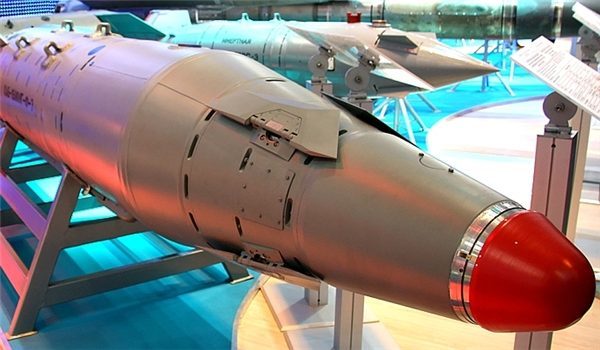
The Arabic service of the Russian state news agency, Sputnik, reported that the country has armed its Su-34 Fullback fighters with high precision KAB-1500L laser-guided bombs for missions in Syria.
The highly sophisticated bombs are likely used for destroying underground tunnels and command bases of the terrorists, specially in Northern Hama province.
Previously the heaviest bombs Russians used in Syria were KAB-500.
The KAB-1500L - KAB-1500LG-F-E is the current production standard - is a 1,500 kg (3,000 pounds), laser-guided bomb 4.4 to 4.63 m in length and designed to hit stationary ground and surface targets when used by the latest generation of Russian-made fighters and bombers. It is the Russian counterpart to United States Paveway II/III laser-guided bombs. Once released, the pilot or a third party must aim at the target with a laser designator in order to successfully direct the KAB bomb. The KAB-1500LG-F-E features an impact fuze with three delay modes.
Russia's family of KAB-1500, KAB-500 and KAB-250 smart bombs are an equivalent to the US Paveway II/III, GBU-8/15, and GBU-31/32 JDAM families of guided bombs. Sharing common design modules with unique seeker designs, and a range of standard warhead types, this family of weapons encompasses all of the baseline capabilities in their US equivalents.
The KAB (Korrektiruyeskaya Aviatsionnaya Bomba) family of weapons were developed during the 1970s by Moscow based GNPP Region, now part of Tactical Missiles Corporation, and it is likely that warstocks of the Paveway, Walleye and HOBOS captured in South Vietnam during 1975 played an important role in the design process. The basic configuration of the 500 kg weapons is common to the GBU-8 HOBOS TV guided bomb family using tail controls and fixed canards, less the GBU-8's lift enhancing strakes. The 1,500 kg weapon is closer to a hybrid of the Paveway II and HOBOS configuration, with steerable canards and spring deployed cruciform tail.
A number of different seeker/guidance packages are available for these weapons, which can be supplied with a wide range of compatible warheads. In this fashion the optimal configuration for specific roles and missions can be chosen. Russian sources report, in additiona to daylight television, semi-active laser homing and satellite inertial guidance packages, also a millimetric band active radar seeker and thermal imaging (IIR) seeker in development.
The Su-27/30 Flanker and Su-34 Fullback are cleared to lift up to 6 KAB-500s or 3 KAB-1500s on wing stations 3 and 4, inlet stations 9 and 10, and centreline tandem stations 1 and 2. The KAB-500 is carried on a BD-3U adaptor, the KAB-1500 on a BD4 adaptor. The APK-9E Tekon datalink pod, used for some variants, is carried on inlet station 9, as is the Thales Damocles pod.
Russian industry manufactures a number of laser designators such as the Klyon PM/PS, Kaira 24M, I-25 Shkval, or a targeting pod such as the Sapsan-E. Recently the French Thales Damocles pod was licenced, with the laser exciter configured with Russian seeker coding.



Comment: Lots of technical specs there, but what it comes down to is that the Russians are implementing some high-tech weaponry to defeat an enemy who entrenches itself among civilian populations. Quite different from Senator "bomb, bomb, bomb Iran" McCain's claim that Russia is 'barrel bombing' Syria.