
© REUTERS/ U.S. Navy/Handout
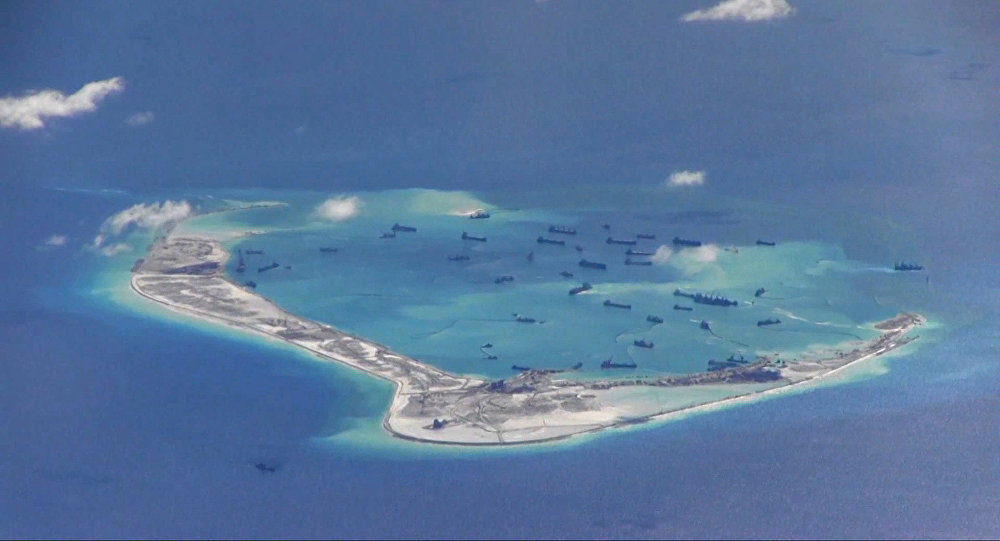
Before assuming office, Tillerson told the Senate Foreign Relations Committee in January that China's island-building program in the South China Sea should be stopped.
"We're going to have to send China a clear signal that, first, the island-building stops. And second, your access to those islands also is not going to be allowed," he told the senators.
Beijing responded to Tillerson's remark, saying that its actions were legal and within the framework of its territorial sovereignty.
"This will not happen because this can never happen. This is what I think and feel," Denisov told the Russian daily Kommersant, asking the question whether the US could impose a blockade in the South China Sea and whether this could result in a conflict.
"Seriously speaking, I can only suggest that [US President] Donald Trump and his entourage are advocates of the business approach to foreign policy - first intimidating [the opponent] and then discussing real options from a position of strength," the diplomat pointed out.'According to Denisov, currently there is no visible deterioration between Washington and Beijing and bilateral contacts are now "reviving."
He added that US-Chinese contacts are conducted particularly in a "business manner and friendly."
"They have both phone and direct conversations. Yang Jiechi [one of the most prominent architect of China's foreign policy] recently visited Washington and had numerous meetings there. Some experts suggest that the first meeting between Trump and [Chinese President] Xi Jinping is already in preparation," Denisov said.China and some other regional players, including Japan, Vietnam and the Philippines, have differences over the maritime borders and areas of responsibility in South China Sea and East China Sea.
Beijing says that the Philippines and Vietnam deliberately use Washington's support to escalate tensions in the region. In July 2016, the Hague's Permanent Court of Arbitration ruled that China has no rights for territorial claims in the South China Sea. According to the ruling, the disputed Spratly Islets are not an exceptional economic zone. China has not recognized the ruling.



Reader Comments
to our Newsletter