
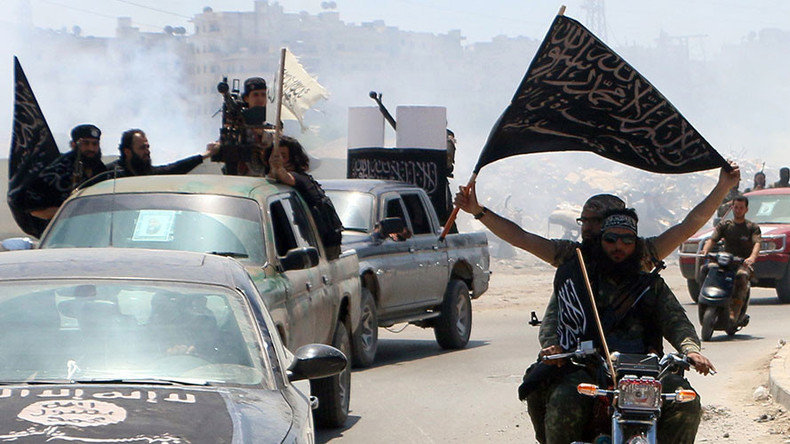
© Fadi al-Halabi / AMC / AFP
To get a sense of how disturbing, or at least unusual, this coverage is, imagine if the 2013 murder of British soldier Lee Rigby by two Islamists had led to headlines like 'This is for Afghanistan' or 'Remember Basra' (those two knifemen, like Karlov's killer, justified their action as a response to militarism overseas). Or if the 7/7 bombings had not given rise to front pages saying 'Terror bombs explode across London' or 'BASTARDS' but rather 'While you kill us in Iraq, we will kill you here'.
Reading the early coverage of Karlov's killing, and noting how different it is to British press coverage of other acts of Islamist terror, one gets the impression that the media think this killing is justified, or at least understandable. 'Remember Aleppo': they're saying this as much as the killer is — a perverse union of terrorist and editorial intent.
But the killer said, first, 'Allahu Akbar'. Which perhaps suggests that his sympathy was not with Syria as such but with certain forces in Syria. Forces likely to shout 'Allahu Akbar' as they kill people. Islamist forces. Something peculiar has happened in British media and political circles in recent weeks. Having spent years telling us al-Qaeda-style groups are the greatest threat to our way of life, these people have lately become spectacularly uncritical about, and even weirdly supportive of, the existence and influence of al-Qaeda-style groups in Syria.
The press coverage of Karlov's killing is in keeping with the superbly reductive, highly moralised media coverage of events in Aleppo over the past fortnight, in which there are apparently only two sides: defenceless civilians and evil Russia and Assad. The militants in Aleppo, which include some grotesquely illiberal and misanthropic groups, have been airbrushed out of the coverage as surely as some reporters airbrushed away, or at least demoted to paragraph six, the Turkish assassin's cry of 'Allahu Akbar'.
The Western media coverage of Syria counts as some of the most biased, uncritical war reporting of recent times. A vastly complex war, referred to by one journalist in August as 'the world's most complicated cat's cradle', has in recent weeks been reduced to a simplistic, binary morality play, a clash of innocence and evil. The British media coverage of Aleppo in particular has focused heavily, and at times entirely, on the horrendous plight of civilians. Footage shows us civilians cowering in their homes, dashing through the streets to avoid Russian bombs, gathering in hospitals for news of loved ones.
What's missing is striking: images of the gunmen, an estimated 10,000 of them, huge numbers of whom are al-Nusra, who had made Eastern Aleppo one of their harsh, unforgiving strongholds. These militants would muddy the simplistic narrative of a Russian-led genocide against Syrian civilians, and so they're simply redacted from what we see on the TV news: an act of omission that borders on censorship.
Comment: What's also missing from the mainstream coverage is any indication that the people of Aleppo are thankful for its liberation, which counters the narrative that the Syrian Arab Army is "committing attrocities" against the city's inhabitants. See:
The end result is coverage that elevates emotionalism over analysis, feeling over fact, making readers weep over helping readers understand. And coverage which, in the process, ends up doing Islamists' bidding. In the words of Patrick Cockburn of the Independent, Western news organisations are 'being spoon-fed by Syrian jihadists and their sympathisers who make it impossible for independent observers to visit areas they control'. Given that it's too dangerous for Western journalists to go to Eastern Aleppo, the media have become reliant on anti-Assad and anti-Russia activists to provide them with information and heartrending footage. But of course, these activists are only permitted to do and say certain things, given they live in areas controlled by 'some of the most violent and merciless movements on Earth', in Cockburn's words. The consequence? 'There's more propaganda than news coming out of Aleppo', as Cockburn says.


Comment: See also: