
© REUTERS/ Azad Lashkari
In an interview with Sputnik, Major Chris Hunter, a former British Army's senior counter-terrorism expert, pointed to higher echelons of power in "some neighboring countries," including Turkey, which he said managed to benefit from Daesh's production of arms in Iraq's Mosul.
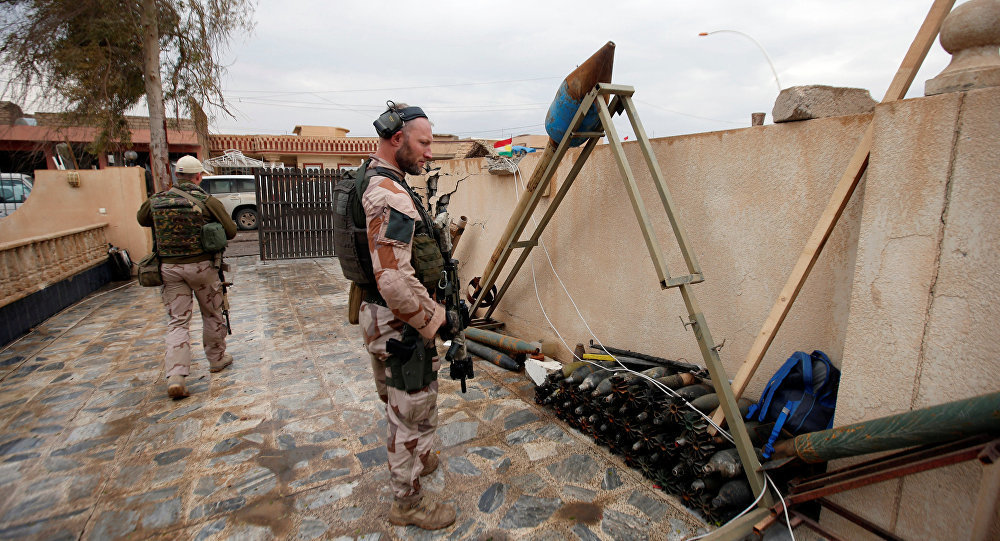
The interview came after the publication of a report by the Conflict Armament Research monitoring group (CAR), which said that Daesh had been producing weapons on a mass scale in the Iraqi city of Mosul. Moreover, the sophistication of its arms manufacturing matched national military forces.
The document also said that the terrorists had standardized production and had a robust supply chain of raw material from Turkey.
According to the report, "the degree of organization, quality control, and inventory management indicates a complex, centrally controlled industrial production system."
The latter included a monitoring system with regular, detailed reports on production rates and quality that helped ensure standardization — usually to the tenth of a millimeter.
Speaking to Sputnik, Chris Hunter said that fifty commercial entities from twenty countries were involved in a global supply chain as far as Daesh's arms production is concerned.
Describing Daesh as a sophisticated and "very wealthy" terrorist organization, Hunter said that higher echelons of power profited from Daesh smuggling arms through the territories of a spate of Middle Eastern countries, including Turkey.
"In particular, there were smuggling routes from the borders of Turkey, Syria, Lebanon and other countries," he said, adding that "we also talk about benefits in the highest levels in some neighboring countries."
In this vein, it is safe to say that Daesh's arms manufacturing business is worth "potentially billions of dollars," according to Hunter.
CAR investigators estimated that Daesh had produced tens of thousands of rockets and mortar rounds in the months leading up to the Mosul offensive.
The Iraqi army launched an operation backed by Kurdish fighters and US-led coalition air support on October 17 to retake Mosul, Daesh's last major stronghold in the country.



more info and it's not that simple. Even well designed, licensed military rifles for example will jam, malfunction and need proper maintenance and training in using. A copy, of a copy of a copy of a weapon by a bunch of undisciplined nitwits can do as much damage, as a snowball thrown at house's glass window : Minimal.