
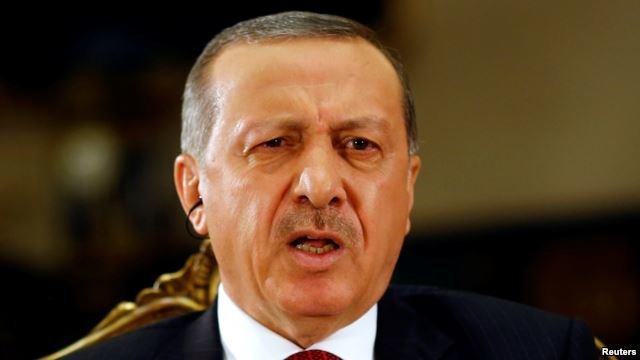
© Reuters
Speaking on July 22, Cavusoglu said Turkey was ready to take part in a commission on the extradition of the exiled founder of a transnational social and religious movement, Fethullah Gulen.
Turkey's President Recep Tayyip Erdogan has accused the 75-year-old Gulen of masterminding the July 15 coup plot.
Gulen has condemned the coup attempt and denied any involvement -- suggesting instead that it may have been staged by Erdogan as an excuse to crack down on Turkey's opposition and expand the Turkish president's powers.
Ankara has said it will request Gulen's extradition from the United States but has not yet done so, although authorities say they have sent evidence against Gulen to Washington.
U.S. Secretary of State John Kerry has said Washington would consider an extradition request, but that there would have to be compelling evidence of Gulen's guilt before he would be extradited.
About 60,000 of Gulen's suspected followers in Turkey have already been targeted since the attempted coup collapsed early on July 16, including senior military officers, soldiers, police, judges, civil servants, college deans, and teachers who have been detained, suspended, or placed under investigation.
More than 10,000 -- mostly soldiers or military officers -- have been arrested and charged or detained.
Another 50,000 people - including about 3,000 members of the judiciary -- have been suspended from their jobs or face an investigation.
European Union foreign policy chief Federica Mogherini has expressed concern over the mass punishments. She has urged Turkey to respect human rights and the rule of law.
The EU also has expressed concern about suggestions that Ankara could suspend parts of the European Convention on Human Rights in order to impose the death penalty against coup plotters.
Turkey's Justice Minister Bekir Bozdag responded to the EU criticism on July 22 by saying there have been "armed Gulenist forces" within Turkey's army, universities, media, and judiciary.
Bozdag also said the possible use of the death penalty against coup plotters should be considered "from a legal point of view, not on the basis of an EU opinion."
Meanwhile, Erdogan said Gulen's followers in Turkey would be treated as "another separatist terrorist organization" -- a step that puts the movement on par with Turkey's outlawed Kurdistan Workers Party (PKK).
"We will do everything necessary to have the highest rate of success...[and do] whatever the law allows or admits," Erdogan said. "They are traitors."
Speaking to Reuters on July 21 after declaring a three-month state of emergency, Erdogan also said Turkey's armed forces will be quickly restructured and have "fresh blood."
He said a meeting of Turkey's Supreme Military Council scheduled for August 1 may be brought forward to as soon as July 25 in order to oversee the restructuring of the armed forces.
The council -- the top governmental body overseeing Turkey's military -- is headed by Prime Minister Binali Yildirim and includes Defense Minister Fikri Isik and Chief of the General Staff General Hulusi Akar.
The state of emergency gives Erdogan and his cabinet special powers to rule by decree.
It allows the government to take speedy measures against coup supporters and to bypass parliament in order to enact new laws or to suspend rights and freedoms as the government sees necessary.
Deputy Prime Minister Numan Kurtulmus said the special emergency powers could last only 45 days, adding that Ankara wants "to end the state of emergency as soon as possible."
But Erdogan has said there was nothing to prevent the state of emergency from being extended beyond the initial three months, if necessary.
"This state of emergency is not a curfew," Erdogan told Reuters. "People will still be on the street minding their own business and getting on with daily life."

Reader Comments
to our Newsletter