
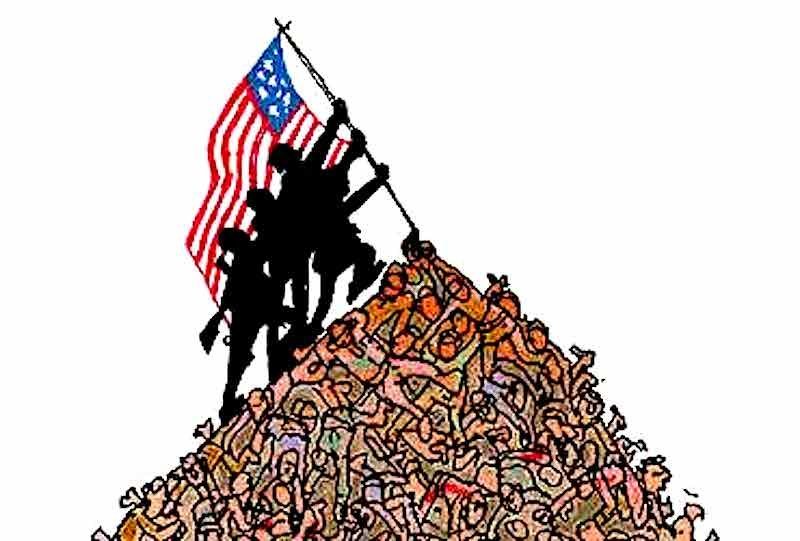
© www.globalresearch.comUS conviction and morality, piled high and deep.
The document is alleged to have expressed frustration with America's inability to halt a civil war in Syria that has killed around half a million people and contributed to a worldwide refugee crisis. The New York Times and the Wall Street Journal both quoted from the document on Thursday, saying they had seen or obtained copies. A section of the document cited by the Times said that American policy has been "overwhelmed by the unrelenting violence in Syria," while calling for a "judicious use of stand-off and air weapons, which would undergird and drive a more focused and hard-nosed US-led diplomatic process."
The Wall Street Journal report said that the document repeatedly called for "targeted air strikes" against the Syrian government in light of the collapse of the ceasefire brokered earlier this year. The memo was filed in the department's "dissent channel," which was created during the Vietnam War as a way for employees who had disagreements with State Department policy to register their protest with the secretary of state.
State Department spokesman John Kirby said the department was reviewing the cable. "We do not know, nor are we particularly interested" how the contents of the message ended up public, Kirby told reporters Friday. "People can react to it as they wish," Kirby said, adding that Secretary of State John Kerry would continue pursuing the current policy of ending the Syrian civil war through a political transition.
Comment: In other words, someone surfaced this memo in order for the government to be comparatively perceived as taking the "high road," while introducing this more radical idea...a likely policy ploy to gain future leverage and momentum for more aggressive action from legislators and the public. Currently, prolonging the war with coercive diplomacy is in the US' empirical interest, as is feeding the MIC. Either way, win-win.
Kerry, who is visiting Denmark, commented that the internal memo from American diplomats is an "important statement" he will be discussing upon returning to Washington. "It's an important statement and I respect the process, very, very much. I will ... have a chance to meet with people when I get back," Kerry told Reuters in Copenhagen.
Secretary Kerry has hinted at the possibility of the US undertaking a more robust intervention in Syria more than once. While President Obama has openly called for regime change in Syria, current US policy and military funding is directed towards a campaign to defeat Islamic State (IS, formerly ISIS/ISIL).
While the US and other Western and Middle Eastern countries continue to support anti-government groups fighting Syrian President Bashar Assad's forces, an open intervention was prevented in 2013 in the wake of chemical attacks in Syria thanks to Russia's diplomatic efforts and Damascus' willingness to cooperate and destroy all of its chemical arms.
While the American public remains opposed to involvement in another Middle Eastern war, Washington has backed rebel groups in Syria and continued to insist that President Assad must leave power, blaming him for the rise of IS.
Comment: Blaming Assad, of all people, for the rise of IS? Delusional. Demented. Uninformed. Unfortunately, sheeple will eventually believe anything, including State Department personnel.
Several US military commanders have expressed concern about a lack of a clear alternative to Assad who could unify the country and advance US national security interests, however, and Moscow has repeatedly stressed that removing Assad and effectively letting Islamist groups take control would send the country into chaos.


Comment: Kerry's 'diplomatic efforts' (according to plan?) have all but collapsed. If he truly was invested in a solution, a compromise, an ending to this war...he would have vigorously done so and met Russia more than halfway. It seems Kerry is holding out for the backlash of official and public opinion in order to create a circumstance enabling a more aggressive and expanded attack on the Assad government, provoking Russia in the process.
The memo concludes: "It is time that the United States, guided by our strategic interests and moral convictions, lead a global effort to put an end to this conflict once and for all." Unfortunately the moral convictions part has become entangled with and subservient to supporting strategic interests...with much more emphasis on 'conviction' than 'morality.'