
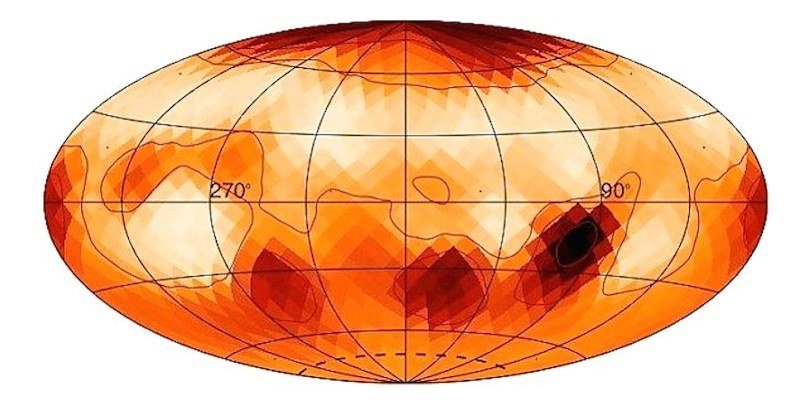
© Roettenbacher et al.A distant star has been seen to spin so fast that its magnetic field erupts from its poles rather than around its equator (marked in dark red). This fast spin is an expected feature of binary stars, but its strange magnetic field has not been seen before on such a star as Zeta Andromeda.
On our sun, sunspots form where the magnetic field is much stronger than normal, around its centre. They never appear at the poles, and only appear between around 40° north and 40° south latitudes.
Mapping Distant Star SystemsZeta Andromeda is a binary star in the constellation Andromeda, and lies about 180 light-years away. It is 16 times more massive than our own sun, and spins at 40 km per second - 20 times faster than the sun.
Zeta Andromeda is 180 light-years away, meaning it is smaller than a pixel on a telescope sensor. How then do astronomers map the position of sunspots on the star?
The Doppler method allows them to observe how the wavelengths of light emitted as the star rotates are squeezed and stretched, like the way an ambulance siren changes note as it passes. By making Doppler observations simultaneously with several telescopes, far more detail can be revealed than with even the largest single instrument.
Recent advances in telescope technology mean this interferometry technique, pioneered by radio astronomers, can now be applied to visible and near-infrared light observations.
The astronomers used the Chara array at Mount Wilson, which consists of six one-metre telescopes and is the world's highest angular resolution telescope at these wavelengths.
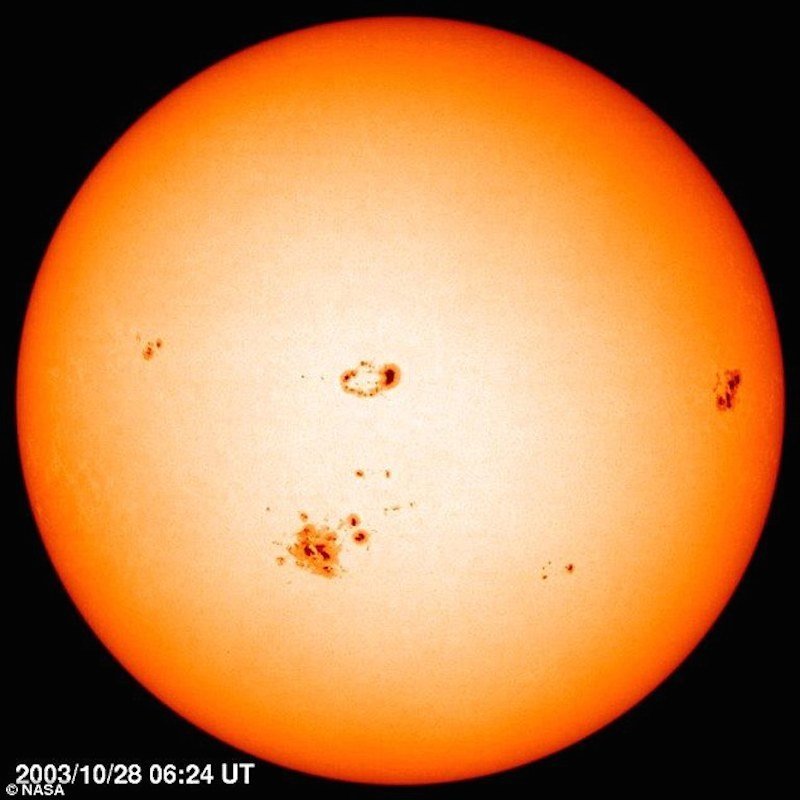
© NASAOn our sun, sunspots (pictured) form where the magnetic field is much stronger than normal, around its centre. They never appear at the poles, and only appear between around 40° north and 40° south latitudes.
The position of these spots shows that the star is powered by completely different internal dynamics, the scientists report in the journal Nature.
'This asymmetry of sunspots indicates that the star's magnetic field is formed in a different way than happens in the sun,' explained astrophysicist Professor Heidi Korhonen of the Bohr Institute's Dark Cosmology Centre in Copenhagen.
'We see dark sunspots on the northern pole, while at lower latitudes the sunspots do not last, but appear and disappear again with an asymmetrical distribution. This was surprising.'
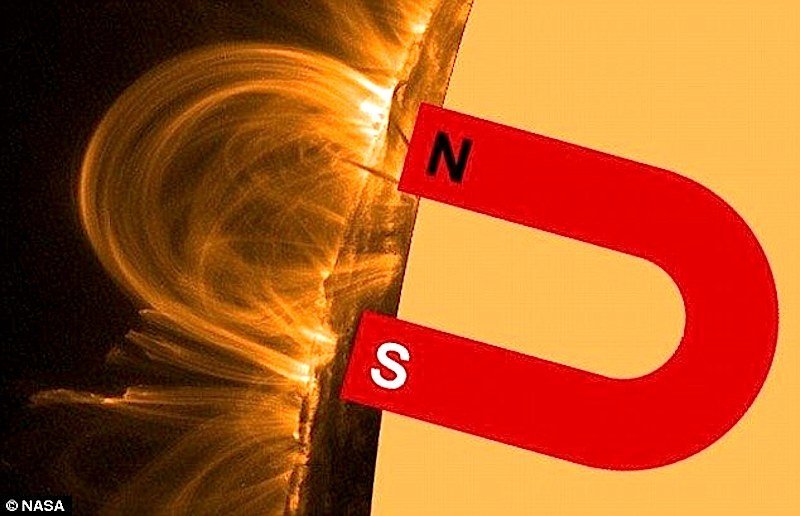
© NASABy tracking the star, researchers found a huge sunspot on its north pole, and others near its south. The orientation of the star means its south pole can't be seen directly from Earth. The position of these spots shows the star is powered by completely different internal dynamics.
Sunspots are relatively cool areas created where magnetic field lines erupt from a star's surface. On our sun they occur in pairs where the field line leave and re-enter the star, and are always close to the sun's equator. They indicate where solar storms are erupting, which are the source of the streams of particles that create the northern and southern auroras, as well as damaging satellites and power networks.



Reader Comments
to our Newsletter