
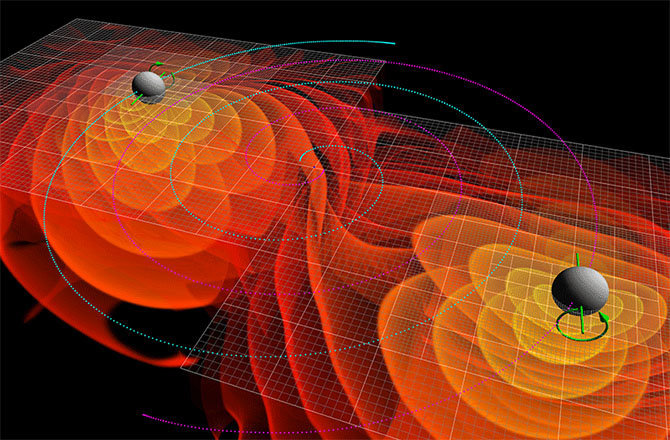
© NASAThis simulation shows computer modeling of two black holes in orbit before spiraling in to merge.
The observation, which was announced on Feb. 11 to global fanfare, not only confirmed one of the last predictions of Einstein's 100-year-old theory of general relativity, it also showed us that black holes, of around 30 solar masses, exist and may be more common than current theories predict. This detection is also the first tantalizing view of a type of astronomy that will, in the future, change the way we see the universe. Gravitational wave astronomy is a paradigm shift away from the electromagnetic spectrum; we can now see invisible energetic events that produce gravitational waves, but may not produce any electromagnetic hint.
Today, however, NASA announced that its space-based gamma-ray observatory detected a faint signal in the rough vicinity of the predicted gravitational wave source, providing a breathtaking insight to this particular black hole merger.
NASA's Fermi Gamma-ray Space Telescope detected the very weak and brief burst of high-energy X-rays, consistent with a short gamma-ray burst (or GRB), less than half a second after LIGO registered GW150914. This is surprising — it was assumed that when black holes collide, they do so "cleanly," according to a NASA news release, not producing any kind of electromagnetic trace. So are the two signals related to the same event? The timing makes it highly likely; there's only a 0.2 percent chance that they occurred in the same patch of sky at the same time but belonged to two different high-energy phenomena.
"This is a tantalizing discovery with a low chance of being a false alarm, but before we can start rewriting the textbooks we'll need to see more bursts associated with gravitational waves from black hole mergers," said Valerie Connaughton, member of the Gamma-ray Burst Monitor (GBM) team at the National Space, Science and Technology Center in Huntsville, Ala.
The majority of GRBs are believed to be created when massive stars implode after running out of fuel and then explode, forming black holes in their wake. These are known as "long GRBs." The intense radiation — detected as a flash of gamma-rays and high-energy X-rays — originates from dying stars' poles at the time of explosion. There is, however, a more mysterious type of GRB that is short period (less than 2 seconds) and possibly linked with black hole and neutron star mergers.
Now that astronomers have access to the gravitational wave spectrum, perhaps the true nature of "short GRBs" can be tracked down.
"With just one joint event, gamma rays and gravitational waves together will tell us exactly what causes a short GRB," said Lindy Blackburn, a postdoctoral fellow at the Harvard-Smithsonian Center for Astrophysics in Cambridge, Mass., and a member of the LIGO Scientific Collaboration. "There is an incredible synergy between the two observations, with gamma rays revealing details about the source's energetics and local environment and gravitational waves providing a unique probe of the dynamics leading up to the event."
The gravitational wave signal was generated by the rapid spiraling and collision of two black holes, an event that created the now-famous black hole "chirp." But if indeed this Fermi detection is also of the same event, astrophysicists will have to figure out how this is possible. Black hole mergers aren't supposed to generate significant quantities of energy in the electromagnetic spectrum unless there's a quantity of gas close to the merging region. But it is thought that the vast majority of any gases surrounding the black hole binary would have disappeared long ago.
In short, this faint GRB signal has come as a surprise and physicists have to work out whether we're not fully understanding the dynamics of black hole mergers or that we're seeing some new physics that have so far remained hidden.
Whatever the cause, this is just the beginning of an exciting era for astronomy; gravitational waves will allow us to probe some of the most extreme events in the universe, no doubt answering many questions but also revealing many new cosmic mysteries.
Source: NASA



Reader Comments
to our Newsletter