
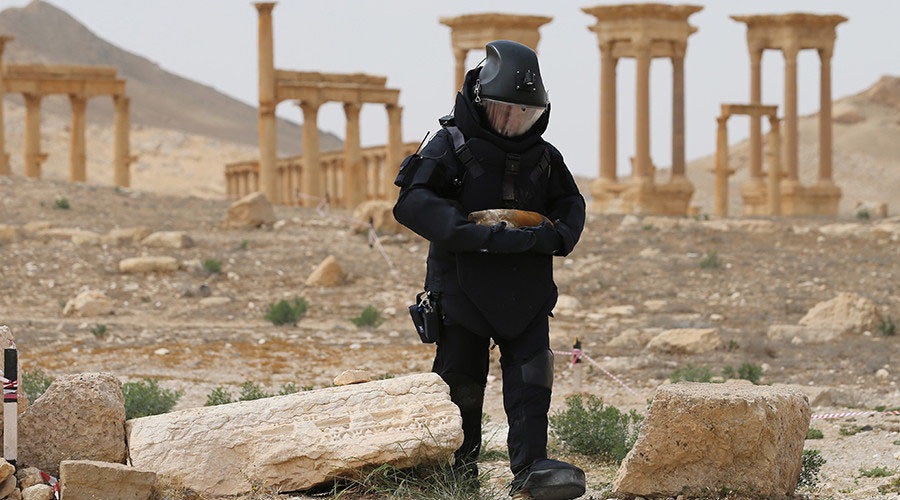
© Ministry of Defence of the Russian Federation
"Beginning April 1, over 30 kilometers of roads and more than 182 hectares of land have been demined; 2,987 explosive objects have been unearthed," Russian Defense Minister Sergey Shoigu said at a teleconference at the National Defense Control Center.
Palmyra booby-trap: ISIS had 3,000 bombs rigged, ready to level entire city with one clickhttps://t.co/bhbCPmfS78 pic.twitter.com/t4U9LkZrMJ
— RT (@RT_com) April 1, 2016
Russian sappers clear ISIS mines in #Palmyra, as locals return (PHOTOS) https://t.co/TcQmIvK9w0 pic.twitter.com/EGNhZQUtZb
— RT (@RT_com) April 10, 2016
Russia's mine-clearing Uran-6 robots to help get rid of hidden explosives in Palmyra (VIDEO) https://t.co/NhNeLxI1jf pic.twitter.com/TR2xXNr2hH
— RT (@RT_com) March 31, 2016
"It's fitted out with the most advanced medical equipment to operate autonomously for 30 days. If necessary, both the Syrian military and local citizens returning back home can address to that medical installation," Shoigu said.
Syrian forces supported by the Russian Air Force ousted IS terrorists from Palmyra on March 27, an achievement not only considered a strategic win, but also a symbolic victory.
The city had been under IS control for more than 10 months, during which the terrorists destroyed a number of unique ancient monuments, including the Arch of Triumph and the iconic 2,000-year-old Bel Temple. The City of Palms has been left partly devastated and ridden with explosive devices.



Comment: Bravo to Russia. They may have scaled back their air campaign, but they are making sure the job of neutralizing the aftermath of the terrorists' occupation is complete.