

During a recent deep-sea dive in the Hawaiian Archipelago, a remotely operated vehicle came across an unknown creature.
Unlike most cephalopods, the little octopus found by the NOAA Deep Discoverer lacks pigment, making it ghostlike and mysterious, and every bit adorable.
At more than 4,000 meters below the surface, this is the deepest observation ever published of this type of cephalopod, and researchers say its cartoonish appearance has social media users pushing to name it 'Casper.'
The discovery was made during the first operational dive of Okeanos Explorer's 2016 season on February 27.
Researchers planned to collect geological samples from the Necker Ridge in order to determine its possible connection with Necker Island (Mokumanamana).
But, during its mission, the remotely operated vehicle called Deep Discoverer found something extraordinary - a small octopus sitting on a rock.
This one, however, appeared to be low in muscle and lacks the pigment cells called chromatophores, which most cephalopods have.
And, its suckers are arranged in one series on each arm, as opposed to two.
The NOAA says the ghostly octopus is 'almost certainly an undescribed species and may not belong to any described genus.'
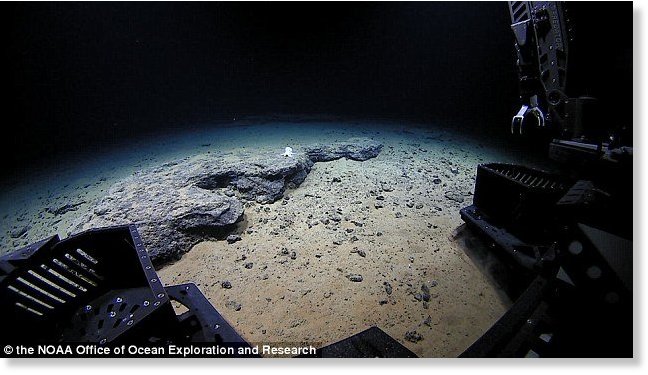
The remotely operated vehicle called Deep Discoverer found something extraordinary – a small octopus sitting on a rock, pictured above.
Cirrate octopods are finned, also known as 'dumbo' octopods.
They have fins on the sides of their bodies, and cirri associated with the suckers on their arms, NOAA explains.
While cirrate octopods have been reported even deeper than this find, even upwards of 5,000 meters, this is the deepest published report of an incirrate.
All others are recorded at depths less than 4,000 meters.
Michael Vecchione of NOAA writes that he's since contacted other researchers to weigh in on the find, including Louise Allcock who is currently stationed on a British ship near Antarctica, and Uwe Piatkowski, of Germany.
The team is now considering taking the observation a step further, and combining it with others observations from the eastern Pacific into a manuscript for publication.
But, the researchers all agreed that 'Casper' the adorable ghost was certainly an unusual find.



The only person who got their mind blown looking at this thing just sitting there? Was it transparent?