
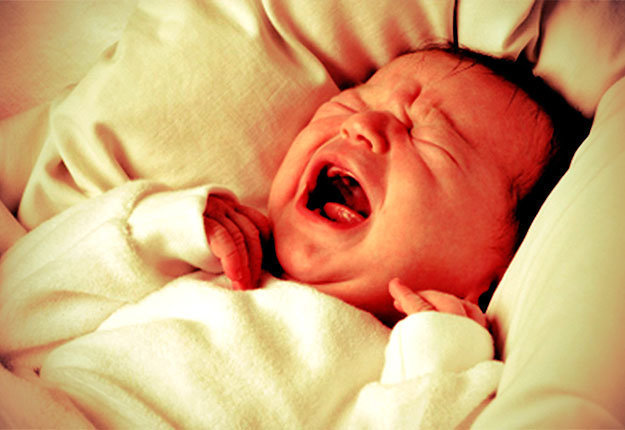
© UnknownHighly contagious and potentially deadly infection takes hold in Queensland, Australia.
It can cause mild respiratory or gastrointestinal symptoms in babies but in newborn infants, can lead to serious complications such as hepatitis or encephalitis, and can be fatal.
Infectious diseases expert Dr Theo Sloots said the very young were in the "danger period" to contract parechovirus, which is highly contagious.
The virus broke out in Brisbane in September and Dr Sloots has since tracked it spreading through infants on the Gold Coast, Toowoomba and, last month, in Townsville, Mackay and Bundaberg.
"It's an important issue," he said. "When children get sick they go to the GP who doesn't recognise it as parechovirus. They just think it's an infection. Awareness needs to be raised among GPs."
"It's in the kids under three months that it causes severe disease and in a considerable number of those, it involves the central nervous system and they go into intensive care," Dr Sloots said.
The virus spreads person to person through respiratory droplets or faeces.
Symptoms of parechovirus via Better Health
Parechovirus can cause no symptoms at all, but newborn children or young infants with parechovirus may develop:
- a high temperature (fever)
- irritability, lethargy or off food
- a rash
- fast breathing
- diarrhoea or loose stools.
A more severe blood infection (sepsis) can occasionally occur where babies can become unwell very quickly. This requires management in hospital to monitor your child closely. Rarely, the virus can affect the lining of the brain, leading to more severe symptoms such as seizures or muscle jerks.
Comment: Sounds like an adverse reaction to vaccines, something that should be ruled out. See also:
Treatment for parechovirus
There is no specific treatment for parechovirus. Fever in children under six months of age needs review by a doctor. If diarrhoea is present, offer the child plenty of fluids.
If there are any worrying symptoms or you remain concerned about anything, consult your doctor immediately.
Prevention of parechovirus
There is no vaccine available against parechovirus.
Good personal hygiene is essential to prevent the spread of parechovirus to others, both for those infected and their carers.
Treatment for parechovirus
There is no specific treatment for parechovirus. Fever in children under six months of age needs review by a doctor. If diarrhoea is present, offer the child plenty of fluids.
If there are any worrying symptoms or you remain concerned about anything, consult your doctor immediately.
Prevention of parechovirus
There is no vaccine available against parechovirus.
Good personal hygiene is essential to prevent the spread of parechovirus to others, both for those infected and their carers.


Reader Comments
[Link]
"Human parechoviruses (HPeV) were first identified in 1956 and were previously known as echoviruses 22 and 23. They are part of the larger parechovirus genus of viruses. Some HPeV strains are associated with more severe infections such as encephalitis and flaccid paralysis. "
"Anyone can get infected with parechovirus. Young babies appear to be at risk of more severe disease.
How is it prevented?
There is no vaccine to protect you from parechovirus infection.
Good hygiene is the best protection: wash hands with soap and water after going to the toilet, before eating, after wiping noses, and after changing nappies or soiled clothing"
Most likely the media is reporting this to scare people into 'demanding' a vaccine be produced, ignoring the fact that the 'science' behind vaccines isn't very robust where as the economics behind them has been a driving force. Also encouraging them to avoid taking responsibility for their own health and immune protection, giving that, instead, to 'authorities'.
Perhaps it's even to spread fear and hysteria in order to better 'control' the human herd properly. And most likely to vector people away from questioning vaccines and discourage them from this particular web site.
[Link]