
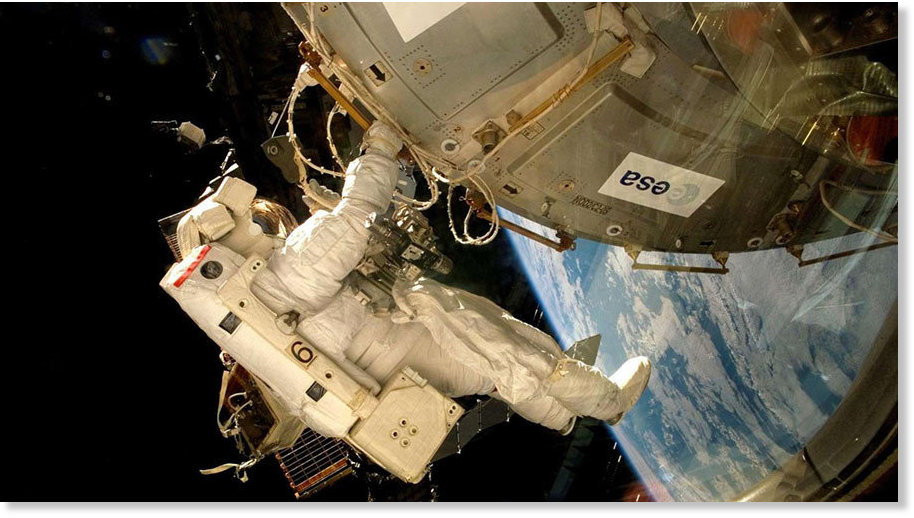
© European Space AgencyAn astronaut fixes the EXPOSE-E platform onto the International Space Station. ESA
The tiny fungi, Cryomyces antarcticus and Cryomyces minteri, are two cryptoendolithic organisms found in extreme conditions on Earth. They are able to survive in the cracks of rocks by feeding on traces of minerals. Members of the ISS Lichens and Fungi Experiment (LIFE) team collected samples in the McMurdo Dry Valleys, a snow-free desert in Antarctica that suffers from high winds and low temperatures, making it arguably the least hospitable place on the planet.
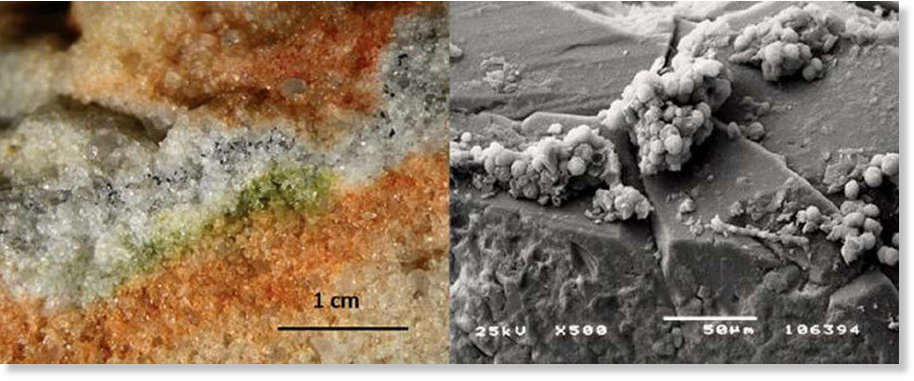
© S. Onofri et al. Section of rock colonized by cryptoendolithic microorganisms and the Cryomyces fungi in quartz crystals under an electron microscope.
Eighteen months later, scientists studied the results, which have been published in the journal Astrobiology.
"The most relevant outcome was that more than 60% of the cells of the endolithic communities studied remained intact after 'exposure to Mars', or rather, the stability of their cellular DNA was still high," said Rosa de la Torre Noetzel from Spain's National Institute of Aerospace Technology (INTA), one of the co-authors of the study.
Fewer than 10 percent, which is still a significant number of the samples, were able to form colonies.
The LIFE researchers also exposed two mountain lichens to Mars-like conditions as well as open space. Those on the simulated Red Planet showed much better survival rates, suggesting that Mars could have, and may have had, at least some of the conditions necessary for life.
"The results help to assess the survival ability and long-term stability of microorganisms and bio-indicators on the surface of Mars, information which becomes fundamental and relevant for future experiments centered around the search for life on the red planet," said de la Torre Noetzel.



Reader Comments
to our Newsletter