
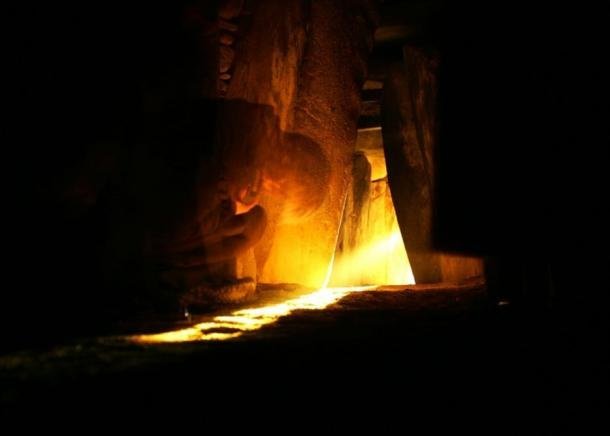
© NASASolstice sunrise light entering the Newgrange monument, a photo by Cyril Byrne of the Irish Times
While the monument near the Boyne River in County Meath is open all year and is one of Ireland's most popular attractions, it draws special international attention today.
Newgrange predates the great pyramids at Giza in Egypt by some 500 years and Stonehenge by about 1,000 years. When it was built, sunrise on the shortest day of the year, what we now call December 21, entered the main chamber precisely at sunrise. Experts say it is not by chance that the sun shines there. Now it enters about four minutes after sunrise because of changes in the Earth's orbiting of the sun since then.
Archaeologists say they believe Newgrange and two other nearby monuments, Knowth and Dowth, were tombs, built in ancient times to provide somewhere to bury the dead and as ritual and community gatherings, perhaps to honor ancestors. They believe it took decades to construct by generations of the Neolithic people, about whom little is known.
The tomb itself is massive and impressive and is surrounded by a henge or ring of huge stones. Experts say they believe the huge stones were moved from the nearby river, perhaps by rolling them on logs.
The number of bone fragments found inside Newgrange hardly constitute evidence of a communal burial chamber, Ancient Origins reported in 2013 in a two-part article about the Neolithic structure. In total, the bones of only five individuals were found inside the monument during excavations in the 1960s. Some bones could have been taken away after the rediscovery of the entrance to the passage and chamber in 1699. But at over 85 meters (278 feet) in diameter, and containing more than 250,000 tons of stone and earth, this monument would seem such a lavish and grandiose tomb for a few mere mortals, if that were indeed its sole purpose.
Read the rest of the article here.




1. The idea that Newgrange was aligned to 'Venus' and an 8 year cycle has been made by other researchers. But which 'Venus' is the question? The faintly twinkling planet we know (whose light would hardly penetrate the inner chamber with any substance) or the comet Venus which may have returned every eight years once upon a time and lit up the winter sky with a quite different light over many a long year before either finally leaving the solar system, devastating the world with her fiery tresses or even, as per Velikovsky, settling down in a perpetual orbit to become our planet Venus (the ancients were adamant that Venus was originally a comet). It is worth noting that the tripal spiral ubiquitous triple spiral symbol of the stone's of Ireland are clearly comet spirals and may relate to returning cometary cycles and the special effects created by the original 'Gods' of the sky.
2. The white quartz frontage of Newgrange seen in the picture was found encircling the site and neatly 'restored' to the front wall in modern times, as it was thought to have fallen off over time. More likely the restorers ruined the original design of a crescent moon placed deliberately on the floor and encircling the womb of the mound. By such slights of hand are the wisdom of our ancestors lost and new 'myths' about the purpose of such structures constituted. For the name of the site in Irish is Brú na Bóinne which most likely means "womb of the bright cow" or "womb of the Moon". Every 19 years the sun and moon align with the same rising azimuth and the moonlight will also penetrate deep within the mound - part of the great cosmic dance of the 'God' Apollo (or Lugh) and his sister that the Hyperboreans alluded to.
Thus, among other things, I would suggest the structure was a cosmic clock used to monitor the Gods as they came and went. Our ancestors knew with real purpose how vital it was to monitor the skies. As above, so below.
FWIW