
Medicine was very different just eight decades ago. Below is a map from 1932 released by the National Wholesale Druggists' Association which depicts some of the important species of medicinal plants that were native or cultivated in each state of the United States prior to the emergence of big-pharma.
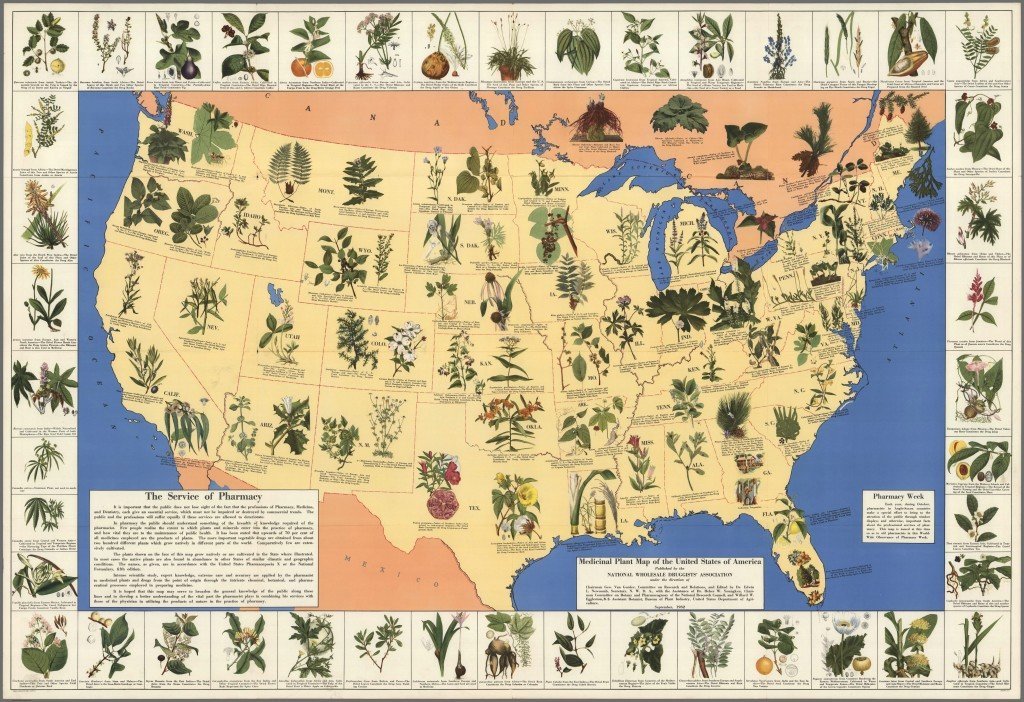
“Medicinal Plant Map of the United States of America.” Edwin Newcomb and the National Wholesale Druggists’ Association, 1932
- Mentha piperita, commonly called peppermint, has been used to treat digestive ailments such as irritable bowel syndrome, to lessen inflammation in the respiratory tract, and to improve muscle tension and headaches.
- Hydrastis canadensis, known as goldenseal root, is credited with the ability to aid digestion, stimulate the appetite, reduce inflamed mucous membranes, reduce inflammation in the body, act as an antimicrobial, and stimulate muscles.
- Linum usitatissimum, commonly known as flax, is well-known for its superfood properties, particularly when it comes to flax-seed. Flax seed has been used for the treatment of disorders of the respiratory tract, eyes, infections, cold, flu, fever, rheumatism and gout. This superfood is also known for its richness in omega-3 and omega-6 fatty acids, protein and dietary fiber.
- Hamamelis virginiana, also known as American witch hazel, was used to treat swellings, inflammations, and tumors based on knowledge gained from the Native Americans.
- Aloe vera is well known for its rejuvenating and healing abilities. It has been used widely for millenniums as a multipurpose skin treatment, and is now widely used in cosmetics and other beauty products, as well as a dietary supplement.
"Intense scientific study, expert knowledge, extreme care and accuracy are applied by the pharmacist to medicinal plants and drugs, from the point of origin through the intricate chemical, botanical, and pharmaceutical processes employed in preparing medicine."The map also states:
"Few people realize the extent to which plants and minerals enter into the practice of pharmacy, and how vital they are to the maintenance of the public health. It has been stated that upwards of 70 percent of all medicines employed are plant products."During the 1940s and 1950s, the pharmacist's role in the preparation of medicine changed dramatically as the medical industry faced new regulations due to the rise of synthetic preparation of new medications. Within the last 50 to 60 years, these synthetic drugs have become the only legal medications in many Western markets.
Yet today, people are beginning to realize that chemical drugs are not necessarily better or safer than their natural alternatives. Many individuals and healers are once again starting to turn to herbs and plants to treat diseases and their symptoms.
Why has society taken such a sharp turn away from natural cures and towards patented chemicals and biologicals? In the United States, the Federal Drug Administration (FDA) goes as far as to make it illegal for a substance to be used as medicine without the FDA's approval of the substance. Therefore, companies producing herbal supplements and natural remedies cannot call their products medicine or make claims that it will cures, mitigate, treat or prevent a disease.
The FDA has assumed for itself Godlike power, requiring that its official approval be obtained before any substance can legally be used in the prevention and treatment of disease. The FDA's legal-regulatory control therefore is totalitarian and Napoleonic in construct; what it does not explicitly permit as a medicine is implicitly forbidden. (GreenMedInfo.com)To sell a product as an FDA-approved drug, a company must spend about $800 million to comply with all of the FDA rules and elaborate clinical trial requirements. But because a company cannot patent a product of nature, such a large cost for FDA approval is impractical. This makes marketing natural herbs and plants as medicines unprofitable. As a result, what doctors and healers have called natural medicines through the ages are now called dietary supplements and tinctures.




call Vioxx a medicine and get away with killing 60,000/> people.