
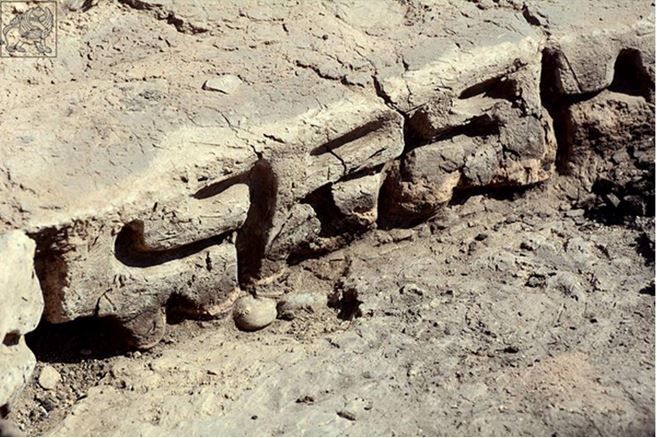
© Qartli.geThe writing, carved into clay, is of an unknown type, and international experts will be called in to help decipher it. This is a close-up photo of the inscription, which appears from other photos to be less than a foot (30 cm) tall.
An unidentified piece of writing found by an archaeological expedition from Georgia's State University at Grakliani Hill, in the eastern Kaspi region, confirmed the existence of the written language on Georgian territory 2,700 years ago.
The archaeologists said the writing had no analogue and it would become "an extremely interesting piece" for foreign scientists and explorers.
The writing was inscribed on the wall of the 7th Century BC temple dedicated to a fertility goddess.
"The discovery is very likely to change Georgian history and will seriously attract international interest," said Georgia's Minister of Culture Mikheil Giorgadze.
He added an outdoor museum would soon be built at the site to allow visitors to observe artifacts and archeological excavations.
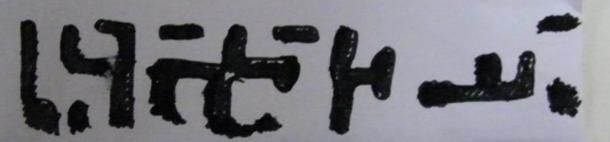
The inscription can be seen in this recreation by George Gigauri
Head of the Institute of Archaeology of Georgia's State University, Vakhtang Licheli, said through the "excellent discovery", Georgia was among the elite civilizations that enjoyed their written languages thousands of years ago.
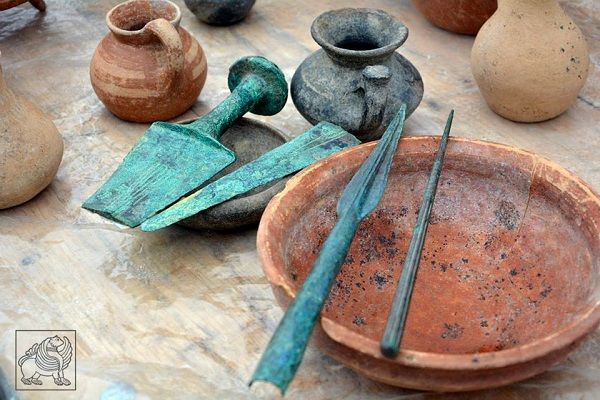
© qartli.geVessels and weapons found at Grakliani Hill.
Grakliani Hill depicts a non - stop 300,000 year chain of human development from the Stone era to the Antic period.
Ten layers of the site have been excavated, through which various ancient weapons, worshiping icons and pharmacological devices were uncovered.
A printing device of the 4th Century BC was described as one of the most important discoveries of the area, which analog was found in South Mesopotamia.
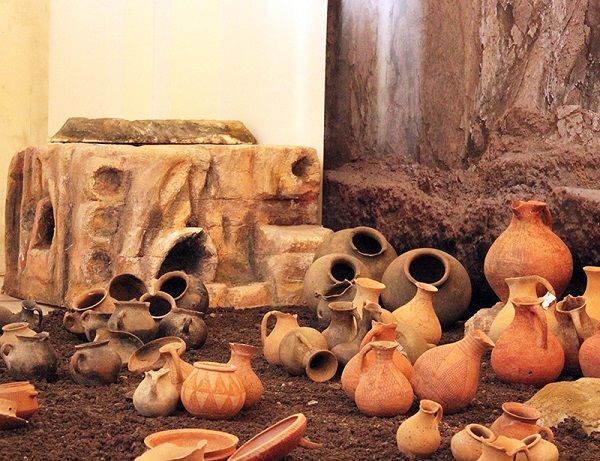
© qartli.geThese vessels were discovered at Grakliani Hill.
Several rooms for worship and special mills and hand-mills also attracted international interest. From this discovery it is believed that wheat used in baking bread was ground there.
Furthermore, an altar platform discovered in the area has no analogue in the world.
Archaeological excavations on Grakliani Hill were launched in 2007.



goddess at the deepest layer of historical excavations.
The logical deduction is that a global catastrophe decimated human population interfering with the ability to carry to term hence the adoration of a woman able to produce a live healthy child. This condition would have created a power bloc for women at least temporarily.
On Crete --up in the hills-- an amphitheater was excavated that had reused blocks with writing. the archaeologists discovered these reused blocks were part of a law or ruling. They concerned women's inheritance rights. It is instructive to note that whatever power women possessed in ancient Crete it was so diminished by time that these blocks were discarded.
It appears that women had power attributed to them publically as the later Cretans rulers measured grain tax allotting the first share to 'the lady.' Altho women and slave both got short measures of barley not the precious wheat. So it appears 'the lady' was a media cover for the actual power being held by the men perhaps as a way to hide as Creteans hired their military.