
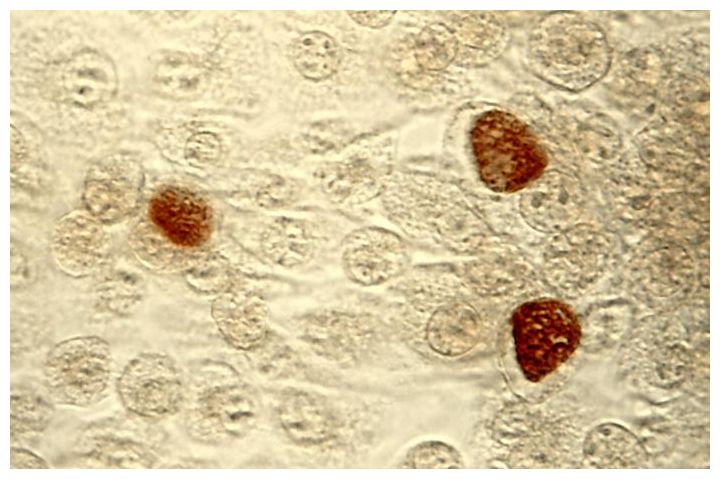
© CDC/Wikimedia CommonsIU researchers confirmed the existence of a molecule in chlamydia bacteria that could lead to new treatments.
Associate professor of chemistry Michael VanNieuwenhze says that for 50 years, researchers inferred that the bacteria chlamydia had peptidoglycan in its cell wall, but, "It was difficult to find because the bacterial cell was actually hidden inside of a host cell. So you have to, if you will, parse the cellular machinery of two different cells to get at the peptidoglycan, if in fact it existed," VanNieuwenhze says.
Biochemistry graduate student Erkin Kuru led the research team that discovered a way to confirm the existence of peptidoglycan in chlamydia. Kuru's team developed a molecular probe that incorporated itself into peptidoglycan and lit up in a specific way when bombarded with light photons.
Now that the existence of peptidoglycan has been confirmed in chlamydia, Kuru says research can move forward on diagnosis techniques and possible new treatments.
"One advantage of inhibiting peptidoglycan in bacteria is, our cells do not have peptidoglycan cell walls. And any drug that would be specific to this peptidoglycan molecule would be basically nontoxic to the humans," Kuru says.
VanNieuwenhze says that means researchers can now come up with a new antibiotic specific to kill chlamydia, hitting it on its peptidoglycan cell walls.
The research team published their paper in Nature this month, and Kuru says reception in the scientific community has been positive.



There are problems with this type of medication still:
1. Just like humans and other beings, not all bacteria (even of the same species) are exactly alike, and maybe they all won't respond in the same fashion to the drug.
2. What usually happens with antibiotics, is that 90 to 95% of the pathogen is destroyed, and the remainder can become resistant if mutation takes place that slightly changes the peptidoglycan specific to that cell wall, thus rendering the drug ineffective.
3. There are no guarantees that it would be nontoxic to humans. Time and time again, we learn there are long term effects to certain drugs and chemicals once thought "nontoxic". The autoimmune system can see the molecular structure of the drug as non-self, and just because the medication does not attack human cells does not mean it may not cause a reaction in the body. Our immune defenses are pretty darn intelligent, and they are very hard to fool!
Anyway, just a health care professional's rant...