
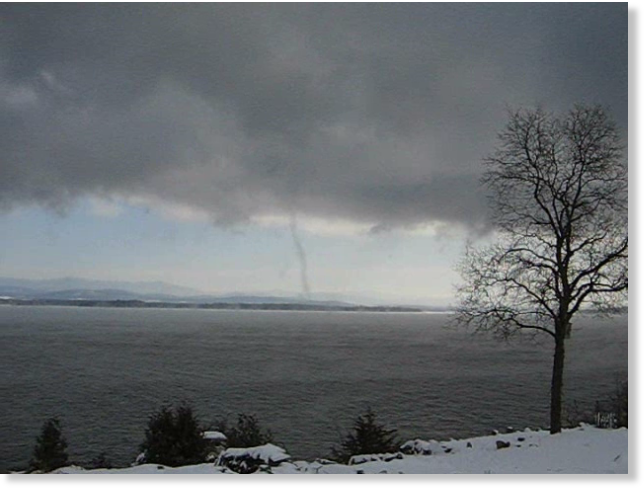
© Andy MacDougal via Burlington, Vt., NWSWinter waterspout over Lake Champlain on Jan. 15, 2009.
While water spouts are relatively common in warm months, producing one in the winter requires a pretty specific set of meteorological circumstances, writes Minnesota Public Radio's chief meteorologist Paul Huttner. Thus, the dearth of images. In fact, for one to form at all you need a temperature difference between the water and the air of 19 degrees C.
Winter waterspouts occur when meteorological conditions are just right. You need a bitter arctic air mass passing over relatively warm lake water, and just enough light, low level wind shear to get the rapidly rising air currents spinning nicely.
Saturday's contrast between bitter arctic air (air temp was about -7 degrees at Two Harbors nearby) and relatively warmer lake water (offshore surface water temps were around 40 degrees) create an "enhanced lapse rate" as temps cooled rapidly with height above the water. That produces rising air, and the lift needed to generate strong updrafts. Slight wind shear gets the air spinning, and small vortexes can form into waterspouts over the lake.


Awesome ! ... It’s said that waterspouts do not suck up water; and that water seen in funnel cloud are actually water droplets formed by condensation … well this is indeed part of the truth … I also consider in most these waterspouts situations, there’s a concealed vessel in the 'overhead cloud formation' … a celestial vessel which activates a columnar vortex producing high energy funnels … thus activating the process which changes the physical state of sea water to separate the salt for the water by ‘vaporizing to agitate the sea water’ as to collect it’s purified atomic/molecular clusters in the form of H20 water droplets …. so if minds wanted to be technical … waterspouts are not actually sucking up sea water … but they are sucking up droplets of water separated from it’s salt compound … how cool is that