

© ExtremeTech
That's where DARPA comes in. The agency has always liked playing smarter - rather than harder - and has a stated goal of allowing its government to view any point on the planet, instantly and in real-time. That being the case, they needed to develop a way of launching surveillance satellites much more cheaply. DARPA has looked into everything from satellite miniaturization to Hyperloop style drone throwers, but a satellite's mirror is the hardest part to launch in most cases. In a move sure to excite cash-strapped astronomers and terrify nervous libertarians, DARPA now says it could have a way around that problem, making high-fidelity space cameras much quicker and cheaper to launch.
View the video below for a quick artist's rendering.
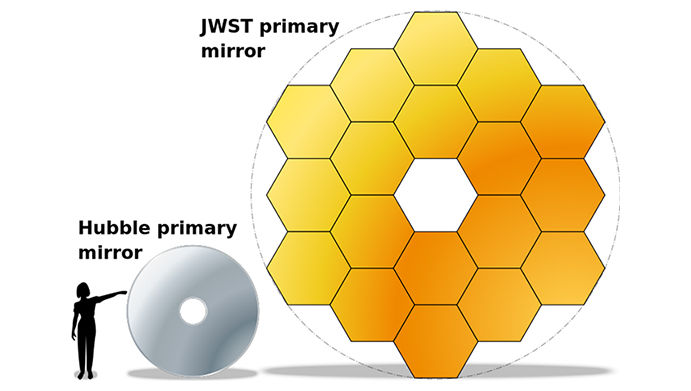
Called MOIRE, or Membrane Optical Imager for Real-Time Exploitation, the project looks to replace one of the heaviest and most troublesome elements in astronomy. Rather than using enormous mirrors or thick, dense lenses to reflect or refract the light into a collector, MOIRE uses membranes about as thick as kitchen plastic wrap to diffract light onto the satellite's collector. MOIRE will launch in a compact state, its version of a mirror mounted on the front in the form of folded, concentric "petals" of this membrane. When the mission reaches its destination, these petals will unfold into huge sails, providing a focusing element larger than any mirror could realistically be. A MOIRA satellite launched at 6.5 meters in diameter, roughly the size of the James Webb mirror, could unfurl to a diameter of more than 21 meters.
© ExtremeTech
That's a big deal, since the diameter of a telescope's focusing device determines its maximum resolution. If you want to look into the very beginnings of the universe or into its most elusive and subtle elements, you need a big mirror, or at least a mirror analog. If you want to view close-up video of a spot on Earth roughly 35,000 kilometers below, you need a big mirror, too.
These membranes aren't just physically smaller and lighter than mirrors and lenses, they're also flexible and easier to protect. It's all well and good to make a seven-meter mirror milled with nanometer precision, but its quality means nothing if it comes into contact with dust, or if it shatters on the way to space. By using a flexible membrane capable of taking even violent shaking with ease, these DARPA researchers hope to address both the fuel and protection costs associated with large space mirrors. These membrane leaves would require little to none of NASA's current egg-drop paranoia about launch packaging.
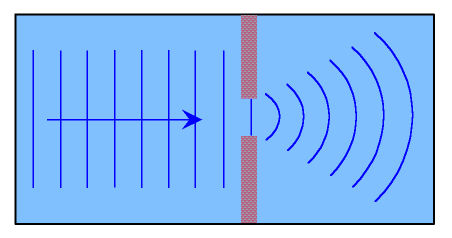
© ExtremeTechDiffraction can dramatically affect the path of a light wave using only a thin obstacle.
This membrane works via the process of diffraction, or the redirection of light around an obstacle. Rather than bouncing light like a mirror or bending it through different media like a lens, this membrane uses specially placed obstacles etched into its surface like the grooves on a record to redirect light rays. This makes it a thin-film version of an ancient idea, the Fresnel lens, which also lets lenses affect the path of light while remaining thin and light. Microscopically etching that idea into the surface of a membrane will, DAPRA hopes, bring the concept new life.
There's no word on the costs of actually manufacturing the membrane, but since its primary functional element is the etching rather than the material itself, this could bring down the costs of satellite manufacturing, as well. Independent teams are already launching small satellites; what if those small satellites could carry a membrane of a size with Hubble's mirror? More to the point, if a team of enthusiasts could do that with a few hundred thousand dollars, what could a national space agency do with a few hundred million? What could DARPA do with several billion, or its military masters with even more?




There's a well-worn saying in Telescopes....they don't scale very well.
What's works in miniature does not automatically translate to larger scales.
I wish them well, but only for pointing away from Earth.
While we're on Space Programs, why is China interested in the Moon?
Lunar geology is quite different. A common lunar rock is KREEP, or Potassium Rare-Earth Element phosphate. China already has a lock on certain rare-earth elements. Do you suppose?