
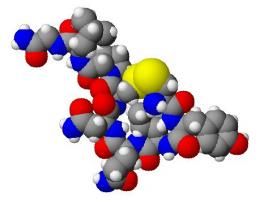
© WikipediaSpacefilling model of oxytocin. Created using ACD/ChemSketch 8.0, ACD/3D Viewer and The GIMP.
"This is the first study to evaluate the impact of oxytocin on brain function in children with autism spectrum disorders," said first author Ilanit Gordon, a Yale Child Study Center postdoctoral fellow, whose colleagues on the study included senior author Kevin Pelphrey, the Harris Professor in the Child Study Center, and director of the Center for Translational Developmental Neuroscience at Yale.
Gordon, Pelphrey, and their colleagues conducted a double-blind, placebo-controlled study of 17 children and adolescents with autism spectrum disorders. The participants, between the ages of 8 and 16.5, were randomly given either oxytocin spray or a placebo nasal spray during a task involving social judgments. Oxytocin is naturally occurring hormone produced in the brain and throughout the body.
"We found that brain centers associated with reward and emotion recognition responded more during social tasks when children received oxytocin instead of the placebo," said Gordon. "Oxytocin temporarily normalized brain regions responsible for the social deficits seen in children with autism."
Gordon said oxytocin facilitated social attunement, a process that makes the brain regions involved in social behavior and social cognition activate more for social stimuli (such as faces) and activate less for non-social stimuli (such as cars).
"Our results are particularly important considering the urgent need for treatments to target social dysfunction in autism spectrum disorders," Gordon added.
More information: "Oxytocin enhances brain function in children with autism," by Ilanit Gordon et al. Proceedings of the National Academy of Sciences




Breastfeeding releases oxytocin, a hormone that relaxes the mother and make her feel more nurturing toward her baby. Some of that hormone has got to get into the breastmilk, part of Nature's plan for stablizing that child's mental state By circumventing this hormonal exchange with bottlefeeding, this is yet one more way the medical establishment ensures children will grow up unbalanced and sick.