
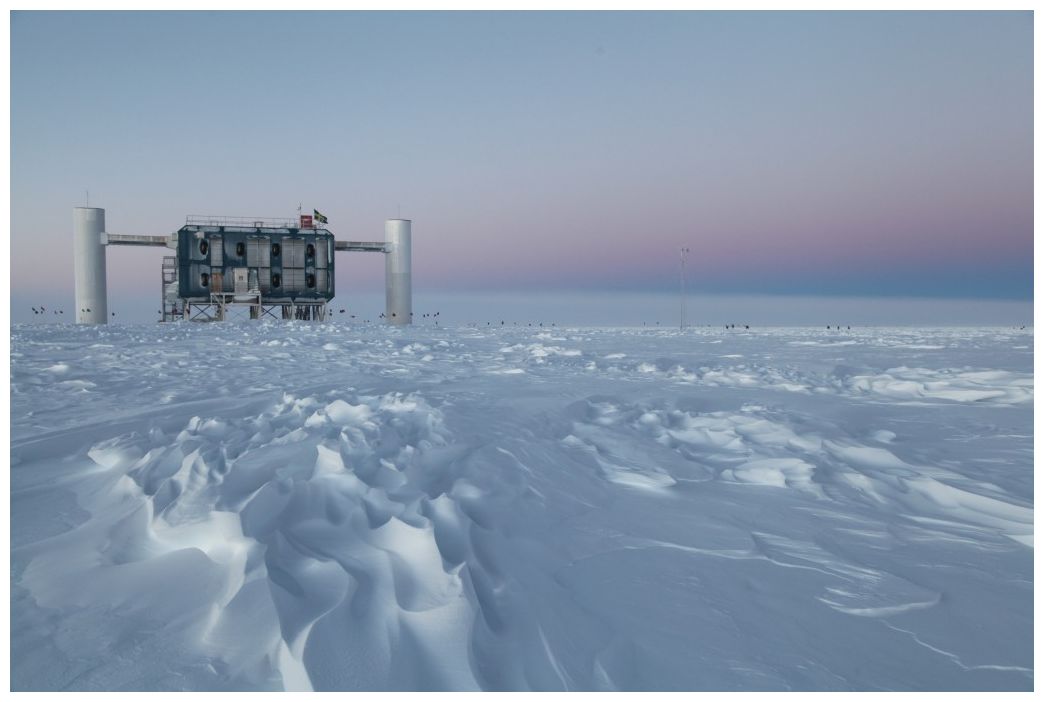
© Sven Lidstrom, IceCube/NSFThe IceCube Laboratory at the Amundsen-Scott South Pole Station in Antarctica.
The neutrinos mark the beginning of an exciting new field of high-energy neutrino astrophysics. "I cannot predict the future but I hope that this may someday be as successful as all the other times when we found new ways to study the universe, like radio astronomy and X-ray astronomy," says University of Wisconsin physicist Francis Halzen, principal investigator on the experiment.
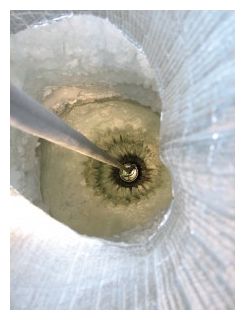
© Jim Haugen, IceCube/NSFA digital optical module (DOM) being lowered into the hole of an IceCube string. The IceCube detector consists of 86 strings of DOMs, which look for light when neutrinos strike the ice.
Because they lack charge and have very little mass (and also are immune to the strong force, the interaction that binds protons and neutrons together in the nuclei of atoms), neutrinos can reach us unimpeded from the inner reaches of exploding stars and near black holes. For that reason, they carry information about distant reaches of the cosmos that would otherwise be lost in particle reactions.
IceCube uses thousands of digital sensors buried a mile beneath the Antarctic ice to detect the light emitted on the rare occasions that a neutrino crashes into a molecule of ice. Its first sighting of its quarry occurred in May 2012, when two neutrinos were detected, each with 1000 times more energy than any neutrino ever detected before.
Nicknamed Bert and Ernie after the Sesame Street Muppet characters (because of the oblong and round shapes of their light signals), these two neutrinos spurred the IceCube team to reexamine the rest of their data at the same energy level. In the end, the IceCube team found 26 additional high-energy neutrinos, most of which come from beyond the galaxy. Their exact source has not been pinpointed.
Cosmic Question
As IceCube likely continues to catch high-energy neutrinos in the years ahead, it should
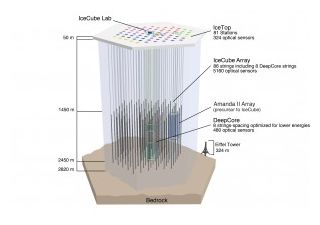
© IceCube/NSFIceCube’s sensors are distributed over a volume of roughly one cubic kilometer of clear Antarctic ice.
Where do these particles come from? What powerful cosmic engine could possibly accelerate a particle that fast? No one knows. Magnetic fields scramble the paths of the cosmic rays en route to Earth, making it impossible to trace their source.
Here's where high-energy neutrinos may be key. Once IceCube has captured enough such neutrinos, scientists should be able track down their source. The neutrinos can in principle travel across billions of light years in a straight line to Earth and point back to whatever made them.
And that source could also be the source of high-energy cosmic rays. While some suspect active galactic nuclei, and others gamma ray bursts or even decaying dark matter, "we may be surprised and find sources that nobody has thought of," says Halzen.
Looking forward, he says, "Things may move fast, they may move very slow." In any case, the dawn of high-energy neutrino astronomy, long promised and hoped for, has finally arrived.



Reader Comments
to our Newsletter