
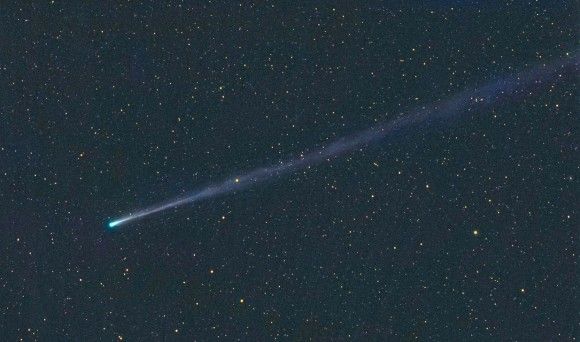
© Michael JaegerComet ISON on Nov. 17 with a tail nearly 8 degrees long streaming from a small, strongly condensed coma. Click to enlarge.
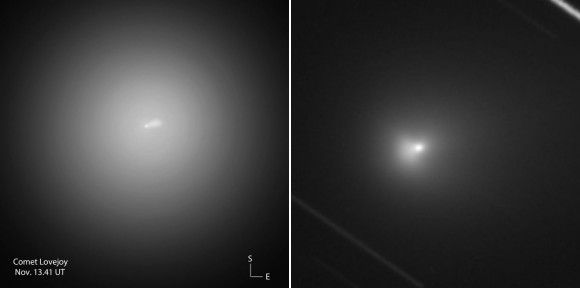
© Bob King/Luc ArnoldSketch using Photoshop of the inner region of Comet Lovejoy’s coma showing the false nucleus and the curious dust fountain observed on Nov. 13 in a 15-inch (37-cm) telescope. At right the same plume photographed on Nov. 12 with north up and east to the left.
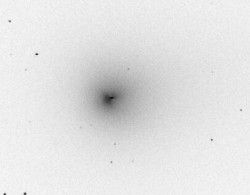
© Dr. P. Clay SherrodNegative image taken Nov. 14 of Lovejoy’s nucleus and dust fan. North up, west to the right.
By good fortune, Dr. P. Clay Sherrod of the Arkansas Sky Observatories, USA, and Luc Arnold of Saint-Michel-l'Observatoire, France, shared images they'd made at high magnification of the identical feature right at the same time as my own observation. There's no doubt that what we saw was a jet or combined jets of dust and vapor blasting from Lovejoy's true nucleus. Jets are linear or fan-shaped features and carry ice, dust and even snowballs from inside the nucleus out into space. They typically form where freshly-exposed ice from breaks or fissures in the comet's crust vaporizes in the sun's heat.
What I wouldn't give to see one up close. Wait - we can. Take a look at the photo of Comet 103P/Hartley made during NASA's EPOXI flyby mission in November 2010. Notice that most of Hartley's crust appears intact with the jets being the main contributors to the dust and gas that form the coma and tail.
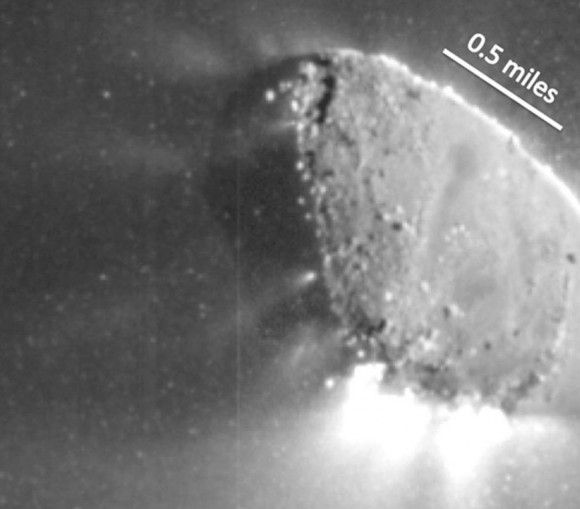
© NASAMultiple jets were actively spewing ice and dust when NASA’s EPOXI mission zoomed by Comet Hartley 2 in November 2010. The fuzzy spots are balls of fluffy snowballs measuring between 1 inch and 1 foot across.
Spotting a jet usually requires good seeing (low atmospheric turbulence) and high magnification. They're low-contrast features but worth searching for in any bright comet. Jets often point toward the sun for good reason - the sunward side of the comet is where the heating is happening. Activity dies back as the comet rotates to face away from the sun during the night and early morning hours. By studying the material streaming away from a comet via jets, astronomers can determine the rotation period of the nucleus.
Sometimes material sprayed by jets expands into a curved parabolic hood within the coma. This may explain the wing-shaped structures poking out from Comet ISON's coma seen in recent photos. Possibly the Nov. 13-14 outburst released a great deal of fresh dust that's now being pushed back toward the tail by the ever-increasing pressure of sunlight as the comet approaches perihelion.
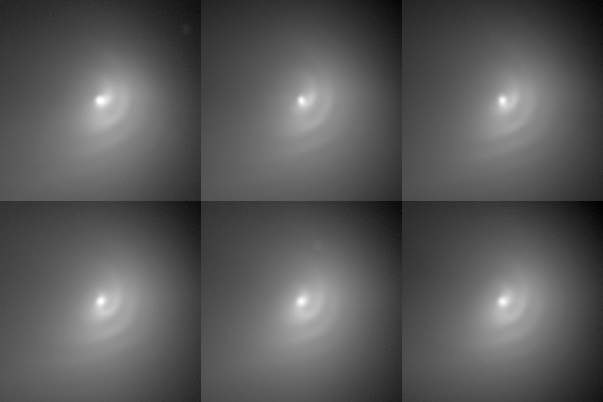
The inner coma of Comet Hale-Bopp developed a striking series of hoods in March 1997 when a dust jet spewed material night after night from the comet's rotating nucleus. The animation captures garden sprinkler effect beautifully. Since the nucleus spun around every 11 hours 46 minutes, multiple spiraling waves passed through the coma in the sunward direction. To the delight of amateur astronomers at the time, they were plainly visible through the telescope.
Nightly images of Comet Hale-Bopp's rotating nucleus and spiraling jet made March 24-30, 1997 by Brad D. Wallis of JPL. The photos were assembled into this animation by Sky & Telescope:
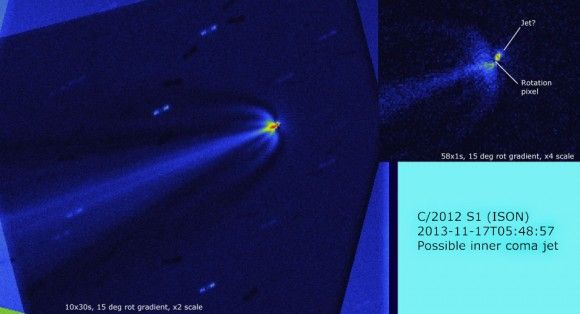
© Denis Buczynski and Nick James of the BAAProcessed images showing a possible jet extending southeast (PA 150 degrees) of Comet ISON’s nucleus as well as the new wing-like hoods on Nov. 17, 2013.
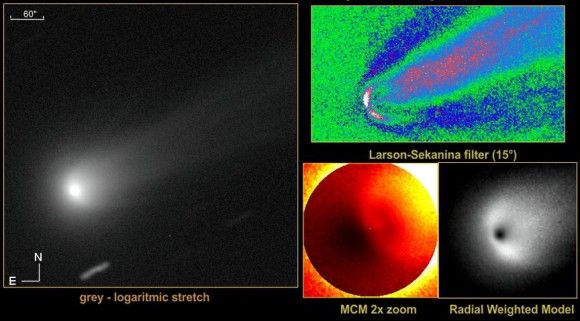
© Erik BryssinckAnother view of the symmetrical “wings” photographed branching from Comet ISON’s coma on Nov. 15. At right, the photo has been specially processed to show the structure more clearly.



that 6th pic looks a lot like the bat ray from the old school batman show.
aren't we (planet Earth) going to pass through the debris field of Ison some time soon as well?